SCIE 3301
Ch 7 Electricity and Magnetism
7.1 Electrical Force & Charge
Important Idea/LO
Differences of negative and positive electric charges
Conservation of Charge
Evidence of Idea
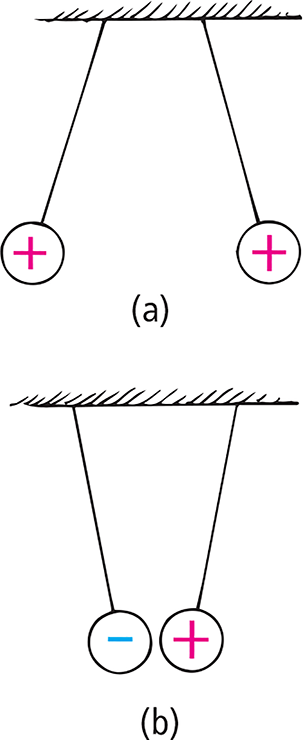
Attraction
Positive attracts negative, but repels positive
Negative attracts positive, but repels positive
Fundamentals of atoms
Every atom is composed of a positively charged nucleus surrounded by negatively charged electrons.
Each of the electrons in any atom has the same quantity of negative charge and the same mass.
Electrons are identical to one another.
Protons and neutrons make up the nucleus.
Protons are about 1800 times more massive than electrons, but each proton carries an amount of positive charge equal to the negative charge of the electrons.
Neutrons have slightly more mass than protons, and they have no net charge.
Whenever something is charged, no electrons are created or destroyed
Electrons just transfer between objects
Vocabulary & Equations
Charge - basic attribute of electrons and protons
Neutrons - neutral particles
Electrons - negative particles
Protons - positive particles
Ion - charged atom (either positive or negative)
Connection
Difference of attraction
Outer electron shell can be dislodged from some materials more readily than others

Challenge Idea/Questions
Which part of an atom is positively charged, and which part is negatively charged?
Core is positively charged; shell negatively charged
What is meant by saying that charge is conserved?
When combing your hair, you scrape electrons from your hair onto the comb. Is your hair then positively or negatively charged? How about the comb?
The 5000 billion billion freely moving electrons in a penny repel one another. Why don’t they fly out of the penny?
What is meant by saying that charge is conserved?
7.2 Coulomb’s Law
Important Idea
Relate the inverse-square law to electrical forces.
Centers of charge can be moved
Evidence of Idea
Coulomb’s Law
Force between 2 charged objects varies directly as the product of their charges and inversely as the square of the distance between them
Vocabulary
Coulomb’s Law - The relationship among force, charge, and distance:

If the charges are alike in sign, the force is repelling; if the charges are unalike, the force is attractive.
Coulomb (C) - SI unit of electric charge. Is equal in magnitude to the total charge of electrons.
Electrically polarized - The electric potential energy per amount of charge, measured in volts, and often called voltage: Electric potential=electric potential energy/charge
Fundamental charge - C
People, Places, Dates
Charles Coulomb - 18th century scientist; discovered inverse relationship of distance and charge
Connection
Gravitational force
The electric force, like gravitational force, decreases inversely as the square of the distance between the charges
constant k relates to G in Newton’s law, but is a large number
electrical forces may attract or repel, while gravitational only attracts
100-watt lamp
The charge of 1 C equates to the charge that flows through a common 100-watt lamp in a little more than a second
Balloon sticks to wall “experiment”
The negatively charged balloon polarizes molecules in the wooden wall, creating a positively charged surface, so the balloon sticks to the wall.

Challenge Idea
How is Coulomb’s law similar to Newton’s law of gravity? How is it different?
How does a coulomb of charge compare with the charge of a single electron?
Two equal charges exert equal forces on each other. What if one charge has twice the magnitude of another? How do the forces they exert on each other compare?
How does the strength of electric force between a pair of charged particles compare when the particles are moved twice as far apart? When three times as far apart?
In what way does an electrically polarized object differ from an electrically charged object?
7.3 Electric Field
Important Idea
Electric fields and their features
Evidence of Idea
“Force Field”
Electrical forces, like gravitational forces, can act between things that are not in contact with each other.
Directional
Moves from positive charges towards negative charges
Vocabulary
Electric field: The force field that fills the space around every electric charge or group of charges; a vector quantity measured by force per unit charge.
Field lines: Demonstrate the direction and intensity of the electric field
People, Places, Dates, Equations
Equation for electric field
Connection
Falling apple
when an apple falls from a tree, we say that it is interacting with the mass of Earth, but we can also think of an apple as responding to the gravitational field of Earth at that point.
Challenge Idea
Give two examples of common force fields.
How is the direction of an electric field defined?
A particle having a charge q coulombs experiences a force F in newtons in a particular electric field E. What is the strength of the field?
Suppose that the strength of the electric field around an isolated point charge has a certain value at a distance of 1 m. How will the electric field strength compare at a distance of 2 m from the point charge? What law guides your answer?
7.4 Electric Potential
Important Idea
Distinguish between electric potential energy and electric potential
Evidence of Idea
The electric potential is the result of electric potential energy per charge
The significance of electric potential (voltage) is that a definite value for it can be assigned to a location
If a particle with electric potential energy is released, it will accelerate in a direction in relation to the state of attraction and change into kinetic energy
Vocabulary & Equations
Electric potential energy - Energy a charge possesses by virtue of its location in an electric field
Electric potential - called voltage; is the electric potential energy per unit charge
People, Places, Dates
Connection
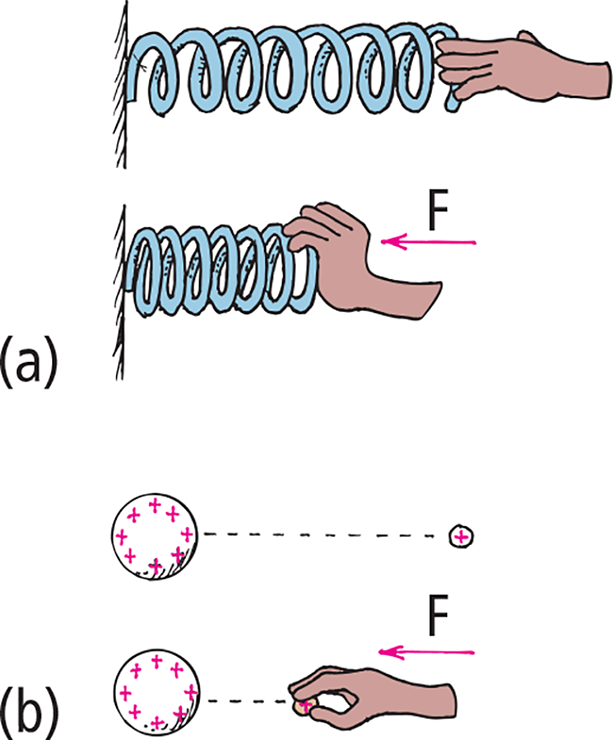
Work to push a positively charged particle to a positively charged object is similar to the work to compress a spring
Challenge Idea
In terms of the units that measure them, distinguish between electric potential energy and electric potential.
A balloon may easily be charged to several thousand volts. Does that mean it has several thousand joules of energy? Explain.
What is the term given to the electric potential energy of a charged object divided by the charge?
Why might the wingspans of birds be a consideration in determining the spacing between parallel wires on power poles?
7.5 Conductors and Insulators
Important Idea
Distinguish between electric conductors and insulators.
Evidence of Idea
Conductors | Insulators | |
Flow of electrons | is permitted | is restricted |
Materials | Copper, silver | glass, rubber |
Atomic structure | loosely bound outer shell | strong connection to core |
Conductivity | High | Low |
Vocabulary & Equations
Conductors - Any material having free charged particles that easily flow through it when an electrical force acts on them.
Insulators - Any material with very little or no free charged particles and through which current does not easily flow.
Semiconductors - A material that can be made to behave sometimes as an insulator and sometimes as a conductor.
Free electrons - electrons from loosely bound outer shells that move freely when an electrical force is applied
People, Places, Dates
Connection
Challenge Idea
What is the difference between a conductor and an insulator? Between a conductor and a semiconductor?
What kinds of material are the best conductors? Why are they so good at conducting electricity?
Why is a good conductor of electricity also a good conductor of heat?
7.6 Voltage Sources
Important Idea
Recognize how a potential difference is necessary for electric current.
Evidence of Idea
Charges flow from high potential to low potential until equilibrium is met.
Batteries or generators are required to pull the negative charges from positive ones to maintain flow
Vocabulary
Potential difference - The difference in electric potential between two points, measured in volts; often called voltage difference.
People, Places, Dates
Connection
Equilibrium of temperature
Water pressure
Water will stop flowing when pressure/heights are equal unless the balance is disrupted by a pump

Challenge Idea
What condition is necessary for heat energy to flow from one end of a metal bar to another? For electric charge to flow?
What condition is necessary for a sustained flow of electric charge through a conducting medium?
A garden hose waters a garden. Water in a car engine cools the engine. Which of these two is analogous to an electric circuit? Defend your answer.
A hydraulic pump doesn’t produce water but, instead, moves it. How is this analogous to an electric battery or generator?
Lillian is charged to some 50,000 V but is unharmed. Her hair, however, stands out. Why is she not harmed, and why does her hair stand out?
7.7 Electric Current
Important Idea
Relate the speed of electrons in a circuit to dc and ac.
Evidence of Idea
Speed of electrons in electric current is very, very low; the electric field is near light speed
DC pushes a constant flow in one direction
AC switches direction of the current by alternating signs at terminals

Vocabulary
Electric Current - A flow of charged particles that transports energy from one place to another, measured in amperes, where 1 A is the flow of 6.25 × 10¹⁸ electrons per second, or 1 coulomb per second.
Direct Current - An electric current that flows in one direction only.
Alternating Current - An electric current that repeatedly reverses its direction; the electric charges vibrate about relatively fixed positions, 60 Hz in the United States.
Conduction electrons - charge carriers that move freely in metals
Drift speed -
People, Places, Dates
André-Marie Ampère -1820s scientist; “Newton of electricity”
Connection
common automobile battery
flow of positive ions or electrons in fluids
Challenge Idea
Why do electrons, rather than protons, make up the flow of charge in a metal wire?
Distinguish between DC and AC.
Batteries and generators produce electric current. Which produces DC and which produces AC?
Which travels at nearly the speed of light in an electrical circuit: electrons, electric field, or both?
Which flows through an electric circuit: voltage, electric charge, resistance, or all three?
7.8 Electrical Resistance
Important Idea
Relate resistance to its role in a circuit.
Evidence of Idea
Wire size
Thinner wires resist more than thicker wires do
Longer wires resist more than shorter wires
Material's conductivity impacts resistance
Temperature affects electrical resistance
Vocabulary
Electrical resistance - The property of a material that resists the flow of electric charge through it; measured in ohms (Ω).
People, Places, Dates
Georg Simon Ohm - German physicist (1826); discovered the relationship among voltage, current, & resistance
Connection
Challenge Idea
Which has more resistance—a thick wire or a thin wire of the same length? A short wire or a long wire?
What is the unit of electrical resistance?
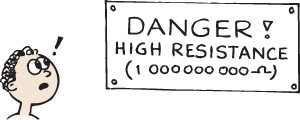
Comment on the warning sign in the sketch.
Which has the greater electric resistance: a wire having no current or the same wire carrying current? Or is the resistance the same for both?
7.9 Ohm’s Law
Important Idea
Relate current, voltage, and resistance in electric circuits.
Evidence of Idea
The relationship among voltage, current, and resistance is summarized by a statement known as Ohm’s law.
Current and voltage are proportional to each other, while current and resistance are inversely proportional to each other
voltage increase →current increase
resistance increase → current decreases
Vocabulary
Ohm’s Law - The amount of current in a circuit varies in direct proportion to the potential difference or voltage and inversely with the resistance:
Resistors - circuit elements that regulate current through resistance

People, Places, Dates
Connection
Biology
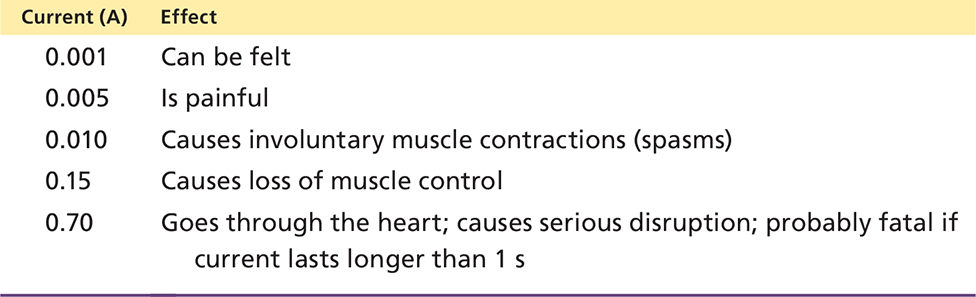
Impact of electric current on a human body depends on the voltage applied and the condition of the body (its resistance)
Resistance can vary from 100 to 500,000 ohms
Can’t feel 12 volts, but can feel 24 volts
REQUIRES a difference in electric potential
Challenge Idea
What is the effect on the current through a circuit of steady resistance when the voltage is doubled? What is the effect on the current if both voltage and resistance are doubled?
How much current does a radio speaker with a resistance of 8 Ω draw when 12 V is impressed across it?
What is the effect on the current in a wire if the voltage is doubled and the resistance is halved? If the voltage is halved and the resistance is doubled? Let Ohm’s law guide your thinking.
Why can a bird safely perch on an uninsulated high-voltage wire?
If a bird perched on a high-voltage wire reaches over with its foot and touches another wire, why is it in trouble?
Will the current in a lightbulb connected to a 220-V source be greater or less than the current in the same bulb when it is connected to a 110-V source?
How much current flows through a lamp with a resistance of 60 when the voltage across it is 12 V?
7.10 Electric Circuits
Important Idea
Distinguish between series and parallel circuits.
Evidence of Idea
Series | Parallel | |
 |  | |
Faulty “Bulb” | Non-functional | Functional in other parts |
Example | Old Christmas lights | house lighting |
Vocabulary
Series circuit - An electric circuit with devices connected in such a way that the same electric current exists in all of them.
Parallel circuit -An electric circuit with two or more devices connected in such a way that the same voltage acts across each one, and any single one completes the circuit independently of all the others.
Challenge Idea
Which type of circuit is favored for operating several electrical devices, each independently of the other—series or parallel? Defend your answer.
How does the sum of the currents through the branches of a simple parallel circuit compare with the current that flows through the voltage source?
As more and more bulbs are connected in a series to a flashlight battery, what happens to the brightness of each bulb? Assuming that heating inside the battery is negligible, what happens to the brightness of each bulb when more and more bulbs are connected in parallel?
In the circuit shown, how does the brightness of each individual bulb compare? Which light bulb draws the most current? What will happen if bulb A is unscrewed? If bulb C is unscrewed?

7.11 Electric Power
Important Idea
Relate current and voltage to power with their units of measurement.
Evidence of Idea
Vocabulary
Electric power - The rate of energy transfer, or rate of doing work; the amount of energy per unit time, which the product of current and voltage can measure:
People, Places, Dates
Connection
Challenge Idea
What is the relationship among electric power, current, and voltage?
Considering a kilowatt and a kilowatt-hour, which is a unit of energy and which is a unit of power?
What unit of measurement is meant by (a) joule per coulomb, (b) coulomb per second, and (c) watt-second?
What happens to the brightness in a lamp of any kind when the current in it increases?
Why are LED bulbs more efficient than incandescent bulbs? Which type is more preferred when placed in a chicken coop to keep chicks warm on cold nights?
If a 120-V line to a socket is limited to 15 A by a safety fuse, will it operate a 1200-W hair dryer?
7.12 The Magnetic Force
Important Idea
Establish the attraction-repulsion rule for magnetic poles.
Evidence of Idea
One end, called the north-seeking pole, points northward. The opposite end, called the south-seeking pole, points southward.
Like poles repel; opposite poles attract.
CANNOT be isolated
A split bar magnet will have N & S poles on each half
Vocabulary
Magnetic forces - (1) Between magnets, it is the attraction of unlike magnetic poles for each other and the repulsion between like magnetic poles. (2) Between a magnetic field and a moving charge, it is a deflecting force due to the motion of the charge; the deflecting force is perpendicular to the velocity of the charge and perpendicular to the magnetic field lines.
Challenge Idea
How is the rule for the interaction between magnetic poles similar to the rule for the interaction between electric charges?
How are magnetic poles different from electric charges?
Electric charge may be positive or negative but not both at the same time. Can a magnet have only one pole?
7.13 Magnetic Fields
Important Idea
Relate magnetic field strength to magnetic field patterns.
Evidence of Idea
Moves from N → S
Closer field lines mean a stronger field
Strong magnetic field at the poles
Magnetism from electron motion
Electron spin (main)
Electron revolution
If spins aren’t synced, they cancel
Vocabulary
Magnetic Field - The region of magnetic influence around a magnetic pole or around a moving charged particle.
Magnetic domains - Clustered regions of aligned magnetic atoms. When these regions themselves are aligned with one another, the substance containing them is a magnet.
Torque - turning force
Connection
The Junkyard
Giant magnets used to move cars in a junkyard are composed of electromagnets
Electromagnetic fields and animals
Pigeons have been found to have multiple-domain magnetite magnets within their skulls that are connected by a large number of nerves to their brains, and part of their brains, their eyes
Certain bacteria biologically produce single-domain-size grains of magnetite (an iron-containing magnetic material) that they string together to form magnetic compasses
Monarch butterflies and sea turtles are known to employ their magnetic sense to migrate vast distances
Challenge Idea
What produces a magnetic field?
Why is iron magnetic and wood is not?
Surrounding any mass is a gravitational field. Surrounding any electric charge is an electric field. What surrounds any magnet?
In what sense is motion relevant to a magnetic field?
Since every iron atom is a tiny magnet, why aren’t all things made of iron also magnets?
7.14 Magnetic Forces on Moving Charges
Important Idea
Show how the relative direction, field, and motion of charged particles affect the force on those particles.
Evidence of Idea
Charged particle moving → interacts with the field
Experiences a deflecting force
Perpendicular experiences greatest force
Parallel experiences zero
Direction of charged particle to the field will change the deflection
Charged particle at rest DOES NOT respond to magnets
Interaction of differing forces
Gravitational & Electrical forces act in parallel to lines between
Magnetic forces interact at right angles to the field and the velocity
Vocabulary
galvanometer - current-indicating instrument that uses coils of wire and a compass needle
ammeter - for amperes
voltmeter - for volts
People, Places, Dates
Connection
Earth’s Magnetic Field
Charged particles from outer space are deflected by the magnetic field
Reduces the amount of cosmic radiation experienced
Challenge Idea
What is the direction of the magnetic force that acts on a moving charged particle?
What is a galvanometer? What is it called when it is calibrated to read current? To read voltage?
In what relative direction between a magnetic field and a current-carrying wire is the force on the wire the greatest? The least?
What happens to the direction of the magnetic force on a wire in a magnetic field when the current in the wire is reversed?
Is it correct to say that an electric motor is a simple extension of the physics that underlies a galvanometer?
7.15 Electromagnetic Induction
Important Idea
Describe Faraday's law.
Evidence of Idea
Electric current can be produced in a wire when a magnet passes through a coil
No battery or other voltage source required
More coils produces more voltage
The induced voltage in a coil is proportional to the number of loops multiplied by the rate at which the magnetic field changes within those loops
Inducing voltage/Changing loop’s magnetic field
Moving loops near a magnet
Moving magnet near loops
Changing current in nearby loop
Current still dependent on resistance of coil & circuit
Vocabulary
Electromagnetic induction - The induction of voltage when a magnetic field changes with time.
Faraday’s Law - An electric field is induced in any region of space in which a magnetic field is changing with time.
Maxwell’s counterpart to Faraday’s Law - A magnetic field is induced in any region of space in which an electric field is changing with time.
People, Places, Dates
Michael Faraday - Physicist in the 1800s who researched electricity and magnetism
Joseph Henry - Physicist in the 1800s who researched electricity and magnetism
James Clerk Maxwell - Physicist in the 1860s who introduced a counter concept to Faraday’s Law
Connection
Challenge Idea
What are the three ways in which voltage can be induced in a wire?
(a) What is induced by the rapid alternation of a magnetic field? (b) What is induced by the rapid alternation of an electric field?
In what way did Maxwell add to the physics of electromagnetic induction?
How does electromagnetic induction lead to the nature of light?
Chapter 8 - Waves: Sound and Light
8.1 Vibrations and Waves
Important Idea
Distinguish among amplitude, wavelength, frequency, and period.
Evidence of Idea

Amplitude carries energy
All waves have a vibrating source
As frequency increases, period decreases
Vocabulary
Amplitude - For a wave or a vibration, the maximum displacement on either side of the equilibrium (midpoint) position.
Wavelength - The distance from the top of one crest to the top of the next crest or, equivalently, the distance between successive identical parts of the wave.
Frequency - For a vibrating body, the number of vibrations per unit time. For a wave, the number of crests that pass a particular point per unit time.
Hertz - The SI unit of frequency; one hertz (symbol Hz) equals one vibration per second.
Period - The time required for a vibration or a wave to make one complete cycle.
People, Places, Dates
Heinrich Hertz, who demonstrated the existence of radio waves in 1886
Connection
Broadcasting Electromagnetic Waves
FM radio is measured in Megahertz (MHz)
AM radio is measured in kilohertz (kHz)
Challenge Idea
Distinguish among amplitude, wavelength, frequency, and period.
What is the source of all waves?
What does it mean to say that a radio station is “at 101.1 on your FM dial”?
How does the frequency of a vibrating object relate to its period of vibrations?
8.2 Wave Motion
Important Idea
Describe how energy is carried in waves.
Evidence of Idea
Medium returns to initial condition after waves cease
This relationship applies to all kinds of waves, whether they are water waves, sound waves, or light waves.
Vocabulary
Wave - A disturbance that travels from one place to another, transporting energy, but not necessarily matter, along with it.
or
People, Places, Dates
Connection
Pond waves
Energy moves, but the water stays
Leaf bobs on top of the ripples
Challenge Idea
In one word, what is it that moves from source to receiver in wave motion?
Does the medium in which a wave travels move with the wave?
What is the relationship among frequency, wavelength, and wave speed?
You dip your finger at a steady rate into a puddle of water to make waves. What happens to the wavelength if you dip your finger more frequently?
How does the frequency of vibration of a Ping-Pong ball bobbing in water compare to the number of waves passing it each second?
8.3 Transverse and Longitudinal Waves
Important Idea
Distinguish between transverse and longitudinal waves.
Evidence of Idea

Transverse →vibration at right angles to waves
Longitudinal → vibration parallel to waves
Vocabulary
Transverse wave - A wave in which the medium vibrates in a direction perpendicular (transverse) to the direction in which the wave travels.
Longitudinal wave - A wave in which the medium vibrates in a direction parallel (longitudinal) to the direction in which the wave travels.
People, Places, Dates
Connection
Example of transverse waves
String instruments
Radio
Light
Challenge Idea
In what direction are the vibrations relative to the direction of wave travel in a transverse wave? In a longitudinal wave?
Distinguish between a compression and a rarefaction.
What kind of motion should you impart to a stretched coiled spring (or to a Slinky) to produce a transverse wave? To produce a longitudinal wave?
8.4 The Nature of Sound
Important Idea
Identify compressions and rarefactions in a sound wave.
Evidence of Idea

Compression is the bunching of air molecules
Rarefaction is air molecules spread out
Most sound is transmitted through air, but any elastic substance—solid, liquid, or gas—can transmit sound
Speed of Sound
Sound requires time to travel from source to receiver
Wind conditions, temperature, & humidity impact the speed
The faster the molecules move the faster sound moves
Vocabulary
People, Places, Dates
Connection
Challenge Idea
Define the wavelength of sound in terms of successive compressions of air.
Can sound travel through a vacuum? Why or why not?
Which is louder: a sound wave of high amplitude or one of low amplitude?
In the stands at a racetrack, you notice smoke from the starter’s gun before you hear it fire. Explain.
8.5 Resonance
Important Idea
Distinguish between forced vibration and resonance.
Evidence of Idea
A tuning fork is “louder” when pressed against a table
The table is large so it vibrates more air
The table is forced to vibrate because of the frequency of the fork
Different material vibrate at different frequency
A wrench sounds different than a baseball bat dropped onto a concrete floor
Vocabulary
Forced vibration - The setting up of vibrations in an object by a vibrating source.
Natural frequency - A frequency at which an elastic object naturally tends to vibrate.
Resonance - A dramatic increase in the amplitude of a wave that results when the frequency of forced vibrations matches an object’s natural frequency.
People, Places, Dates
Connection
Swing set
Example of resonance
Push/Pump with the natural frequency of a swing increases amplitude
Challenge Idea
Why does a struck tuning fork sound louder when its handle is held against a table?
Distinguish between forced vibrations and resonance.
What is the danger posed by people in the balcony of an auditorium stamping their feet in a steady rhythm?
When does forced vibration produce resonance?
What physics principle does Manuel use when he pumps in rhythm with the natural frequency of the swing?
8.6 The Nature of Light
Important Idea
Describe the nature and range of electromagnetic waves.
Evidence of Idea
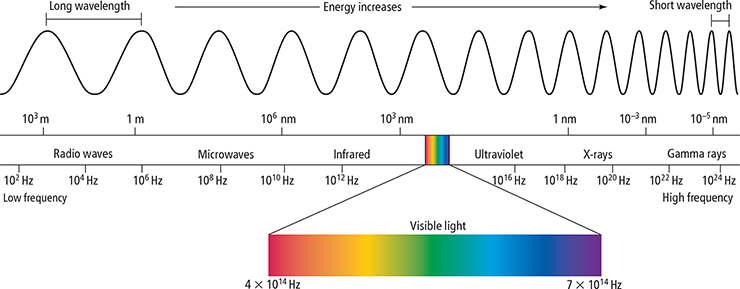
Electromagnetic Spectrum
Light is a __________ wave
Travels at __________ m/s
Consists of oscillating __________ and __________ fields
Visible Light Spectrum
Frequency range from __________ (lowest) to __________ (highest)
Remembered by acronym: __________
Vocabulary
Electromagnetic wave - An energy-carrying wave produced by an oscillating electric charge.
Electromagnetic spectrum - The continuous range of electromagnetic waves that extends in frequency from radio waves to gamma rays.
People, Places, Dates
Connection
Challenge Idea
What is the principal difference between a radio wave and light? Between light and X-rays?
How does the frequency of an electromagnetic wave compare with the frequency of the vibrating electrons that produce it?
What is the fundamental source of electromagnetic radiation?
Which has the shorter wavelengths—ultraviolet or infrared? Which has the higher frequencies?
Do radio waves travel at the speed of sound, the speed of light, or somewhere in between?
8.7 Reflection
Important Idea
State the law of reflection.
Evidence of Idea
The angle of reflection equals the angle of incidence.

Vocabulary
Reflection - The returning of a wave to the medium from which it came when it hits a barrier.
Law of reflection - The angle of reflection equals the angle of incidence.
absorbed - penetrating an opaque surface
transmitted - absorbed and reemitted from transparent material
diffuse reflection - light bouncing off a rough/granular surface in many directions
echo - reflection of sound
incidence - the angle at which an object strikes the surface
People, Places, Dates
Connection
Diffuse reflection
Most of the environment is seen by diffuse reflection
Challenge Idea
What is the law of reflection?
Does the law of reflection hold for diffuse reflection? Explain.
8.8 Transparent and Opaque Materials
Important Idea
Describe the process in which light travels through transparent materials.
Evidence of Idea
Electrons in some matter that light touches are forced into vibration and help to carry energy from one place to another
The ability of the atoms to vibrate at the frequency of visible light allows the light to “pass” through
If the photon doesn’t fully “pass” through (~4% bounce back as reflection), the matter is considered translucent
If no photons can “pass” through, then the matter is opaque
Photon that “passes” through glass is different than the photon that incident upon the glass
Vocabulary
Transparent - materials that allow light to pass through them in straight lines
Opaque -materials that absorb light without reemission
People, Places, Dates
Connection
Transparent material
Glass, water
Challenge Idea
The sound coming from one tuning fork can force another to vibrate. What is the analogous effect for light?
(a) What is the fate of the energy in ultraviolet light incident on glass? (b) What is the fate of the energy in visible light incident on glass?
How does the average speed of light in glass compare with its speed in a vacuum?
If you fire a bullet through a board, it will slow down inside and emerge at a speed lower than the speed entered. When light passes through glass, does it similarly slow down and also emerge at a lesser speed? Defend your answer.
Is light transparent or opaque to the light of frequencies that match the natural frequency of glass? Explain.
Short wavelengths of visible light interact more frequently with atoms in glass than do longer wavelengths. Does the time of this interaction tend to speed up or to slow down the average speed of light in glass?
What determines whether a material is transparent or opaque?
8.9 Color
Important Idea
Describe how color depends on the frequency of light
Evidence of Idea
The white light from the Sun is a composite of all the visible frequencies
The colors we see depend on the frequency of the light we see
A material will either reflect or absorb the different frequencies
Reflected frequencies are what our eyes perceive the color to be
Reflecting all frequencies is white
Reflecting no frequencies is black
Objects can have the capacity to reflect a broad band of frequencies, but only the frequencies present in the illuminating light can be reflected
Vocabulary
People, Places, Dates
Connection
If we pass sunlight through a prism and then place a deep-red rose in various parts of the spectrum, the rose will appear brown or black in all regions of the spectrum except in the red region.
Challenge Idea
What is the relationship between the frequency of light and its color?
Distinguish between the white of this page and the black of this ink, in terms of what happens to the white light that falls on both.
In a dress shop with only fluorescent lighting, a customer insists on taking garments into the daylight at the doorway to check their colors. Is she being reasonable? Explain.
We say all the colors in the rainbow produce white. What is the explanation for the “color” black?
What color of light illuminating blueberries will make them appear black?
What color of light do we see when only red and green LEDs are lit on the screen of a monitor?
8.10 Refraction
Important Idea
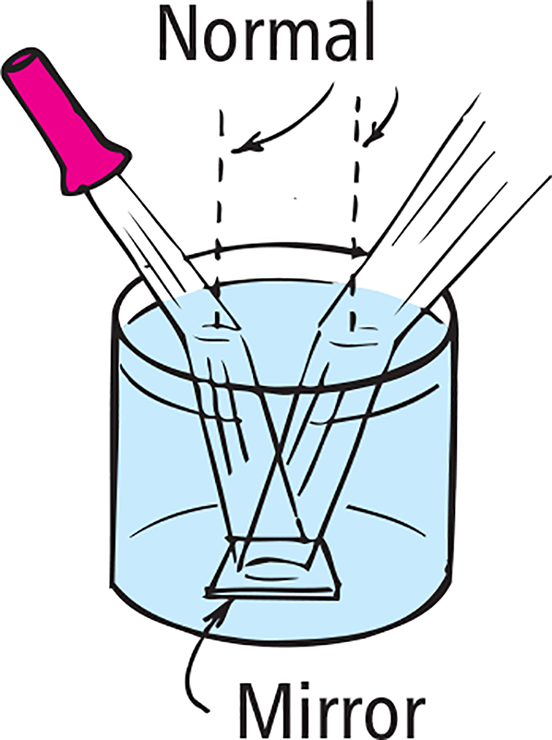
Describe how changes in wave speed cause refraction.
Evidence of Idea
A waves speed depends on the medium
When medium changes the speed changes
Changed wave speed can bend the wave
Temperature & uneven winds can impact sound
Dispersion
Different frequencies will refract at different angles when passing through transparent materials
Vocabulary
Refraction - The bending of waves due to a change in wave speed.
Dispersion - The separation of light into colors arranged by frequency.
People, Places, Dates
Connection

Challenge Idea
What causes the bending of light in refraction?
Does a single raindrop illuminated by sunlight deflect light of a single color, or does it disperse a spectrum of colors?
Does a viewer see a single color or a spectrum of colors coming from a single faraway drop?
Distinguish between a converging lens and a diverging lens
A friend says that a change in speed is necessary for wave refraction. Do you agree or disagree?
When you look downward at a fish in water, does refraction make the fish appear closer to the surface or deeper?
A pair of toy cart wheels roll obliquely from a smooth surface onto two plots of grass—a rectangular plot and a triangular plot—as shown. The ground is on a slight incline, so that after slowing down in the grass the wheels speed up upon emerging onto the smooth surface. Make a sketch and show likely paths and direction of travel in and out of the plots.

When you view the Sun near the horizon, does refraction make it appear higher or lower in the sky?
8.11 Diffraction
Important Idea
Describe the spreading of waves that pass through openings of various widths.
Evidence of Idea
A wide opening causes less distortion than a narrower opening
Vocabulary
Diffraction - Any bending of light by means other than reflection and refraction.
People, Places, Dates
Connection
Challenge Idea
For an opening of a given size, is diffraction more pronounced for a longer wavelength or a shorter wavelength?
Does diffraction help or hinder viewing with a light microscope?
Do small openings or large openings produce more diffraction?
Why do radio waves diffract around buildings, whereas light waves do not?
8.12 Interference
Important Idea
Describe how interference is a property of all wave behavior.
Evidence of Idea
Constructive interference combines the waves
Destructive interference reduces/cancels the waves

Vocabulary
Interference - The combined effect of two or more waves overlapping.
People, Places, Dates
Connection
Challenge Idea
What kinds of waves exhibit interference?
Distinguish between constructive interference and destructive interference.
A nylon guitar string vibrates in a standing wave pattern, as shown. What is the wavelength of the wave?

What kind of waves exhibit interference?
8.13 The Doppler Effect
Important Idea
Relate the shortening and lengthening of waves due to motion to the Doppler effect.
Evidence of Idea
An object trailing behind the waves it produces
Vocabulary
Doppler effect - The change in frequency of a wave due to the motion of the source (or due to the motion of the receiver)
People, Places, Dates
Christian Johann Doppler, 1803–1853 Austrian physicist and mathematician
Connection
Challenge Idea
Why does an observer measure waves from an approaching source as having a higher frequency than if the source were stationary?
hen the frequency of sound is doubled, what change occurs in its speed? What change occurs in its wavelength? Defend your answers.
A railroad locomotive is at rest with its whistle shrieking, and then it starts moving toward you. (a) Does the frequency that you hear increase, decrease, or stay the same? (b) How about the wavelength reaching your ear? (c) How about the speed of sound in the air between you and the locomotive?
Can the Doppler effect be observed with longitudinal waves, with transverse waves, or both?
8.14 The Wave–Particle Duality
Important Idea
Relate how light can be seen as composed of particles and as composed of waves.
Evidence of Idea
Plato, Greek philosopheres, & Isaac Newton believed light to be composed of particles
Maxwell, Young, Hertz viewed light as waves
Einstein claimed light was waves of particles called photons
Energy of photon proportional to its frequency or E~f
Electrons are ejected from some metal surfaces when exposed to light
Light frequency NOT intensity ejects the electrons
Vocabulary
Wave-particle duality - The exhibition of both a wave nature and a particle nature of light.
People, Places, Dates
Thomas Young - demonstrats light’s wave nature
Connection
Challenge Idea
What evidence can you cite for the particle nature of light? The wave nature of light?
Which are more successful in dislodging electrons from a metal surface—photons of violet light or photons of red light? Why?
When does light behave as a particle? When does it behave as a wave?
Explain briefly how the photoelectric effect is used in the operation of at least two of the following: an electric eye, and a photographer’s light meter.
Does the photoelectric effect prove that light is made up of particles? Do interference experiments prove that light is composed of waves? (Is there a distinction between what something is and how it behaves?)
In what sense can light be thought of as a “wavicle”?
Chapter 9 - Atoms & the Periodic Table
sosmfshjfg;
Important Idea
Evidence of Idea