Chapter 17 Foreign Exchange Market
This chapter discusses the functioning of the foreign exchange market and how the value of different currencies is determined.
Reasons for Currency Exchange
Reasons for purchasing foreign currencies:
To buy foreign goods and services.
To acquire foreign assets:
Physical assets like land and capital.
Financial assets like stocks and bonds.
Motivations for acquiring foreign goods, services, & assets:
Cheaper goods and services.
Better quality goods and services.
Higher returns on investments.
Learning Objectives
Goals of this chapter include:
Explain how the foreign exchange market operates and the importance of exchange rates.
Identify long-term factors affecting exchange rates.
Illustrate and interpret demand and supply curves for the foreign exchange market's equilibrium.
List factors affecting exchange rates in the short run.
Foreign Exchange Market Concepts
Definition of Key Terms
Exchange Rate: The price of one currency in terms of another.
Foreign Exchange Market: A financial market where exchange rates are determined.
Spot Transaction: Immediate exchange of bank deposits (completed within two days).
Forward Transaction: Exchange of bank deposits at a specified future date.
Spot Exchange Rate: The current exchange rate for a spot transaction.
Forward Exchange Rate: The agreed price for future exchange in a forward transaction.
Currency Movement Definitions
Appreciation: A currency increases in value relative to another currency.
Depreciation: A currency decreases in value relative to another currency.
Implications of appreciation and depreciation:
When a currency appreciates, domestic goods become more expensive for foreigners whereas foreign goods become cheaper for residents of the appreciating country.
The foreign exchange market primarily operates over-the-counter, mainly among banks.
Long-Run Factors Affecting Exchange Rates
Key Factors
Relative Price Levels
Trade Barriers
Preferences for Domestic vs. Foreign Goods
Productivity
Detailed Analysis of Demand and Supply for Dollars
Demand Curve Characteristics:
Slopes downward because a cheaper dollar means:
American goods become cheaper for foreigners.
American capital assets become cheaper.
American financial assets become cheaper.
Demand for dollars increases as foreign buyers seek these cheaper products.
Supply Curve Characteristics:
Slopes upwards due to:
More euros per dollar making European goods cheaper for US consumers.
In turn, demand for euros increases as US consumers purchase European goods and assets.
Charting Exchange Rates
Important to specify which currency is being charted.
Examples include changes in:
Relative price levels
Trade barriers
Preferences for domestic vs. foreign goods
Productivity
Economical Theories
Law of One Price: A principle stating that in an efficient market, all identical goods must have only one price when expressed in a common currency.
Theory of Purchasing Power Parity (PPP):
Assumptions:
All goods are identical in both countries.
Trade barriers and transportation costs are negligible.
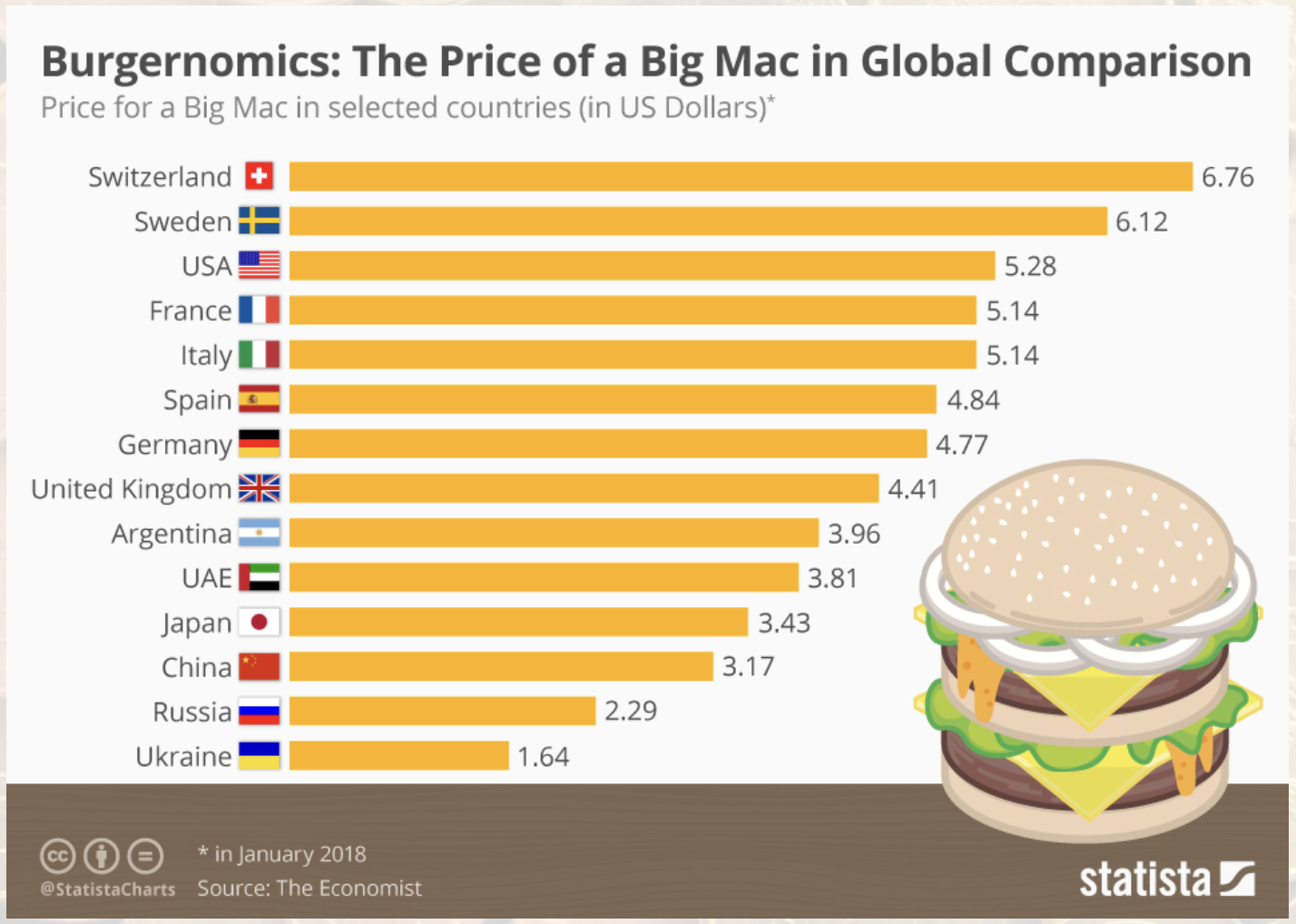
Burgernomics: Application of PPP Using Big Mac Index
Introduction of the Big Mac Index by The Economist as a humorous guide to assess whether currencies are at their correct value according to purchasing power parity.
Big Macs, sold consistently worldwide by McDonald's, provide a basis for currency comparison based on local prices.
Data is collected from 56 regions and countries, highlighting price comparisons for a Big Mac in various countries.
Price Comparison of Big Macs Around the World (January 2018)
Prices of a Big Mac in selected countries (in US Dollars):
Summary of Long-Run Factors Affecting Exchange Rates
Factor | Change in Factor | Response of Exchange Rate, E* |
|---|---|---|
Domestic price level | ↑ | ↓ |
Trade barriers | ↑ | ↑ |
Import demand | ↑ | ↓ |
Export demand | ↑ | ↑ |
Productivity | ↑ | ↑ |
Exchange Rates in the Short Run
Market Mechanics
In the short run, exchange rates are primarily influenced by relative real returns on financial assets.
If US real interest rates rise compared to foreign rates (e.g., euro), the demand for US bonds increases, resulting in
A rightward shift in the demand curve for dollars.
Concurrently, fewer Americans will want euro-denominated bonds, leading to a leftward shift in the supply of dollars.
This combination results in the appreciation of the dollar.
Money Supply's Impact on Exchange Rates
Changes in Money Supply:
A higher domestic money supply typically causes the domestic currency to depreciate. This occurs because an increased money supply means:
A greater quantity of dollars enters the economy,
An increase in demand for both domestic (American) goods and foreign goods, which raises supply and contributes to depreciation.
Application of the Global Financial Crisis on the Dollar
During the onset of the global financial crisis in August 2007, the dollar lost value significantly, dropping 9% against the euro, reaching a historic low by July 2008.
However, in a surprising turn, after the nadir on July 11, the dollar surged by over 20% against the euro by October's end.
Examination of the interplay between the global financial crisis events and the volatility in the dollar's value is warranted.