Physical Fitness Test
Sets of activities designed to determine a student’s level of physical fitness.
DIFFERENT TESTING PARAPHARNALIA
- First aid kit
- Tape measure
- Stop watch
- Mat
- Weighing scale
- Stairs/Steps
- Masking Tape
- Ruler
Health-Related Fitness
BODY COMPOSITION
BODY MASS INDEX (BMI)
Formula to measure:
weight=68 kg
height = 165 cm (1.65m)
Calculation: 68/(1.65)^2 = 24.98
| Rating | Men | Women |
|---|---|---|
| Underweight | <20 | <19 |
| Healthy Range | 20-25 | 19-20 |
| Overweight | 26-30 | 25-30 |
| Obese | >30 | >30 |
3-MINUTE STEP TEST
Measures the Cardiovascular endurance
Equipment: Steps, stopwatch
Procedure:
a. Position at least 1 foot away from bench/steps.
b. when ready, the student will start to step forth and back to the steps without a pause or rest for 3 complete minutes.
c. try to maintain 4 beat cycles that is R foot up (ct.1), L foot up (ct.2), R foot down (ct. 3), L foot down (ct.4). Be consistent with the pace.
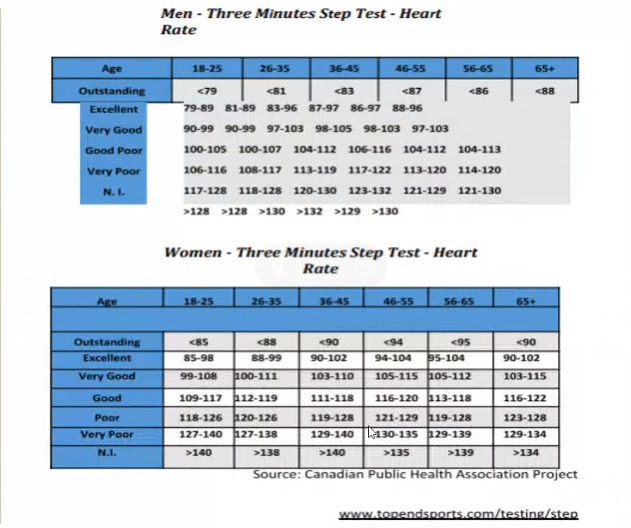
d. Immediately after the exercise find your pulse and count the beats for 20 secs, then multiply it by 3.
e. Do not talk while taking the pulse beat.
f. Compare your heart rate results with the chart provided:
 Resting Heart Rate
- RHR for 10 seconds = No. of beats x 6
- RHR for 15 seconds = No. of beats x 4
- RHR for 30 seconds = No. of beats x 2
Adult = 60-90/min
Child = 80-100/min
Infant = 100-120/min
Push Up
Measures endurance of the shoulders and arm muscles
Equipment: Exercise mat or clean mat.
Procedure:
a. For male: only the hands and toes are in contact with the exercise mats.
b. Straighten the arms while keeping the body especially the back straight or aligned.
c. When ready, start by lowering the body with the arm bended up to 90-degree angle
d. For female: Knees are in contact with the floor, feet are in crossed position.
e. when ready slowly lower the body with arms fixed at 90-degree angle.
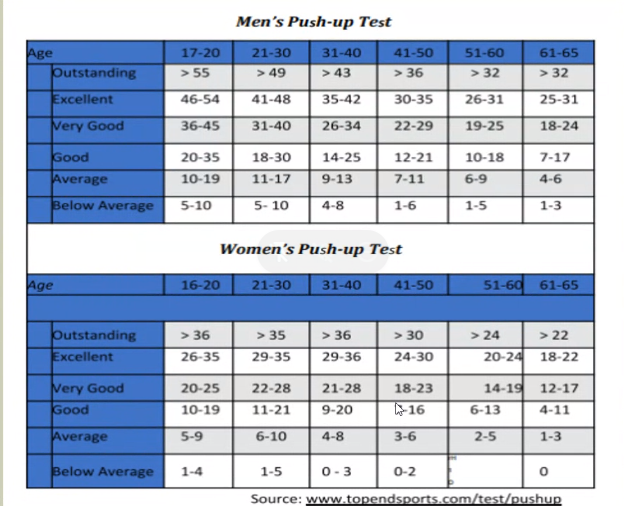
g. Perform as many continuous repetitions as possible.
h. See how you rate on the chart.
Basic Plank
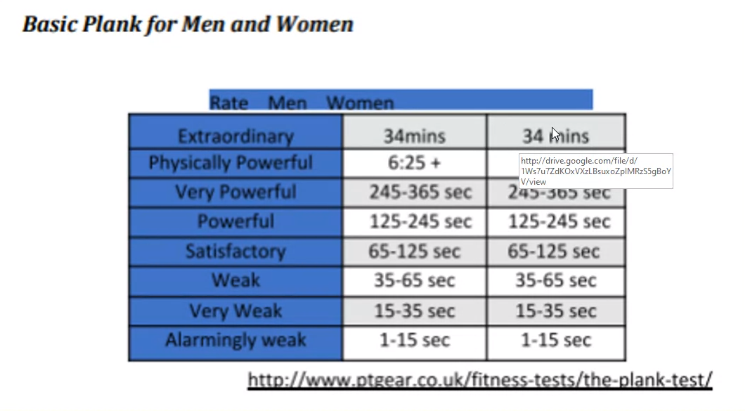
Measures strength/stability of the core muscle
Equipment: Timer or stopwatch, mat
Procedure:
a. Assume a push-up position: elbows are aligned with the shoulders.
b. On a “GO” signal, bend you elbows supporting the weight with your elbows and toes; back is flat with head, neck and spine are in a straight line.
c. Do not let stomach to drop or allow the hips to rise.
d. Record the time and find how you rate.
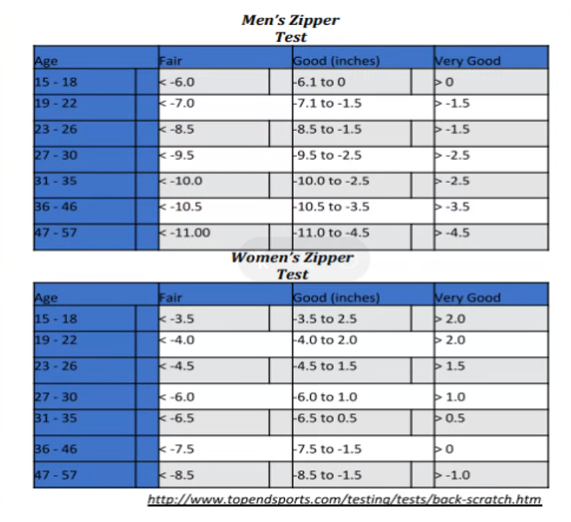
Zipper Test
Tests the flexibility of the shoulder girdle
Equipment: measure tape
Procedure:
a. Stand erect.
b. Put the right arm over the back of the shoulders, bend the elbow and try to reach down as low as possible.
c. Extend left elbow behind across your back and try to reach as high as possible.
d. For the partner measure the space/gap between middle fingers(touched, overlapped or the gap in between)
e. Repeat the process to test the left flexibility
f. use centimeters in recording the score
Sit and Reach
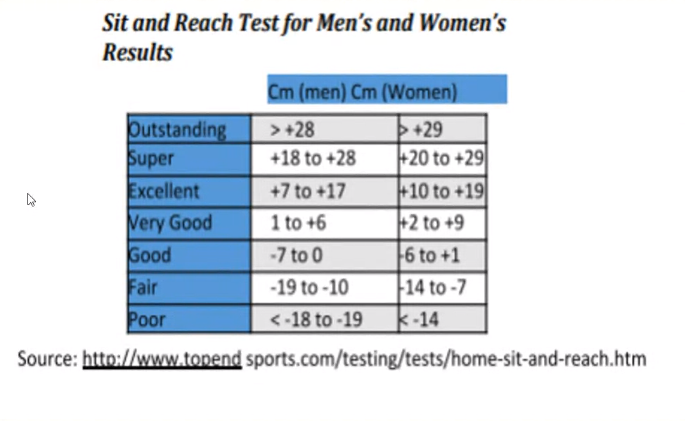
measures the flexibility of the hamstring and lower back
Equipment: Tape measure or meter stick, cardboard or paper
a. Take a seat with your back lie flat on the wall.
b. Legs extended in front, feet in on12 inches apart.
c. To start - interlock fingers and extend the arms in front touching the floor without bending the elbows.
d. Place the hands on top of the card board or paper.
e. start the test by pushing the paper slowly; try to reach the farthest possible without bending your knees.
f. No bouncing or jerking while doing the test.
g. Do the test twice. Record the farthest distance in centimeters.
Squat test
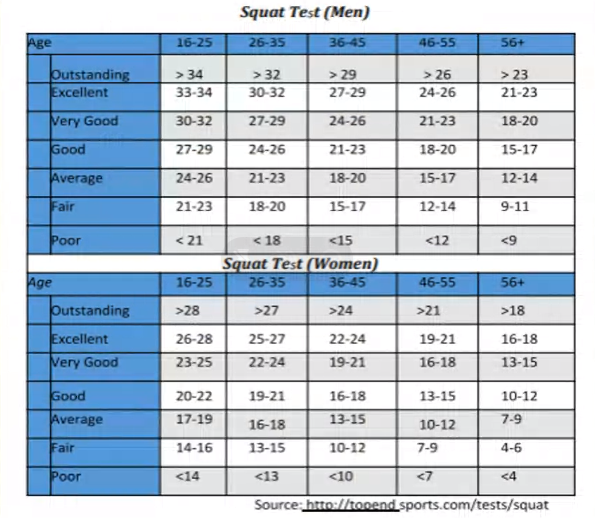
Determine the level of the leg endurance
equipment: Flat wall, timer or stopwatch
Procedure:
a. Lean back against the wall; feet about two ft. away from the wall
b. Bend knees and assume an imaginary sitting position.
c. Place hands at the sides, lower down and keep that position for as long as possible.
d. Record the time and evaluate your results from the chart.
Skill Related Fitness
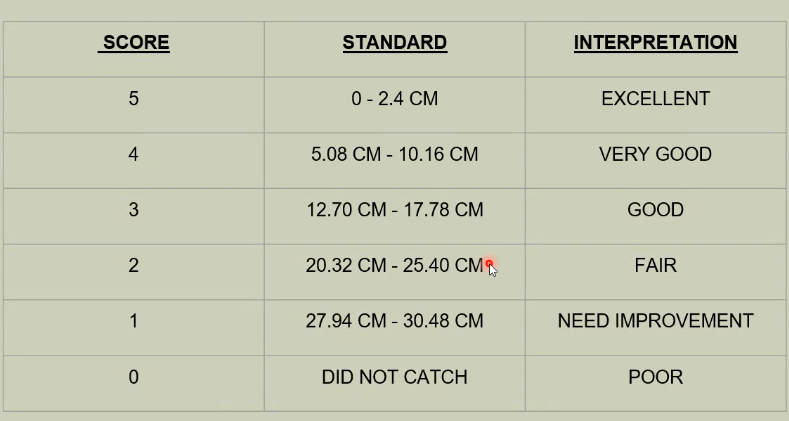
Measures the time to respond to a stimulus
Equipment: 24-inch ruler, arm chair or table and chair.
Procedure:
a. Sit comfortably on a chair, place hand on the desk/table or armchair;
b. Place the heel of the hand on the edge of the table/arm chair;
c. Catch the ruler using the thumb and the index finger without lifting the elbow from the table/armchair as the partner drops the ruler.
d. Do this thrice. Record the middle of the three scores and compare results to the chart.
 Juggling
measure the eye and hand coordination
Equipment: Sipa made of washer with straw(4.6 grams) or 20pcs rubber bands in bundle
procedure:
a. Hit the sipa/bundled rubber bands alternately with right and left palm upward.
b. the height of the sipa is above the head.
c. Count how many times it has been hit continuously. Stop the test when the material drops.
d. record the number of hits and compare your results to the chart
| Performance rating | paper juggling |
|---|---|
| High performance | 9-10 |
| Good Fitness | 7-8 |
| Marginal Fitness | 4-6 |
| Low Fitness | Less than 4 |
Stork Balance Stand test
assesses one’s ability to maintain equilibrium
Equipment: Flat, non-slip surface. stopwatch/timer
Procedure:
a. position by placing hands on hips;
b. Raise right foot and put it at the back of the left knee
c. The time will start when the student assumes a tip toe position and start to balance.
d. Repeat the procedure to the opposite foot
e. Start the time as the heel is raised off the floor; stop the time if: the hands are removed from the hips, out of balance or the student starts to bounce, The non-supporting foot was removed from its original place, When the student’s heel touched the floor.
| Rating | Score (seconds) |
|---|---|
| Outstanding | >55 |
| Excellent | 41-55 |
| Very Good | 26-40 |
| Good | 15-25 |
| Fair | <15 |
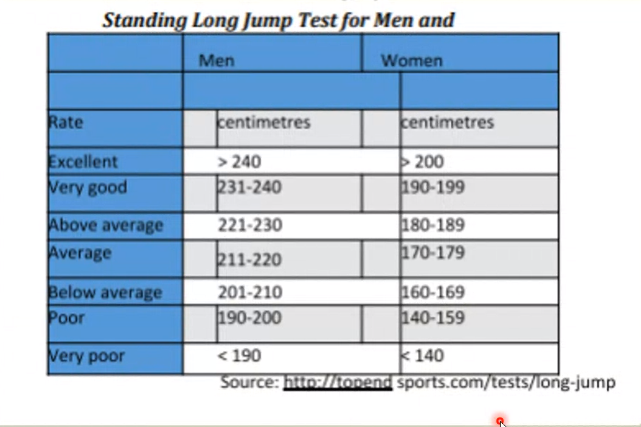
Standing Long Jump
measures the strength and power of the leg muscle.
Tape measure, meter stick and masking tape.
Procedure:
a. Place a take off line; stand behind the take off, shoes should not go beyond the line
b. Try to jump as far as you can; do not control the momentum of the jump
c. Measure the distance between the take off line to the nearest heel using centimeter
d. Do it twice in succession and record both jumps.
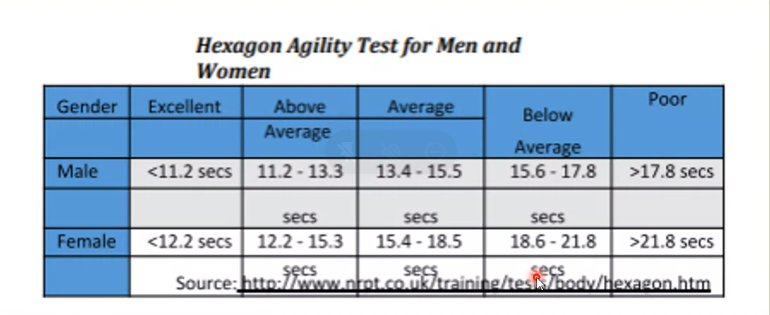
Hexagon Agility test
measures the ability of the body to move in different directions quickly.
Equipment: Tape measure/meter stick, stop watch, chalk or masking tape
Hexagon size: Length - 24 inches, 120 Degrees angle
Procedure:
a. stand inside the hexagon
b. At the “go” signal jump clockwise over the line then jump back in
c. Continue the pattern with all the sides of the hexagon
d. Rest for 1 minute then repeat the test in counter clockwise pattern.
e. Restart the test if the performer jumps on the wrong side of the pattern.
f. For scoring, add the time of the two revolutions and divide by 2 to get the average.