(Module 35) Agriculture Origins and Diffusions
Domestication: The long-term process through which humans selectively breed, protect, and care for individuals taken from populations of wild plant and animal species to create genetically distinct species, know as domesticates.
First Agriculture Revolutions: Period during which the early domestication and diffusion of plants and animals and the cultivation of seed crops led to the development of agriculture.
Plant Domestication:
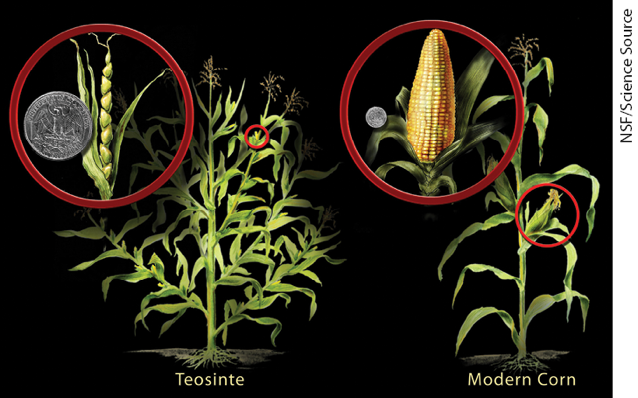
Teosinte: Large wild grass native to Mexico that produced the small ears of maize (corn) that were a favored food among early groups in Mesoamerica.
Mesoamerica: The cultural region in the Americas that includes the diverse civilizations in the modern-day countries of Mexico, Guatemala, Honduras, Belize, El Salvador, Nicaragua, and Costa Rica.
Biodiversity: The variety and variably among species and ecosystems.
Carl Sauer proposed that the process of domestication was independently developed by people who had enough food to remain settled in one place and devote considerable time to plant care.
Animal Domestication:
Some scholars believe that animal domestication occurred later than the first planting of crops (dogs are an exception, whose companionship was likely vital for hunting).
The most recent theories of animal domestication suggests mutually beneficial influence.
Early Hearths of Domestication:
Hearth: A center where innovations or new practices develop and from which the innovations or new practices spread of diffuse.
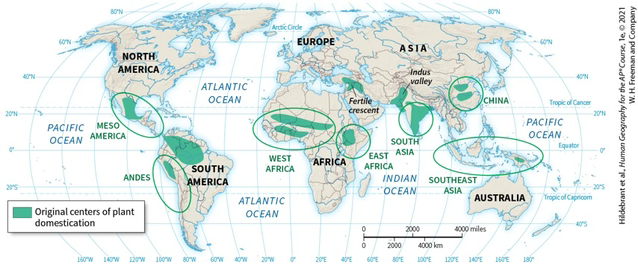
Fertile Crescent: Area in Southwest Asia that includes the river valleys of the Tigris and Euphrates; the earliest center for domestication of seed plants.
Indus River Valley: Area along the Indus River that flows from the highlands of Tibet and continues down along the border between present-day Pakistan and India; a site of the earliest domestication and plants and herd animals.
Other Early Hearths: China, South and Southeast Asia, Malaysia, Africa, and the Americas.
Diffusion of Domesticated Plants and Animals:
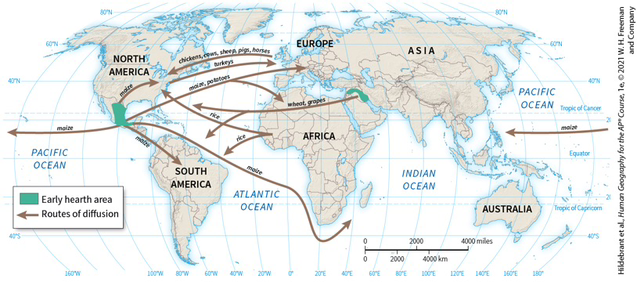
Columbian Exchange: The interaction and widespread transfer of plants, culture, human populations, technology, disease, and ideas between the Americas, West Africa, and the Old World in the fifteenth and sixteenth centuries.
Modern Diffusion of Domesticated Plants and Animals:
The diffusion of crops, animals, and agricultural innovations continues today.
Our understanding of agriculture diffusion focuses on crops, but also the cultures and indigenous technical knowledge systems in which they are imbedded.
Sometimes acceptance of a new crops has unintended consequences (e.g., Irish Potato Famine)