The niche
The Ecological Niche
Definition
The ecological niche refers to the functional role of a species within a community, including its activities and relationships.
Fundamental Niche
Defined as the total range of environmental conditions under which a species can survive.
Resource Utilization and Environmental Factors
Key Factors
Environmental aspects contributing to niches include:
Temperature
Humidity
Salinity
These factors create varying optimal conditions for different species.
Temperature Preferences
Different plant species have varying optimum temperatures for photosynthesis based on their origin:
Temperate lowland: 80-250 m
Mountain valley: 530-900 m
High mountain communities: 2500-2600 m
Dimensions of Niches
One-Dimensional Niche
Species inhabit niches based on a single resource dimension, such as temperature.
Two-Dimensional Niche
Species distribution across two environmental factors, displaying limits for individuals versus populations:
Zones where populations thrive, such as optimal range, compared to limits of tolerance.
Coexistence of Species
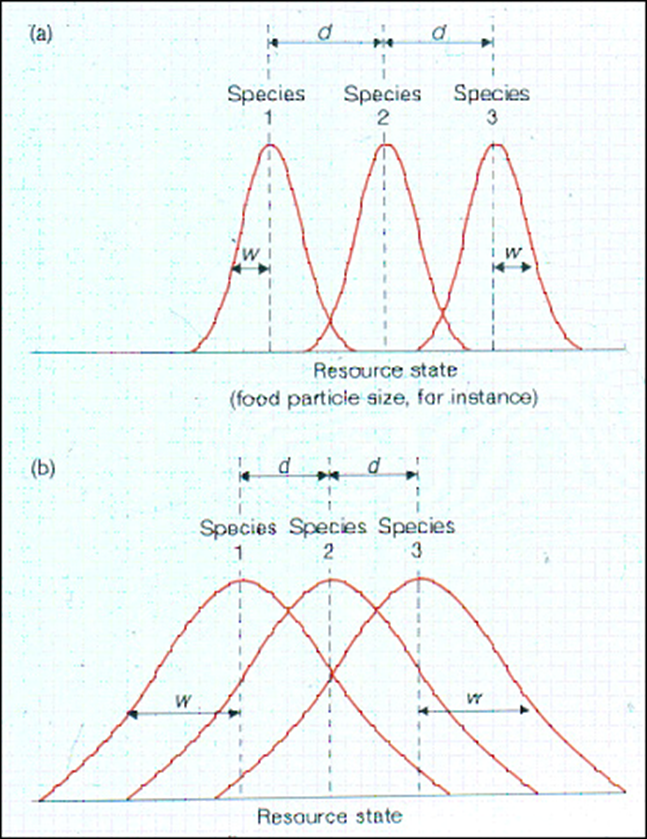
Resource Utilization Curves
Illustrates relationships of species along a resource spectrum, demonstrating niche overlap:
Narrow niches with limited overlap lead to less interspecific competition.
Broader niches result in intense competition.
Practical Example
Feeding positions of bat species in coniferous forests are another instance showing niche utilization and concentration in certain zones.
Realized Niche
Realized niches are influenced by competition, which may limit species distribution and population dynamics:
Example: Barnacle species Cthamalus and Balanus illustrating zonation in distribution due to competition.
Competitive Release
Refers to niche expansion that occurs when interspecific competition is reduced, allowing species to utilize resources previously beyond reach.
Specialized and Changeable Niches
Niche characteristics can be both specialized and adaptable to environmental shifts, seen in mobile sand dune ecosystems.
Limits to Niches
Ecological Constraints
Altitudinal and latitudinal limits apply to many niches, affecting species distribution and adaptation.
Ecotones are transitional areas between different community types, indicating shifts in niches.
Phenotypic Variation
Physical expression of a characteristic of an organism, determined by both genetic constitutions and environment
Example: Achillea lanulosa exhibits growth variations due to environmental constraints, showcasing the relationship between phenotype and niche adaptation.
The morphology of birch trees differs between coastal and inland environments, affecting their growth forms due to environmental stressors.
Biomes
Defined as biological subdivisions reflecting specific physiological and ecological characteristics of plant life, broader than individual niches.
Plant communities are classified based on temperature and precipitation:
Ranges from Tropical Rainforest to Tundra based on environmental factors.
Climate Change Implications
Current discussions include how climate change might affect existing niches and biomes.
Summary of Key Concepts
Fundamental Niche: Total environmental range suitable for survival.
Realized Niche: Actual niche exposed to competition.
Resource Utilization Curves: Graphical representation of resource use and competition.
Competitive Release: Expansion of niche due to decreased competition.
Environmental factors like altitude and latitude define limits to niches.
Different environments can produce varying phenotypes from single genotypes.
References
Acknowledgements to various ecological studies and texts that informed this material.