BIOCHEMISTRY
In terms of carbon atoms, trioses are the smallest monosaccharides that can exist. There are two such compounds, one an aldose (glyceraldehyde) and the other a ketose (dihydroxyacetone).
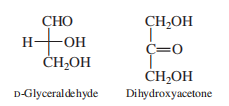
Of the many monosaccharides, six that are particularly important in the functioning of the human body are the trioses d-glyceraldehyde and dihydroxyacetone and the d forms of glucose, galactose, fructose, and ribose. Glucose and galactose are aldohexoses, fructose is a ketohexose, and ribose is an aldopentose. All six of these monosaccharides are water-soluble, white, crystalline solids
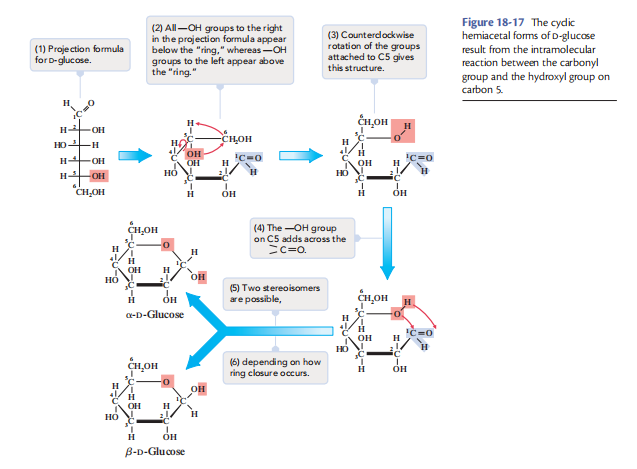
bacteria that cause tooth decay cannot use polyalcohols as food
sources, as they can glucose and many other monosaccharides.
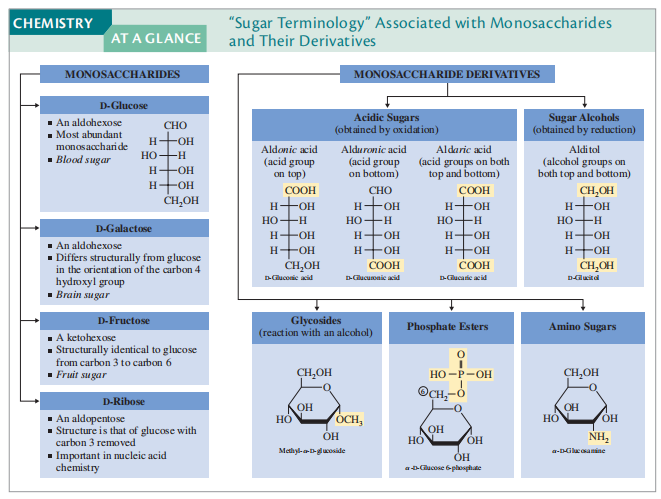
The a form of lactose is sweeter to the taste and more soluble in water than the b form. The b form can be found in ice cream that has been stored for a long time; it crystallizes and gives the ice cream a gritty texture.
The focus on relevancy feature Chemical Connections 18-B—Changing Sugar Patterns: Decreased Sucrose, Increased Fructose—discusses the increasing trend of using fructose instead of sucrose as a sweetener in beverages and processed foods.
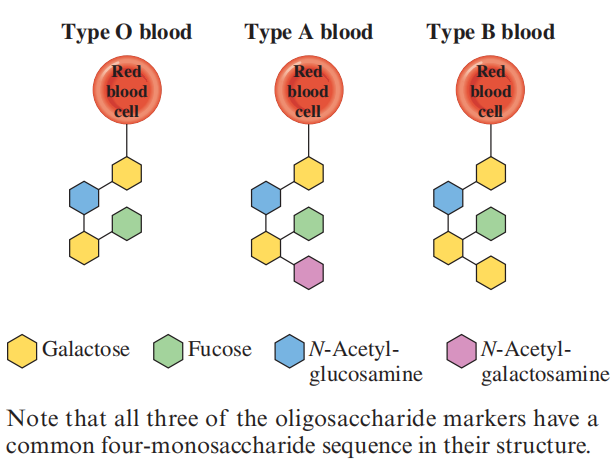
A transfusion of the wrong blood type can cause the blood cells to form clumps, a potentially fatal reaction. People with type O blood are universal donors, and those with type AB blood are universal recipients
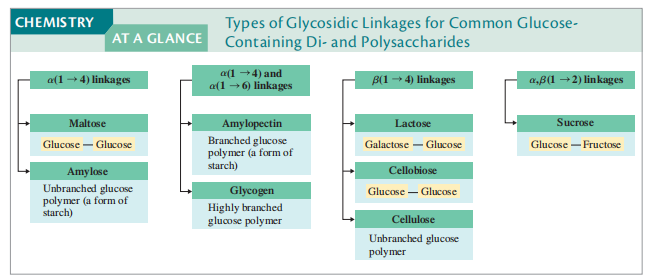
Structurally, chitin is identical to cellulose, except the monosaccharide present
is the glucose derivative N-acetyl-d-glucosamine (NAG) rather than d-glucose itself.
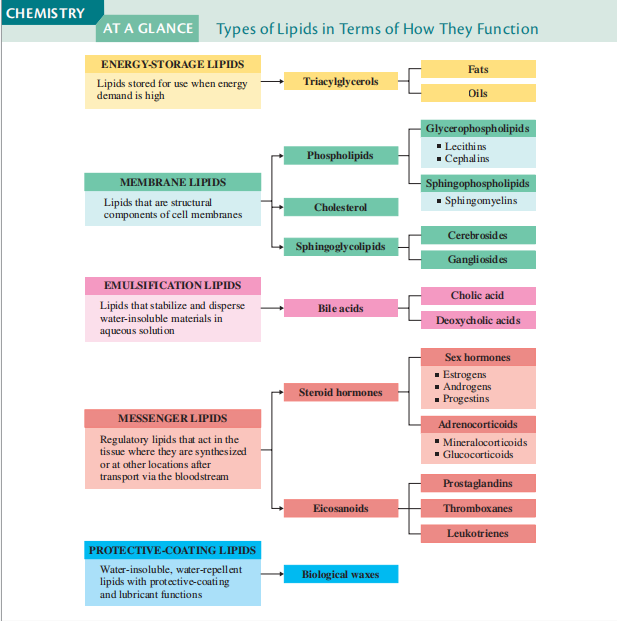
1. Energy-storage lipids (triacylglycerols)
2. Membrane lipids (phospholipids, sphingoglycolipids, and cholesterol)
3. Emulsification lipids (bile acids)
4. Messenger lipids (steroid hormones and eicosanoids)
5. Protective-coating lipids (biological waxes)
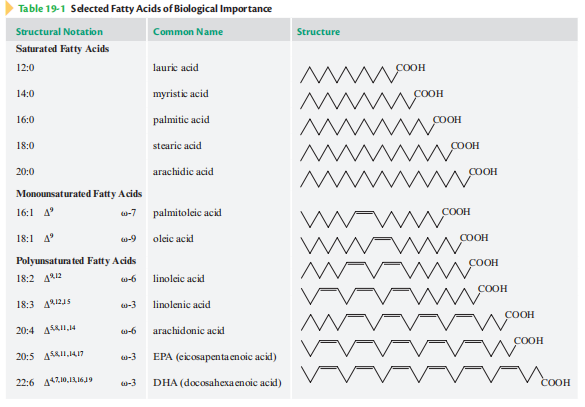
omega- methyl end
delta- carboxylic end
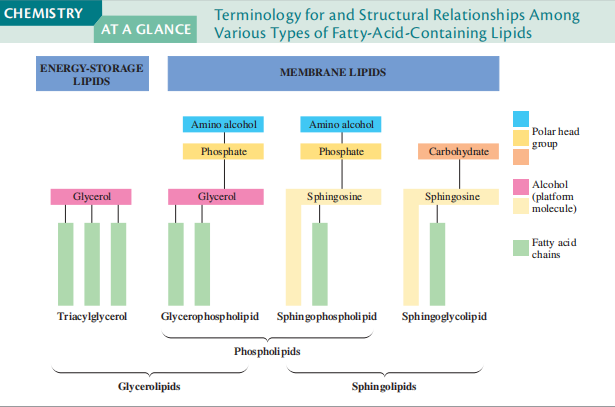
Saponifiable lipids always contain at least one of these three types of linkages.
The linkage “makeup” for the five kinds of saponifiable lipids is as follows:
1.Triacylglycerols—three ester linkages
2. Glycerophospholipids—four ester linkages
3. Sphingophospholipids—one amide and two ester linkages
4. Sphingoglycolipids—one amide, one ester, and one glycosidic linkage
5. Biological waxes—one ester linkage
Protein
Polar Acidic - Apartic and Glutamic Acid
Polar Base - Hystidine, Arginine, Lysine
Polar Neutral - Cysteine, Glutamine, Asparagine, Tyrosine, Threonine, Serine
Non Polar - Glycine, Alanine, Valine, Leucine, Isoleucine, Proline, Phenylalanine, Methionine, Tryptohan
Structure of Proteins
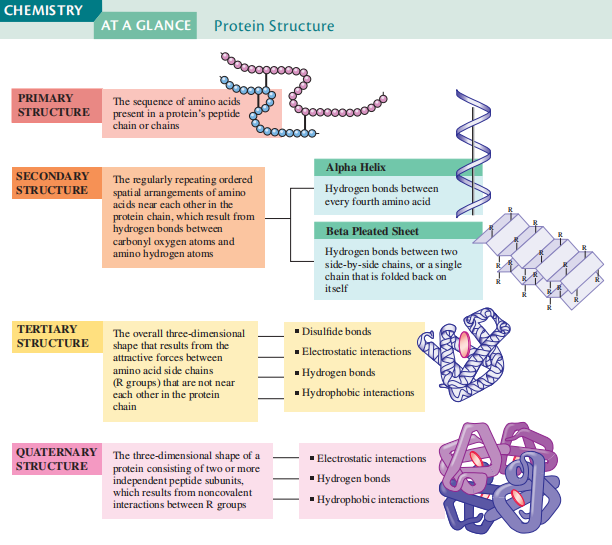
Primary - ordered amino acids linked together — attachment
Secondary - arrangement in space by the backbone portion of protein ( a helix and b pleated sheet
Tertiary - 3 dimensional that results from interactions between aa side chains
Quarternary - organization among the various peptide subunits in a multimeric protein
Catalytic — enzymes
Defense — immunoglobulin and antibodies
Transport — hemoglobin, transferrin, lipoprotein
Messenger — insulin, glucagon, and human growth hormone
Contractile — actin, myosin, flagella
Structural — collagen, a keratin
Transmembrane — protein channels
Storage — ferritin, myoglobin
Regulatory — insulin, molecules that binds with enzymes
Nutrients — casein, ovalbumin
Buffer — (acid-base balance) hemoglobin, transmembrane proteins
Fluid-balance — albumin and globulin
Oxidized
FAD
NAD+
Reduced
FADH2
NADH
Coenzyme A - COA-SH (Vit B deriative)
Acetyl Coa
4 stages of biochemical catabolism and energy production
Digestion
Acetyl Coa
Citric Acid
Electron Transport chain and Oxidative phosphorylation
(Happens in mitochondria)
Phosphorylation is a biochemical process where a phosphate group is added to a molecule
Kinase an enzyme that catalyzes the transfer of a phosphate group from ATP to a specified molecule.
FMN is stronger oxidzibg agent than NAD
subtrates - is the reactant in an enzyme-catalyzed reaction (acts)
lyases catalyzes the addition of froup to double bond or removal of a group ro form a double bonds with hydrolysis or oxidation
ligase catalyzes the bonding together of 2 molecules into one with participation of ATP
Allosteric site - another site and distorts active site
Zygmogens - inactive form, pro enzyme, and are “are turned” at the appropriate time and place
sulfa drugs - competitive inhibitor that is responsible for converting PABA to Folic Acid
cytochrome - hemeprotein