Light
Behaviour:
Light is a form of energy allowing us to see. Its main source is the Sun, and it is the fastest thing in the Universe. Light travels in straight lines (rectilinear propagation), due to this we cannot see around corners.
Light Ray - the direction of the path that the light is travelling in.
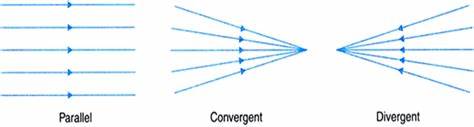
Beam - A collection of light rays. A beam can be parallel, divergent (spreading out), or convergent (coming together).
Luminous & Non-Luminous Objects:
Luminous objects are those which can emit their own light (the sun, a candle, a lightbulb, phone screens).
Non-luminous objects are those which cannot emit their own light (the moon, a chair, a human, a shoe).
Opaque, Translucent, and Transparent:
Opaque materials do not allow any light to pass through them (wood, a mirror, humans). Shadows form when opaque materials block light.
Translucent materials only allow for a certain amount of light to pass through them (vegetable oil, tinted car windows, wax paper).
Transparent materials allow for all light rays to pass through them (glass, air, water).
Reflection:
This happens when light rays bounce off of an opaque surface. There are 2 types:
Regular - This type of reflection only happens with a smooth, opaque surface like a mirror where all light rays will reflect perfectly into your eye.
Diffuse - In this type of reflection, light rays will be scattered due to a rough surface, like paper where only some of the light rays will reflect into your eye.
Parts of the ray reflected into the mirror: Normal, Incident ray, Angle of Incidence, reflected ray, Angle of Reflection, Point of Incidence, and Emergent Ray.
Normal - the perpendicular that is drawn to the reflecting surface. When light travels into a dense medium it bends towards the normal, and when light travels into a less dense medium it bends away from the normal.
Incident ray - the ray of light which strikes the surface
Angle of Incidence - angle between the incident ray & the normal
Reflected ray - light ray that bounces off of the surface
Angle of Reflection - angle between the normal & reflected ray
Point of Incidence - point at which the light hits the surface
Emergent Ray - the ray of light that leaves the medium after refraction
Law of Reflection: The angle of incidence = the angle of reflection
When you look in a plane (flat) mirror everything is the same, except your reflection is laterally inverted, meaning that your left appears as your right and vice versa in a mirror.
Mirrors & Images:
We see an image when light is reflected of a smooth surface and travels into your eye. There are 2 types of images:
Real Image - can be produced on a screen.
Virtual Image - cannot be produced onto a screen and doesn’t exist behind the mirror.
Refraction:
This is the bending of light rays as it travels through different media. Light rays refract because they travel in straight lines but pass through different media (materials) at different speeds.
Lenses:
This is a transparent piece of glass that can refract light. There are 2 types:
Concave lens (Diverging Lens):
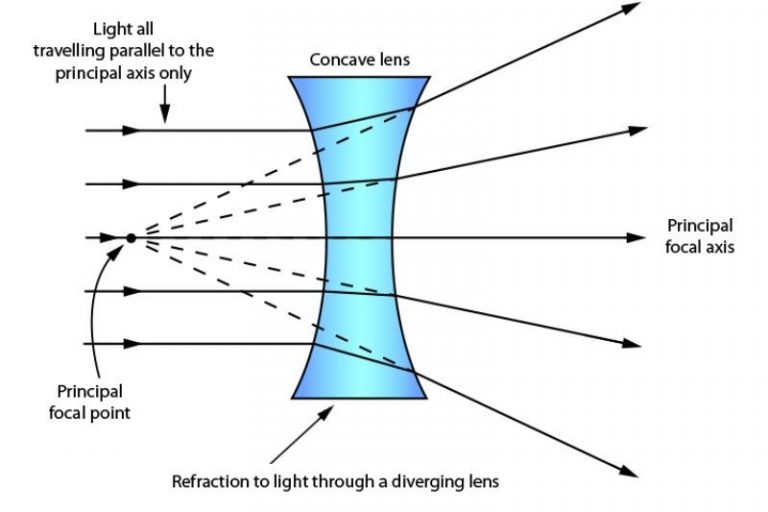
These curve inwards so it is thinner in the middle. It is known as a diverging lens because it causes light rays to spread out in different directions. If it is used to produce an image on a screen, it will give a smaller, upright image.
Concave lenses can correct myopia (near-sightedness) which is when distant objects appear blurred as light rays are refracted too much and become focused in front of the retina. Only close objects can be seen clearly.
Convex Lens (Converging Lens):
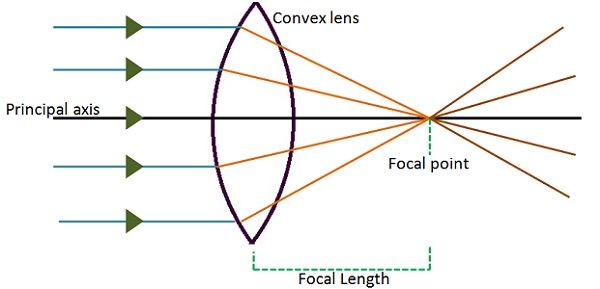
This lens curves outwards meaning it is fatter in the middle. It is called a converging lens because it causes light rays to come together at a point. If it is used to produce an image it will produce a larger, upside-down image.
Convex lenses can correct hypermetropia (far-sightedness) which is when objects appear blurred because light rays are not refracted enough and become focused behind the retina. Only far objects can be seen clearly.