Chapter 15 — Performance measurement in not-for-profit organisations and the public sector
Performance measurement in not-for-profit organisations and the public sector
Not-for-profit sector: scope and characteristics
The not-for-profit sector includes a diverse range of operations (national government, local government, charities, executive agencies, trusts, etc.)
Fundamental motive: not driven by the aim to maximise profit
Critical issues arise from non-quantifiable objectives and benefits
Key problem areas in NFP performance measurement
Many benefits (and costs) from expenditure are non-quantifiable (e.g., social welfare)
Cost/benefit analysis becomes highly judgemental: social benefits vs social costs, and financial benefits vs financial costs
Danger: non-quantified benefits may be ignored in decision making
NFP bodies often do not generate revenue; they operate within fixed budgets (capital rationing problem)
VFM is a common performance measure but it does not resolve the issue of defining or quantifying ‘value’
The primary objective in NFPs is not profit maximisation but to benefit prescribed groups of people
Multiple stakeholders lead to multiple and sometimes conflicting objectives
In NFPs, non-financial objectives such as quality of care or social impact are often more important and harder to quantify
Political change can influence objectives and priorities
Example: Illustration 3 discusses the problem of multiple objectives (not provided in full here but referenced for TYU)
Value for Money (VFM) and the 3Es (Economy, Efficiency, Effectiveness)
VFM is interpreted as delivering an economic, efficient, and effective service
For VFM, appropriate performance indicators must be chosen for each of the 3Es
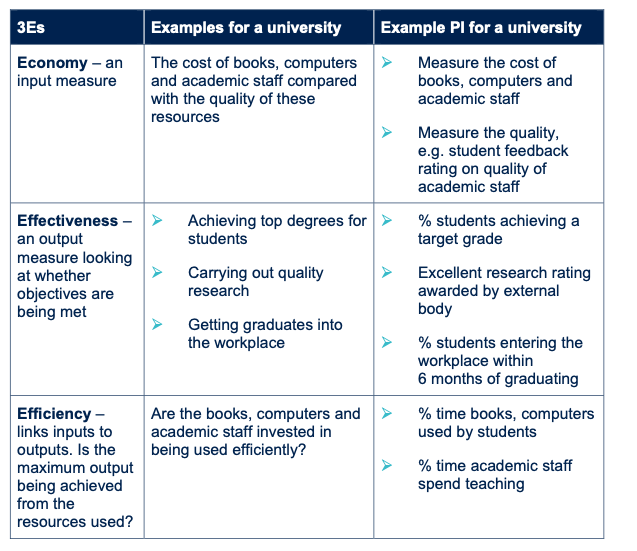
The problem of multiple objectives and prioritisation
Not-for-profit organisations typically use a mix of financial and non-financial objectives
Multiple stakeholders lead to multiple objectives; there is a need to prioritise or compromise between objectives
Non-financial objectives (e.g., quality of patient care) are often harder to quantify
Summary of learning objectives and practical implications
VFM requires balancing economy, efficiency, and effectiveness in a not-for-profit/public sector context
Non-quantifiable benefits/costs require judgement and careful consideration in performance evaluation
Fixed budgets and capital rationing are common in the public sector and can complicate decision making
Excellence in performance measurement emerges from combining financial metrics with non-financial outcomes aligned to stakeholder values
Ethical and practical implications include avoiding “teaching to the metric,” ensuring quality and social value are not sacrificed for the sake of quantified targets, and recognizing the political nature of objectives