Music Theory - General Info
Meter and Rhythm
Meter - aka time signature
Top number → Metric grouping (Duple, triple, etc)
Bottom → Pulse
Simple Meter
-Duple pulse → (Strong - Weak)
-Triple pulse → (Strong - Weak - Weak)
Scales
Major Scale
Pattern → W–W–S–W–W–W–S.
Consists of a sequence of semitones and whole tones
In a major scale, Semitones are located between the 3rd and 4th scale degree, and the 7th and 8th scale degree

Minor Scale(s)
Natural
The natural minor scale has
Key Signatures
Finding key signatures
Look at the key signature, and figure out your options
ex- one flat means it can be F major or D minor
Notice the accidentals in the piece
Find the highest and lowest note - This can help guide you, but it doesn’t always mean that the lowest note is the
Writing down the notes that you see in the piece, and then putting them in order (building a scale) can help visualize
Intervals (Rewatch videos and update notes)
An Interval = The distance between two notes
Harmonic interval = Distance between two notes playing at the same time
Melodic Interval = One note after the other

Simple Intervals = Smaller than an octave (8)
Compound Intervals = Larger than an octave (8)


Interval Quality
Major/Minor
2nds, 3rds, 6ths, and 7ths
Minor →
The smaller, natural size of intervals given above
Major →
The larger, natural size of the intervals given above
Diminished →
If a Minor interval Shrinks by a Semitone/Half step: it becomes Diminished
Augmented →
If a Major interval expands by a Semitone/Half step: It becomes Augmented

We focus on 2nds and 3rds!
Seconds: Span two steps between a line and the adjacent space
m2 = 1 Semitone
M2 = 2 Semitones
A2 = 3 Semitones
Thirds: Span three steps
d3 = 2 Semitones
m3 = 3 Semitones
M3 = 4 Semitones
A3 (rare) = 5 Semitones
Perfect Intervals
Unisons, fourths, fifths, octaves, and their compounds are usually perfect!
If the shrink by a semitone → They become diminished
If they expand by a semitone → They become augmented
We focus on 4ths and 5ths
Fourths: Span four steps
d4 = 4 semitones
P4 = 5 semitones
A4 = 6 semitones
Fifths: Span five semitones
d5 = 6 semitons
P5 = 7 semitones
A5 = 8 semitones
Inversion:
To invert..
Shift the lower note Up an octave
Or
Shift the lower note Down and octave
Impacts of inversions on Size and Quality:

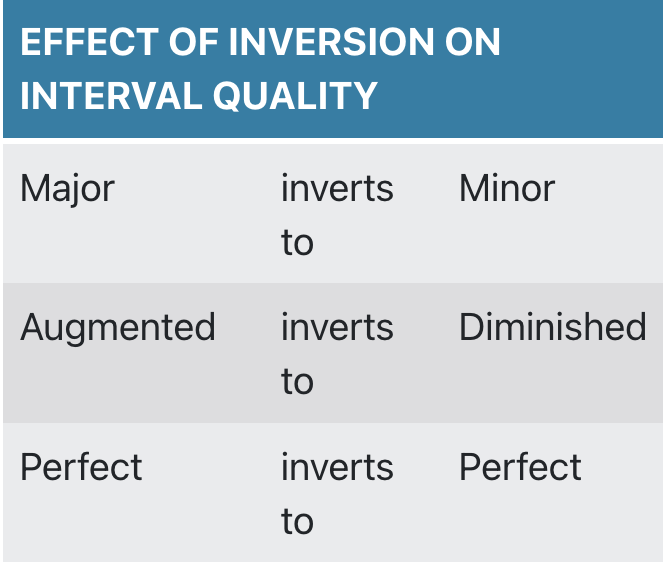

Adding a SHARP to the upper note of the interval, or a FLAT to the lower note of the interval causes it to EXPAND
Adding a FLAT to the Upper note of the interval, and a SHARP to the lower note of the interval cause is to CONTRACT
Consonant vs Dissonant intervals
Consonant
Relatively stable
Occur in beginnings and endings of pieces
Types-
Perfect unisons
Fifths
Octaves
Major/Minor thirds
Major/Minor sixes
Dissonant
Seconds
Sevenths
All diminished intervals
All augmented intervals

Intervals in a key
In a Major key: The intervals above the tonic are all major or perfect
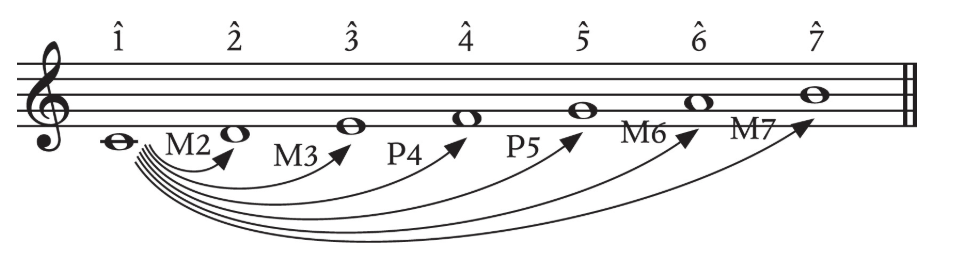
In a Natural minor key: The intervals formed above the tonic are minor or perfect, except for the Major second between the 1st and 2nd scale degree

Review-
4ths, 5ths, and octaves may be Diminished, Augmented, or Perfect
Triads
Triad = A chord made up of three notes
There are four qualities - They are determined by the intervals between the triads Root and Third and the interval between the Root and Fifth

Diminished
Major/Minor chord between Root and third
They get their quality from the root and fifth
Augmented
Major/Minor chord between Root and third
They get their quality from the root and fifth
Minor
A P5 (Perfect fifth) Between the Root and the Fifth
Major
A P5 (Perfect fifth) Between the Root and the Fifth
How to determine
1) Determine the Quality of the Fifth
-If the 5th is augmented, the triad is
-If the 5th is Diminished, the triad is
-If the 5th is Perfect, the triad is Major or minor
2) If the 5th is perfect…
You must determine the quality of the third to determine Major/Minor
If the Third is Major, the Triad is
If the Third is minor, the Triad is
Triad Inversions
A triad contains
Root
3rd
5th
Any one of these tones can be the Bass note (The lowest note in the triad)
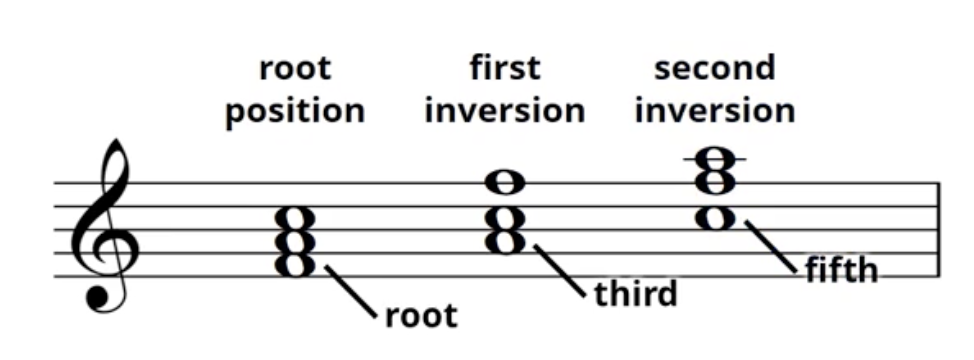
Recognizing Inverted Triads-
Method 1:
Rearrange the notes
Identify position of the bass note

Method 2:
Identify the intervals
Figured Bass Symbol
Intervals above the bass
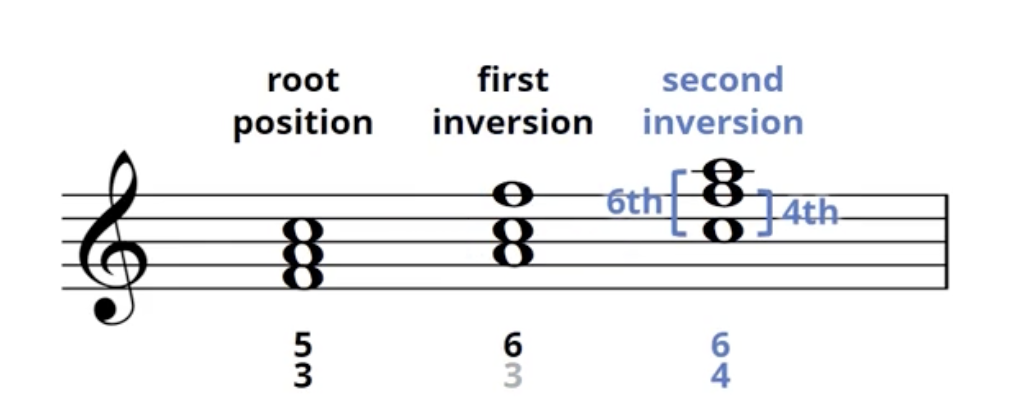

Chord Qualities
Seventh Chord Qualities
Made up of four notes stacked in thirds / A triad with a added seventh above the root
The quality of the chord is determined by
The quality of the Triad
The quality of the Seventh

Major - MM→ Major Triad + Major 7th (Shorthand: CM7)
Dominant/Major Minor - Mm → Major Triad + minor 7th (Shorthand: C7)
Minor - mm → Minor Triad + minor 7th (Shorthand: Cm7)
Half-diminished - dm → Diminished Triad + Minor 7th (Shorthand: C#ø7)
Fully diminished - dd → Diminished Triad + Diminished 7th (Shorthand: C#°7)
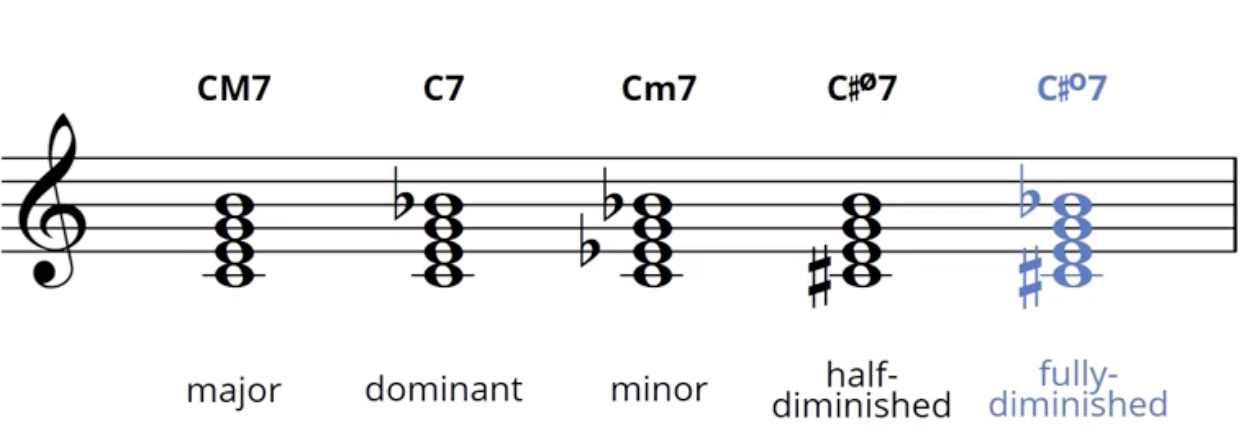
How to write a root position 7th chord from a chord symbol
This is the Chord: F#°7
This is a Fully Diminished (°) F# Major chord
It has a fully diminished triad, and a diminished 7th
To build, start with an F# and stack thirds on top. Then adjust the pitches to make it diminished
F#AC → This triad already contains a minor 3rd and diminished 5th, therefore it is already diminished!
Next, add a diminished 7th on top
F#AC +Eb = F#ACEb
7th Chord inversions
When the _ is the lowest note in the chord…
Root → Bass position (fb: 7)
Third → First Inversion (fb: 6/5)
Fifth → 2nd inversion (fb: 4/3)
Seventh → 3rd Inversion (fb: 4/2)
Figured Bass- Intervals above the bass

Recognizing Seventh Inversions
There are 2 ways to find the inversion!
1) Rearrange the notes and identify the chords root position
Once you have arranged the chord, figure out where the inverted bass note lies in the root position chord. This will allow you to figure out what the inversion is!
2) Identify Intervals
In this example, the inverted chord has a 2nd, a 4th, and a 6th above the bass

This means that it is in 6-4-2 Position, abbreviated as 4-2. Meaning this is a third inversion seventh chord
Writing Inverted Seventh chords from a chord symbol
Lets write an A7 in 4-3 (2nd inversion
A7 means Major minor 7th chord and 2nd inversion means the 5th of the chord is in the bass
First, spell an A7 chord using letter names
A C# E G#
Next, determine what note is going to be in the bass
In this case, the 5th of our chord is going to be in the bass. So E will be the lowest note in this chord
Arrange the chord tones so that E is in the bass, and the rest are above
To check your work, count the interval
Chords in a key

Class notes
Triads
Three notes spelled of skips - FAC -BDF - EGB - etc
Accidentals change quality but not the fact that it is a triad
Major - About the distance between the bottom and middle note distinguish a major from a minor -
Bottom to middle note → 3rd
Minor triad = Minor third
Key signature gives you the major triad → to make it minor, flatten the middle note (3rd)
You can also use the the minor key signature to build the minor triad → And then move
Major
Root →5th | P5 (7 semi
Chords in a key:
I, iv, V, and vi, (1, 4, 5, and 6)
Triads in minor keys
In every minor key, there are three major triads (III, VI,VII), three minor triads (i, iv, v) and one diminished triad (ii°)
(Get chart from paper notes!!)