Notes on Hereditary Influences on Development
Genotype, Phenotype, and Basic Genetic Concepts
Genotype: the genetic endowment that an individual inherits.
Phenotype: the observable or measurable expression of the genotype.
Conception: the moment of fertilization, when a sperm penetrates an ovum, forming a zygote.
Zygote: a single cell formed at conception from the union of a sperm and an ovum.
Genetic material: chromosome — threadlike structure made up of genes; in humans there are chromosomes in the nucleus of each body cell.
Genes: basic units of heredity, hereditary blueprints for development transmitted unchanged from generation to generation.
Deoxyribonucleic acid (DNA): long, double‑stranded molecules that make up chromosomes.
Cell Division and Growth
Growth of the zygote and production of body cells rely on mitosis:
Mitosis: a cell duplicates its chromosomes and then divides into two genetically identical daughter cells.
Stepwise illustration (simplified):
1) Original cell with four chromosomes (illustrative).
2) Each chromosome splits lengthwise, producing a duplicate.
3) Duplicates move to opposite ends; the cell begins to divide.
4) Division completes; two new cells have identical sets of chromosomes.
Germ Cells, Gametes, and Meiosis
Germ (sex) cells: also present; produce gametes (sperm in males, ova in females).
Gametes: produced by meiosis, a germ cell division producing haploid cells that contain half of the parent cell's original chromosome complement.
In humans, each gamete contains chromosomes (half of the 46 in somatic cells).
Meiosis and Genetic Variation
Meiosis process includes:
Duplication of the germ cell's 46 chromosomes.
Crossing over: adjacent duplicated chromosomes cross and exchange segments, creating new hereditary combinations.
The original cell divides to form two new cells, each with 23 duplicated chromosomes (some altered by crossing‑over).
In the final gametes, each chromosome and its duplicate segregate into separate gametes, so each gamete has half the chromosomes of the original cell.
Crossing‑over: during meiosis, genetic material is exchanged between chromosome pairs, producing new combinations.
Sex Chromosomes, Autosomes, and Genetic Inheritance
Germ cell steps (summary): starting from 46 chromosomes, meiosis yields gametes with 23 chromosomes each.
Sex chromosomes: X and Y; autosomes: the 22 pairs of chromosomes identical in males and females.
X chromosome: longer of the two sex chromosomes; females typically have two Xs, males have one X.
Y chromosome: shorter; males have one Y, females have none.
Autosomes: 22 pairs, identical in males and females.
After conception, zygotes carry a full set of chromosomes; inheritance patterns determine phenotypic outcomes.
What Do Genes Do?
Produce enzymes and proteins necessary for cell creation and function.
Guide cell differentiation.
Regulate pace/timing of development.
Environmental factors (internal and external) influence how genes function.
Genetic Variation: Simple Mendelian Example (Illustrative)
Parental genotypes: Mother Nn, Father Nn (example with a single gene affecting vision).
Gametes: N sperm or n sperm; N ovum or novum.
Possible zygotes (genotypes):
NN (homozygous normal vision)
Nn (heterozygous normal vision)
nN (heterozygous normal vision)
nn (homozygous nearsighted)
Phenotypic outcomes depend on dominance relationships; this example illustrates how genotype combinations produce different vision outcomes.
Heredity Disorders and Genetic Abnormalities
Heredity disorders can arise from chromosomal abnormalities or genetic abnormalities.
Detecting, predicting, and treating hereditary disorders is a major area of study.
Chromosomal Abnormalities
Chromosomal abnormalities involve too many or too few chromosomes (aneuploidy) due to uneven distribution during meiosis.
Consequence: gametes with incompatible chromosome numbers lead to zygotes with abnormal development.
Autosomes vs. Sex Chromosomes: abnormalities can involve autosomes (22 autosome pairs) or sex chromosome (23rd pair).
Down syndrome (trisomy‑21): an autosomal abnormality caused by an extra 21st chromosome; individuals typically have distinctive physical features and moderate to severe intellectual disability.
Most frequent autosomal abnormality: Down syndrome (trisomy 21).
Genetic Abnormalities
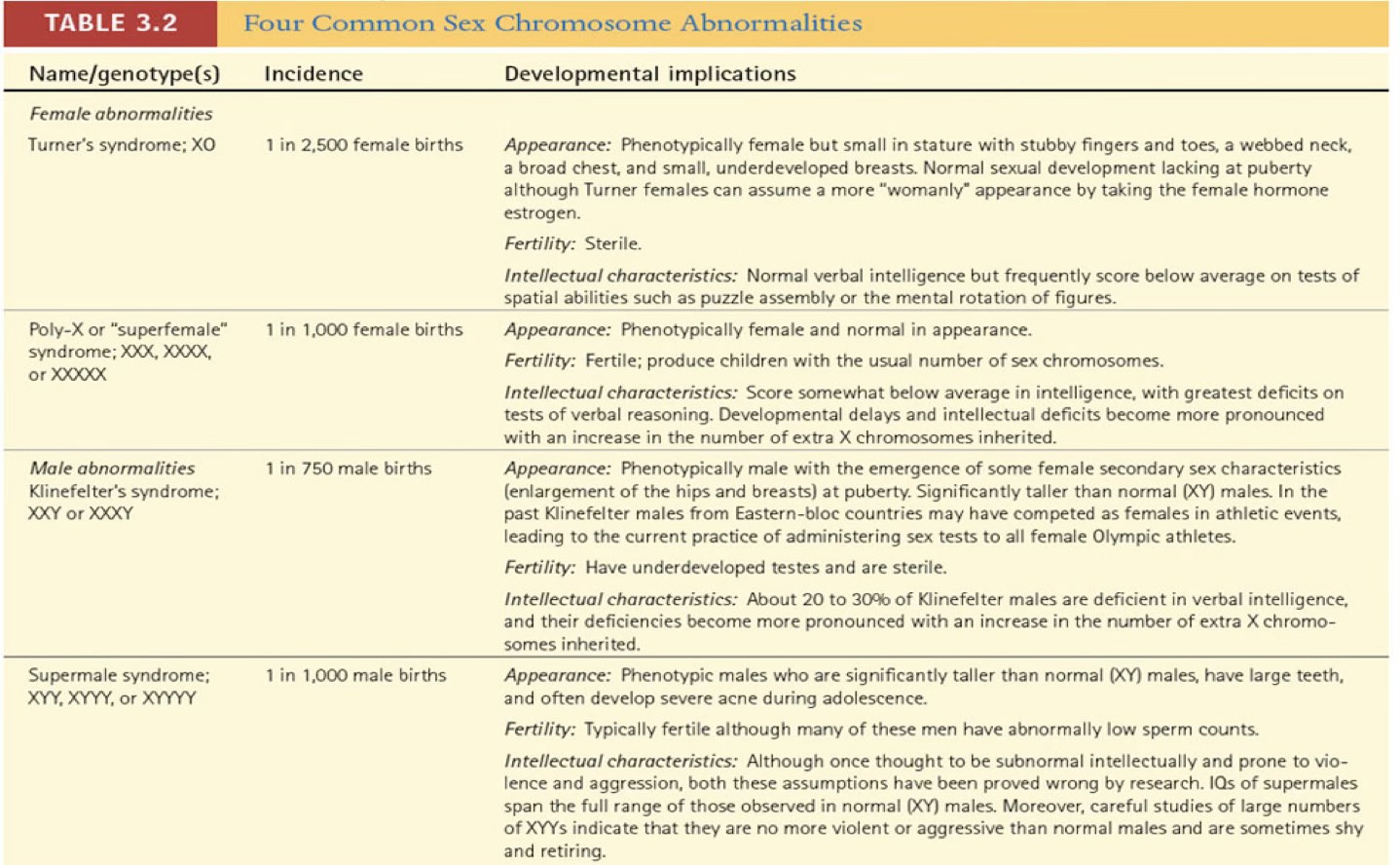
Sex chromosome abnormalities involve the 23rd pair (the sex chromosomes).
Common sex chromosome abnormalities are listed in Table 3.2 (not reproduced here).
Other genetic abnormalities can involve autosomes or sex chromosomes.
Recessive and Dominant Genetic Diseases
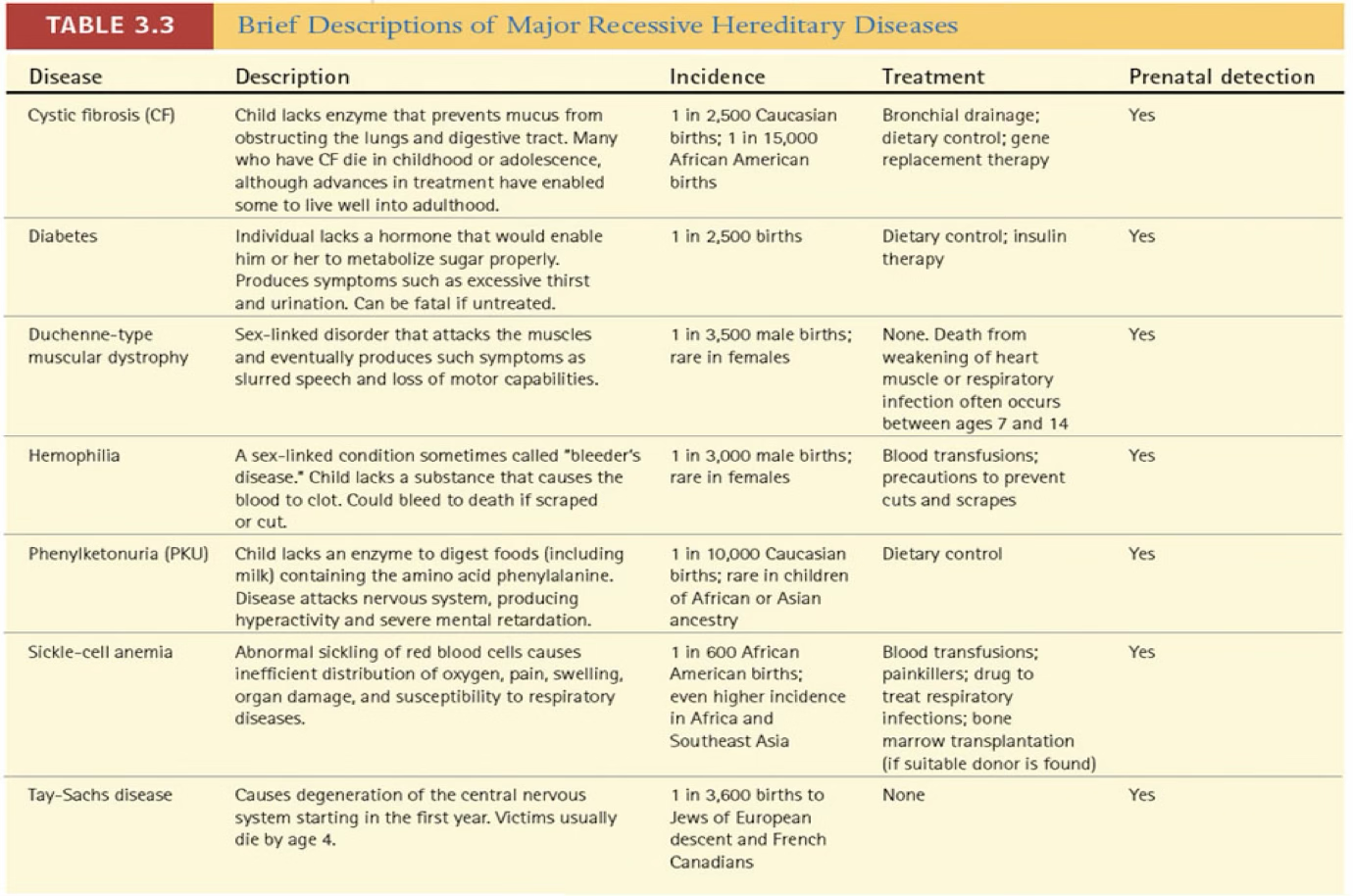
Many disorders are passed when both parents carry recessive alleles.
Some disorders are caused by dominant alleles inherited from either parent; the contributing parent may display the disorder.
Table 3.3 summarizes major recessive hereditary diseases (not reproduced here).
Detecting Genetic Abnormalities
Amniocentesis: extraction of amniotic fluid to test fetal cells for chromosomal abnormalities and other defects.
Conducted around weeks – of pregnancy.
Risks: miscarriage risk higher than risk of birth defect for women under age 35.
Results: typically available in weeks.
Figure 3.10 illustrates the needle insertion and sample collection.
Chorionic Villus Sampling (CVS): sampling fetal cells from the chorion.
Conducted around weeks – of pregnancy.
Results: available within hours.
Risk of miscarriage roughly 1 in 50(2%)
Figure 3.11 shows sampling methods guided by ultrasound.
Ultrasound: uses sound waves to produce an image outline of the fetus; useful after week ; noninvasive. To determine any structural abnormalities.
Treating Genetic Abnormalities
Special diets for metabolic disorders (e.g., phenylketonuria, PKU).
PKU: a genetic disease in which the child cannot metabolize phenylalanine; if untreated, leads to hyperactivity and mental retardation.
Germline gene therapy: a theoretical/experimental approach to repair or replace harmful genes; not yet perfected or approved for humans.
Methods of Studying Hereditary Influences
Heritability: the amount of variability in a trait attributable to hereditary factors.
Selective Breeding
Selective breeding experiments study genetic influences by testing whether traits can be bred via mating.
Example: maze‑learning differences in inbred (maze‑bright vs maze‑dull) lines over generations.
Figure 3.12 (and related concordance data) illustrates maze performance and concordance across identical and fraternal twins.
Family Studies and Kinship
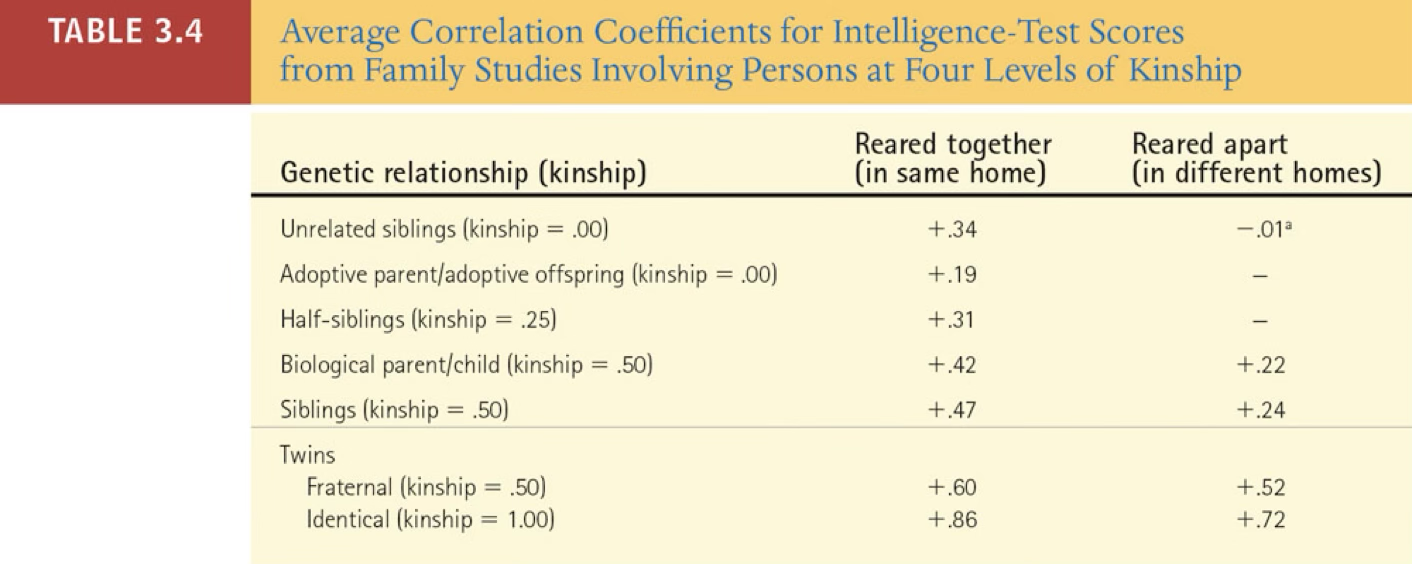
Kinship: the extent to which two individuals share genes.
Twin design: compare twins differing in zygosity (identical vs fraternal) to estimate heritability of traits.
Adoption design: compare adoptees with biological and adoptive relatives to estimate heritability.
Estimating Gene–Environment Contributions
Concordance rate: the percentage of cases in which a trait is present for one twin given it is present for the other.
Heritability coefficient: a numeric estimate from to of the portion of variation due to genetic factors.
Figure 3.14 shows concordance rates for identical vs fraternal twins across behavioral dimensions.
Table 3.4 (average correlations for intelligence test scores from family studies) summarizes findings across kinship levels.
Environment and Heredity
Non-shared environmental influence (NSE): environmental factors that siblings do not share, contributing to differences among them.
Shared environmental influence (SE): environmental factors that siblings share, contributing to similarities among them.
Hereditary Influences on Behavior and Development
Intellectual Performance
As children age, the role of genes in intellectual performance tends to increase.
Nonshared environment tends to increase with age; shared environment tends to decrease.
Figure 3.15 portrays changes in IQ correlations between identical and fraternal twins over childhood.
Personality
Genetic influences on personality traits such as introversion/extraversion and empathic concern.
Introversion/extraversion: opposite ends of a personality spectrum; introverts tend to be shy and withdraw; extraverts are sociable.
Empathic concern: degree to which a person recognizes others' needs and cares about their welfare.
Estimated heritability for empathic concern around +0.40; nonshared environmental influences are most important.
Question: do siblings have different experiences because they have different genes?
Parent, Child, and Transactional Influences
Parent effects model: parenting influences child outcomes.
Child effects model: children influence parenting through temperament and personality.
Transactional model: reciprocal influence between children and parenting; gene–environment interplay fosters development.
Behavioral Disorders and Mental Illness
Many disorders (schizophrenia, alcoholism, criminality, depression, hyperactivity, bipolar disorder, neurotic disorders) have genetic components; individuals inherit a predisposition, not the disorder itself.
Schizophrenia: serious mental illness with disturbances in thinking, emotion, and social behavior.
Bipolar disorder: extreme mood fluctuations.
Neurotic disorders: irrational patterns of thinking/behavior to cope with stress or anxiety.
Theories of Gene–Environment Interactions
Canalization
Canalization: genetic restriction of phenotype to a narrow set of developmental outcomes.
Highly canalized traits are channeled along predetermined pathways, with environment having little effect on the resulting phenotype.
Range of Reaction Principle
Genotype sets limits on the range of possible phenotypes in response to different environments.
Example: hypothetical reaction ranges for intellectual performance across restricted, average, and intellectually enriching environments (Figure 3.16).
Genotype–Environment Correlations
Many behavioral geneticists believe genes influence the environments we experience.
Passive genotype–environment correlation: rearing environments provided by biological parents are influenced by the parents' genes and correlated with the child's genotype.
Evocative genotype–environment correlation: heritable attributes evoke responses from others that shape the environment.
Active genotype–environment correlation: individuals seek out environments compatible with their genotype.
Contributions and Criticisms of the Behavioral Approach
Contributions:
Many attributes thought to be environmentally determined are also influenced by genes.
Genetics and environment are intertwined; understanding behavior requires considering both factors.
Criticisms:
Describes correlations or associations but does not fully explain development.
Environmental forces remain underspecified or not fully explained by the model.