AP LT#2
equillibrium / ekwilibriyo
kasunduan (wotd)
an agreement, where two entities reach an understanding
pamilihan
it is a mechanism where buyer and sellers have transactions
a place for transactions
puwersa ng pamilihan (market forces/relationship of buyer and business)
talks about the relationship of supply and demand
where buyers buy in bulk in low prices (mamimili)
where businesses sell a lot in high prices (bahay-kalakal)
types of interactions between demand and supply
surplus (QD < QS) / kalabisan (labis many)
where there is more stock than demand
nobody wants it, but there is a lot, so they put it at a very cheap price.
shortage (QD > QS) / kakulangan. (kulang lacking)
there is more demand that stock
many people want it, but there is not enough stock for all
they put the money at a very high price, more money for the sellers.
equilibirium (QD = QS)
where the quantities of supply and demand are the same
no more no less.
there are 2 types (presyo and dami)
equilibrium price (the two make an agreement on price)
ex. lets get this for 100, no 200, then 150.
equilibrium amount/dami (the two make an agreement on the amount of product or service)
ex. lets get 5 of them, no 10, then 7
(and no.) disequillibrium
ANY situation where there is no equillibrium or balance
QD is NOT QS
three types of equillibrium in the market
market schedule (the table)
a table that shows the relations between qd and qs in different prices
market curve (a graph)
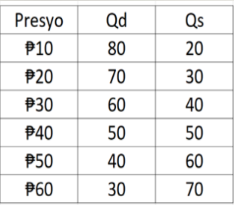
shows the relation of the price, qs and qd on a graph
no. the top space is the surplus (qs) goes up / plus is up
no. the bottom space is the shortage (qd) goes down / other is down
no. the sides are the equilibrrium

market function (the equation)
(Qs = Qd)
a mathematical equation that shows the realtion between demand and supply.
how to solve?
bascially make all alike terms go on the same side
then solve normally
then insert the value of price to the equation given.

price floor and price ceiling
price floor (lowest)
it is the lowest/minimum price to sell any product
it should not be below its dictated price
ex. cat food for 20 is floor.
price ceiling (highest)
it is the maximum legal price to sell a product
should not go past this
ex. cat food for 100 is ceiling
estruktura ng pamilihan / the structure of the market
kompetisyon (wotd)
it is a sitation where people or groups are fighting to get a specific thing.
the structure of the market is based on these factors
dami sa magtitinda (amount of sellers)
if there is more sellers, that means there is a higher competition when selling
if there is less sellers, that means there is less competition when selling
same ppl go to the markets, so you have to gain ur own group of regular buyers
kalayaan sa pagpasok at paglabas (the freedom of entering and exiting)
more freedom, the products you see a lot, higher competition
less freedom, the products you rarely see because its hard, lower competition
you are fighting for your product’s one of a kindness, nicheness
pagkakatulad ng produkto (similarities of products)
similar products, higher competition
less similar, less competition
this is because if you have different products, you have no other person selling your stuff taht means youre the main plug for everyone, unlike similar products with many people selling it.
the different structures
there are 2 main types
ganap na kompetition (perfect competition)
where there are a lot of people buying, and a lot selling
they are selling the same products (homogenous)
when it is free in information and pagpasok and paglabas.
and there is NO indicated price.
di ganap na kompetistion (not good)
there are 4 main types
monopolyo (monopoly) / one main producer
this is where there is ONE main PRODUCER for a certain product
ex. pldt for wifi / maynilad for water
1 seller many buyer
monopsonyo (monopsony) / one main buyer
this is where there is ONE main BUYER
controls the price and the trade.
ex. a company making military weapons
1 buyer many seller
oligopolyo (cartels) / a group of main producers
this is where it is hard to get the products, unlikely
where there is around only 5 main producers that dominate
if one changes their price, the other does so aswell.
few seller same product
ex. telecommunication and gasoline companies.
monopolistic competition / same products, different names
this is where there a lot of people selling the same products
BUT they changed the name and the brandings of theirs
ex. burgers (restaurants mcdo and bk)
many seller same product
the government’s role in the market
laissez-faire (let them have it)
it is where the governemtn doesnt care or barely touches the market
a hands off approach to the market from the government
hayaan silang kumilos / let them have it
when can the government interact?
during market failure
when the market economy isnt doing well
due to it being too free or unequal information
their job is to protect, fix, correct, and improve the results and market.
no. hindi patas na impomasyon (asymmetric information)
where there is more information that is being shownto a group of demographic rather than the other one.
public goods (pampublikong kalakal)
it is the products and services made for everybody
it is made by the government using the tax money
traits
nonexcludable (hindi mapagkakait)
it is free for everyone, everyone can have it
nonrivalrous (hindi pinaagawan)
no fighting over it, because it is ours.
examples, street lights, PUVs, roads, national defense.
externalities (panlabas na epekto)
economic acitivty that excludes people
usually based on their conditions and status
ex. pwd discounts ONLY FOR PWDS
ex. scholarships, ONLY FOR THOSE WHO PASSED
there are two types
positive externatlity / benefits cuz htey reached it
this is when it effects the person in a good way
benefits / pakinabang
negative externality / didnt reach the qualifications
it effects the person in a bad way
it excludes such service to people due to not them meeting the criteria.
modelo ng paikot
daloy (wotd)
flow or stream, it is the movement of something from one place to another
ang pambansang ekonomiya / macroeconomics
it is the whole economy of one country
it is the study of the capability of the residents of the country to get their basic needs.
the 4 primary sectors of our economy
sambahayan (the house, consumers) / they want
it is a group of individuals or a person that CONSUMES products
they earn money from jobs, and spend money to consume)
it houses the workers of these jobs of bahay-kalakal
bahay-kalakal / negosyo (the businesses and producers) / they create
these are those who produce and create the products and services
create, pay, and sell / like a factory
pamahalaan (the government) / they collect tax
it is the sector that collects the tax from the pervious two
uses this tax to create public goods / help control and regulate economy
panlabas the sector (imports and exports) / they ensure global trade
this is the economy of the country that comes from global trade
export - to sell and give to other countries our product (express, to show, to give) / pangluluwas to spread / extradite
import - it is to buy and get the products from the global market and other countries / pangaangkat to akin / inside
paikot na daloy ng ekonomiya (circular flow of economy)
it is where it shows the connection between these sectors and their job in the pambansang economy
the factors of such
the samabahayan consumes
the bahay-kalakal creates
the pamahalaan gets tax
the panlabas na sector ensues global trade.
pagiimpok (saving money for a rainy day)
it is saving for a rainy day
putting aside some money
economic models
these models show in visual form the cycle of the global economy and macroeconomics
gives context and information and to show it.
UNANG MODELO (the house model)
where the sambahayan creates their own goods and uses it
they are SELF-SUSTAINING / they create what they consume and they consume what they create.
ex. island nations, ocean locked (trade isnt easy)

IKALAWANG MODELO (the house model and the business)
cycle between sambahayan and bahay-kalakal
(resource market) the sambahayan gives the resources (LPK) for the bahay-kalakal to create, then sell, (the things used to create)
(product market) then they give back money to the workers through their salary, in which they will buy the products made. (the produced material)
kalakal at paglilingkod (product market) BK → SB
salik ng produksiyon (resource market) SB → BK

IKATLONG MODELO (contains the bank)
this includes the pamilihang pinansyal (or bank)
the bank recieves money from both SB and B-K, which they will store and help invest through interst.
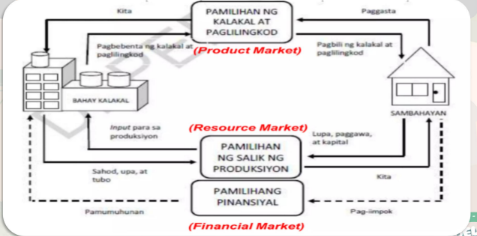
IKAAPAT NA MODELO (includes the government)
this is where they include the government now.
the governent get the tax for public revenues and other public products, they also distrubite the money among the SB and B-K, as another middleman.

IKALIMANG MODELO (contains the panlabas na sektor)
this is the cycle’s final form
includess the exporting of products from BK and importing of SB.
pagluluwas - export
pagaangkat - import
pambansang kita
meaning
it refers to the kita/the money gained by the country to measure their current statue
it comes from 2 different factors
GDP (gross domestic product)
the money earnt INSIDE the country in a given period of time
this also includes the foreign businesses and workers who work in the philippines
ex. a japanese factory in laguna (in laguna, counts to our gdp)
can stand for GAWA DITO PINAS (made here) / where it was made
GNP/GNI (gross national income / gross national product)
it is money earnt by us in different countries in a dictated period of time
this is the OFWs and factories abroad.
ex. a filipino worker working in japan
GAWA NG PINOY / what is the nationality of the person who made it
ways to measure GNI
industrial origin approach (primary industries) / value added approach
includes the primary industries and NFIFA to our GNI.
NFIFA (net factor from abroad)
or NPI, get this by subtracting OFW spendings to foreigner spendings in PH.
formulas (ais is the primary industries, nfifa if
A+I+S = GDP / GDP + NFIFA = GNI
expenditure approach (the four main sectors) / pamaraan batay sa gastos
it includes and focuses on the 4 main industries
forumulas
GNP = C+I+G+(X-M)+SD+NFIFA
C - personal spending
I - spending for commodities
G - spending of the government
(X-M) - spending of the panlabas na sektor
SD - spending not recorded (no receipt or documentation)
factor income approach (the government + companies pay)
it is combining the government + the companies + their workers with cca and ibt
formulas
NI = KEA + KG + KEM + KK
GNI = NI + CCA + IBT
NI = national income
KEA - entrepreneurship money
KG - government money
KEM - employee benefits
KK - corporation earnings
CCA - allowance for depresasyon (capital consumption allowance)
IBT - the taxes for products and services (indirect business tax)
suliraning pangekonomiya
suliranin (wotd)
it means a problem, issue, and challenge
it needs to have a solution
when does a economic crisis turn into a problem?
when it effects the persons kita, status of life, and ability to buy their basic needs.
3 major economic problems
unemployment, kahirapan, inflation
unemployment (the loss of job)
it is defined as a person who does not have a job, but they are actively searching and fnding one.
different concepts of unemployment
marginally attatched the labor force (lazy ppl)
they are people without jobs, ready for one, but are not actively finding one
they might be due to a multitude of reasons
ex. PWDs, those who have retired, or medical or personal issues.
underemployment (more work hours)
there are people who work more to compensate for their pay or their overqualification.
ex. overqualified, not good pay, part time workers.
job mismatch (not correct job)
these are people who studied for something, but did not end up in the desired field they studied for
ex. studying to be a medtech doctor to only be a 7/11 cashier
the reasons of unemployment or job loss (PSO)
population growth (P)
it is due to the rising population, accomodating for more jobs and less oppurtunity
labis na supply ng lakas-paggawa (S)
there are more people finding jobs rather than actual positions
pagkawala ng oppurtunidad (O)
it is the lostt of oppurtunity to find jobs.
EFFECTS (not really necessary)
no pay, basic needs, debt, no job, hard to find jobs due to problems
what we need to do to fix
improving our education system
technical vocational skills, work immersion, career guidance
making more jobs
supporting local businesses for more job openings.
government programs to help solution this
GIP (governent internship program) / internships
it is giving students internships in public offices and in the government
SPES (special program for employment of students) / meanwhile jobs
it is giving jobs to students, pagkasamantalang trabaho
also helping the family of the students for their studies by giving them money.
TESDA (technical educational skills development authority) skills training and certification
it is giving people technical vocational skills to help use it to find a job
more qualifications and more skills to learn in different courses.
TUPAD (tulong paghanapbuhay sa ating mga displaced/disadvantaged workers)’
it is giving work for pay jobs for those in need or disadvantaged
for the needy, displaced people that lost their jobs.
nangangailangan
PESO (public services employment office) / help in finding a job.
it is guidance, counseling, to help jumpstart and to find a job.
information and job fairs.
the ways to lessen unemployment (PTR) !!!
panghikayat ng pamunuhan (saving)
paglikha ng mga trabaho (jobs)
retraining programs.
implasyon
halaga (wotd)
which means value, price, and the means of an object
implasyon
it is the growth of price through a lot of products in an economy in a given period of time
this can lead to problems in the market to even black markets.
types of inflation
there are 2 types of inflation
based on the price rise
creeping inflation (<3%)
it is the rate of inflation under 3%
barely noticable
walking inflation (3%<10%)
it is a bit more noticable but not too massive
below 10, higher than 3
galloping inflation / walking (10%<50%)
it is way more noticable now and is fast
it is above 10%
products cannot be bought normally anymore due to the rise in inflation and the budget keepign the same.
hyperinflation (50%<)
it is the fastest rise of products
50% and above
based on the source
demand pull (the demand is higher than the supply)
the demand is higher than the supply
the seller then rises the prices for more profit
cost-push (due to rising commodity prices)
the prices of raw material the and the price to make them goes up
the seller needs to up the prices to support more production
wage-price sprial (built in inflaition)
it is due to workers wanting more wage due to the rising prices of products
they get paid more, the owner then doesnt have enough money for production, raising prices (cycle continuation)
inflation rate formula
p2-p1/p1 × 100 = inflation rate
the effects of inflation
purchasing price of money goes down / cannot buy that much anymore.
the vlaue of one peso before is not the same as the value now
effect on people with fixed incomes
even as the prices and needs of living goes up, the money you get is constant
ex. people with pension, the price of money before was enough, not anymore.
ways to fight against inflation (GUI)
gumawa ng badyet plan (budget plan)
unahin ang pangunahin bilhin (only buy basic needs)
iwasan bumili ng mga hindi kailangan (dont buy what oyu dont need.)
kahirapan
pagkakataon (wotd)
it is opprutunity, a situtation that you can achieve something
kahirapan
it is defined as your pay not being enough to buy your pangunahing kailangan or basic needs
there are 3 different types of poverty
extreme poverty (matinding kahirapan) / you ant reach any of your basic needs
this is where your pay/kita cannot buy you or your families basic needs
you do not break or reach the food threshold
food threshold
a mark where a person or family can eat meals that can fill them up and have sustinence
moderate poverty (katamtamang kahirapan) / you can reach some of your basic needs
this is where your pay is enough to buy some of your basic needs
BUT NOT ALL, due to some being too expensive for you to buy with you other basic needs.
ex. you can buy your food, but not your sons education
poverty threshold
a mark where you can measure what you have and see what primary needs you have
ex. clothes, house, water and electricity, good health, and other needs.
relative poverty (relatibong poverty) / you have a lower statue than everyone else where you live.
this is where you reach most of your basic needs BUT
you have a lower status that the regular status in your area
basically you are below average in your community
masmababang antas
the psa made the MPI (multidimensional poverty index)
this helps state if you are plausible or still underprivildged and deprived.
do you meet education, health, and a proper home environment?
siklo ng kahirapan (the cycle of poverty)
is a neverending cycle of a family or individual’s bloodline and family to be kept in hardship for a long time
through a span of different generations, due to not that much oppurtunity
reasons and effects of kahirapan (ETKOP)
kakulangan sa edukasyon (E)
pagkawala ng trabaho (T)
mababa o hindi sapat na kita (K)
limitadong opprutunidad (O)
kakulangan sa pangunahing pananangailangan
ways to fight kahirapan (PTET)
mga programang pangkabuhayan (P)
pagagawa ng opprutunidad sa trabaho (T)
mapalawak ang access sa edukasyon (E)
itulong ang mga pamilya na nangangailangan (T)
unecessary causes
no education, no trabaho, not equal distruvtion of wealth, corruption, and natural claamities and climate.
unecessary effects
malnutrition, no education, health problems, not formal jobs, decrease in safety.
who will help us?
pamahalaan, pribadong sektor, mamayan, komunidad
for the essay: community-government led social programs that promore businesses, job fairs, and other skills to help familes, also this is open public counciling whenever.