Mastering the ACT Writing Domain: Ideas and Analysis
Unleashing High-Scoring Arguments on the ACT
To achieve a top score on the ACT Writing test, you must master the Ideas and Analysis domain. This domain measures your ability to generate productive ideas that critically engage with multiple perspectives on a given issue. It is not enough to simply state an opinion; you must situate your opinion within the broader context of the debate.
Generative Strategies: From Prompt to Productive Ideas
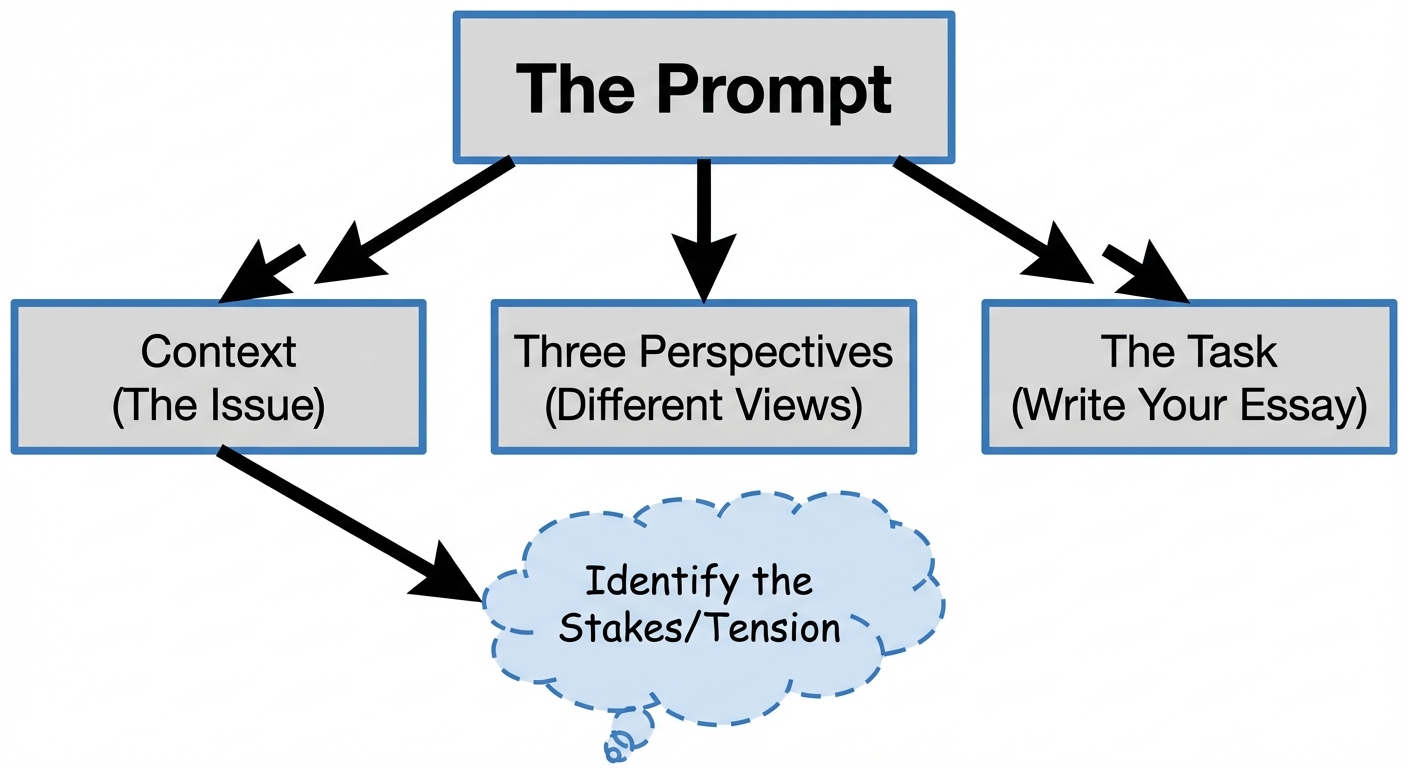
Before you write a single sentence of your essay, you must deconstruct the prompt. The ACT writing prompt consists of three parts: the Context (a paragraph introducing a modern issue), Three Perspectives (different viewpoints on that issue), and the Writing Task.
High-scoring ideas are productive—meaning they move the conversation forward rather than just repeating the prompt.
Analyzing the Context Paragraph
Your opening lines must demonstrate that you understand the stakes of the issue. Why are we debating this topic now? Who is affected?
- Scope: Is this a global problem (e.g., Climate Change) or a personal one (e.g., Creativity)?
- Tension: What two values are at odds? (e.g., Efficiency vs. Privacy, Tradition vs. Progress).
The "Yes, But…" Strategy
To generate ideas that are complex rather than simple, avoid binary thinking. Instead of thinking "Is this good or bad?" ask "In what situation is this good, and at what cost?"
Example Scenario:
- Topic: Intelligent Machines.
- Simple Idea: Robots take our jobs, so they are bad.
- Productive Idea: While automation displaces specific labor sectors, it forces humanity to redefine work around creativity and empathy, qualities machines cannot replicate.
Engaging Critically with Multiple Perspectives
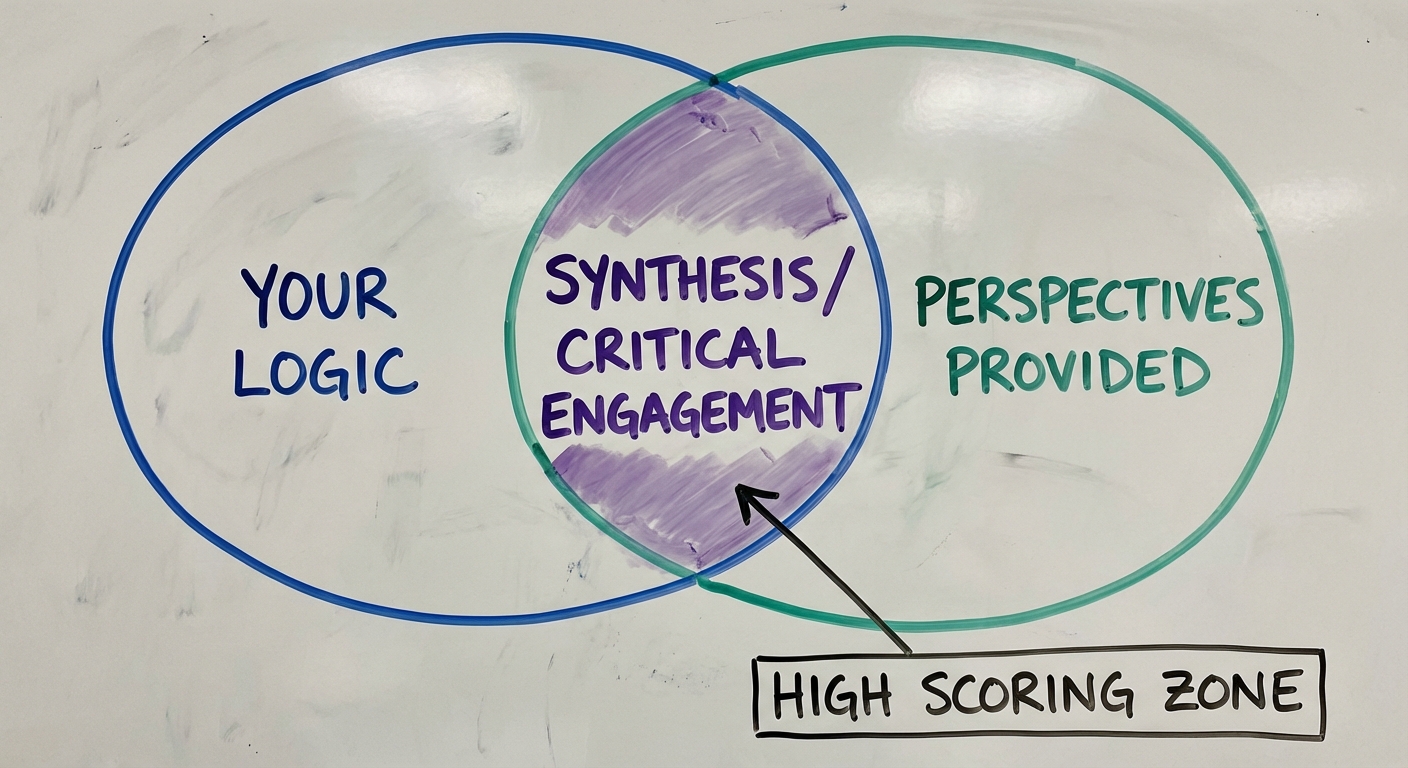
A critical requirement of the Ideas and Analysis score is that you must address the perspectives provided in the prompt. Ignoring them limits your score ceiling significantly.
Relationship with Suggested Perspectives
You are not required to treat every perspective equally, but you must analyze their relationship to your own stance. You can interact with them in three ways:
- Agreement (Corroboration): You align with the perspective but provide new evidence to support it.
- Disagreement (Refutation): You reject the perspective by exposing a logical flaw, a false assumption, or a negative consequence.
- Qualification (Synthesis): You agree with part of the perspective but disagree with another part, or you agree only under specific conditions.
| Engagement Strategy | Action | Key Transitional Phrases |
|---|---|---|
| Corroborate | Support the given view with independent reasoning. | "Perspective 1 correctly identifies that…" / "This aligns with the reality that…" |
| Refute | Dismantle the view using counter-examples. | "While Perspective 2 aims to protect X, it fails to consider Y…" / "This view relies on the false assumption that…" |
| Synthesize | Combine elements to form a nuanced view. | "Perspective 3 offers a compelling vision, yet it overlooks…" / "We can accept X provided that we also address Y…" |
Mapping the Logic
Think of the engagement as a mathematical relationship. If your position is $Thesis$ and the provided viewpoint is $P_1$:
- Weak Analysis: $Thesis$ exists; $P_1$ exists separate from it.
- Strong Analysis: because [reasoning].
- Strong Analysis: because [evidence].
Establishing a Clear Thesis and Position
Your Thesis Statement is the anchor of the Ideas and Analysis domain. It must be a precise claim that establishes your perspective on the issue. It is usually placed at the end of your introductory paragraph.
The Components of a High-Scoring Thesis
A score of 5 or 6 requires a thesis that is nuanced. It should not be a flat statement of fact. It needs to contain a claim and a forecast of your argument's complexity.
Formula for a Nuanced Thesis:
- Concession: Acknowledge the validity of the opposing side (Builds ethos).
- Assertion: Your main stance.
- Rationale: The "because" or "so that" element detailing the underlying value.
Worked Example
Prompt: Should high schools maximize the use of automated education tools?
Low-Level Thesis: "Schools should not use automated tools because they hurt student learning."
- Critique: Too simple. Lacks analysis or specific direction.
High-Level Thesis: "Although automated tools offer unprecedented efficiency in data retention (Concession), schools must prioritize human instruction (Assertion) because education is fundamentally about social development and critical discourse, not just fact acquisition (Rationale)."
- Critique: This thesis sets up a complex comparison between efficiency and social development.
Understanding Purpose and Audience
Students often write the ACT essay as if they are talking to a friend or writing a blog post. To score well in Analysis, you must adopt the persona of an academic observer.
The Audience
Your audience is a panel of educators who value logic, clarity, and objectivity. They do not value emotional diatribes or extreme generalizations.
The Purpose: Persuasion via Analysis
Your goal is to persuade the reader that your perspective is the most valid. However, you achieve this through logos (logic) rather than pathos (emotion).
- Avoid: "It is a tragedy that we are losing our traditions!"
- Adopt: "The erosion of tradition disrupts the intergenerational continuity necessary for community stability."
Tone Check
- Avoid Absolutes: Words like always, never, everyone, and perfect often signal a lack of critical thinking. Real-world issues are rarely black and white.
- Use Qualifiers: Words like often, tends to, predominantly, and in many cases show that you understand the complexity of the issue.
Common Mistakes to Avoid
Even strong writers can lose points in the Ideas and Analysis domain by falling into these traps:
- The "List Trap": Dedicating one paragraph to Perspective 1, one to Perspective 2, and one to Perspective 3 without ever establishing your own distinct argument. You must use the perspectives to build your argument, not just summarize them.
- Drifting Thesis: Starting with one opinion (e.g., "Technology is good") but ending with another (e.g., "Technology is dangerous") without explaining the shift. Your ideas must be cohesive.
- Personal Anecdote Overload: While a personal story can be a hook, relying entirely on personal experience ("My uncle hates computers…") is often insufficient for a high score. You need broader cultural or historical analysis.
- The "Fence Sitter": refusing to take a position. You can see both sides, but you must ultimately prioritize one view or outcome over the other. A conclusion that says "everyone is right" is usually weak analysis.
Summary Checklist for Ideas and Analysis
- [ ] Did I clearly state a position in the introduction?
- [ ] Did I address all three perspectives provided in the prompt?
- [ ] Do I explain why I agree or disagree with those perspectives?
- [ ] Is my argument consistent from start to finish?