Lecture 3 – TUL 1
Types of Mechanical Loads
the body experiences various mechanical forces daily:
tension: pulling or stretching forces
compression: pushing or crushing forces
shear: forces that cause layers to slide past each other
torsion: twisting forces
bending: combination of tension and compression
tissues adapt their structure and function based on the loads they experience
Collagen: The Major Tensile Molecule
42 genes in the human genome encode distinct collagen chains
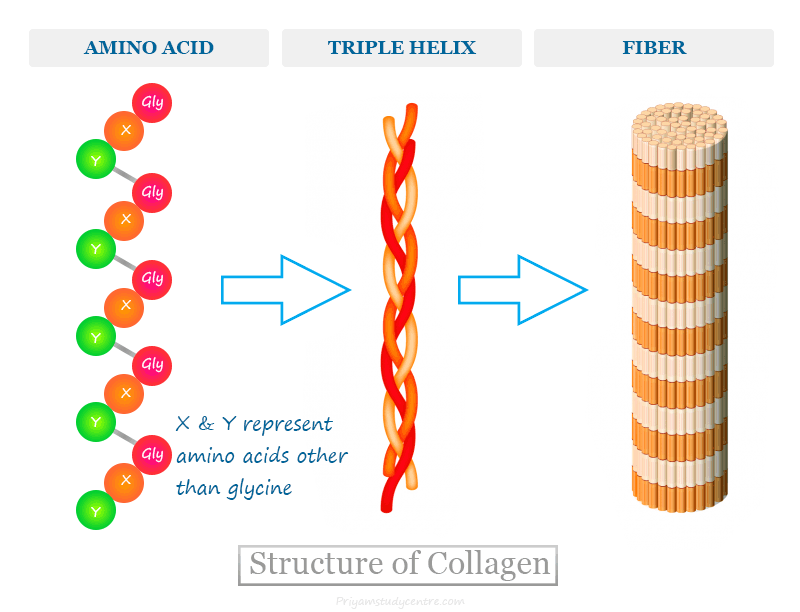
all collagens share a common property: they’re formed from a triple helix of alpha-chains
the repeating amino acid sequence is Gly-X-Y
X is often proline
Y is often hydroxyproline
Collagen Synthesis
Synthesis of pro-alpha chain:
contains Gly-X-Y repeats; synthesised in the rough ER
Self-assembly of three pro-alpha chains:
three chains wrap around each other
Pro-collagen triple helix formation:
formation of pro-collagen molecule with pro-peptide ends; secreted into ECM
Cleavage of pro-peptide:
pro-peptides are removed by proteases outside of the cell
Self-assembly into fibril:
collagen molecules assemble into fibrils (visible banding pattern on EM)
Aggregation into fibre:
fibrils bundle together to form larger collagen fibres
vitamin C is essential for lysyl hydroxylase, the enzyme that hydroxylates proline and lysine, enabling proper coiling
Collagen-Related Diseases
Scurvy (Vitamin C Deficiency)
Lack of vitamin C → impaired hydroxylation of proline and lysin → unstable collagen triple helix
Rotten teeth, bleeding gums, bleeding from mucous membranes, bowed legs
Areas with high collagen turnover is affected most
Osteogenesis Imperfecta
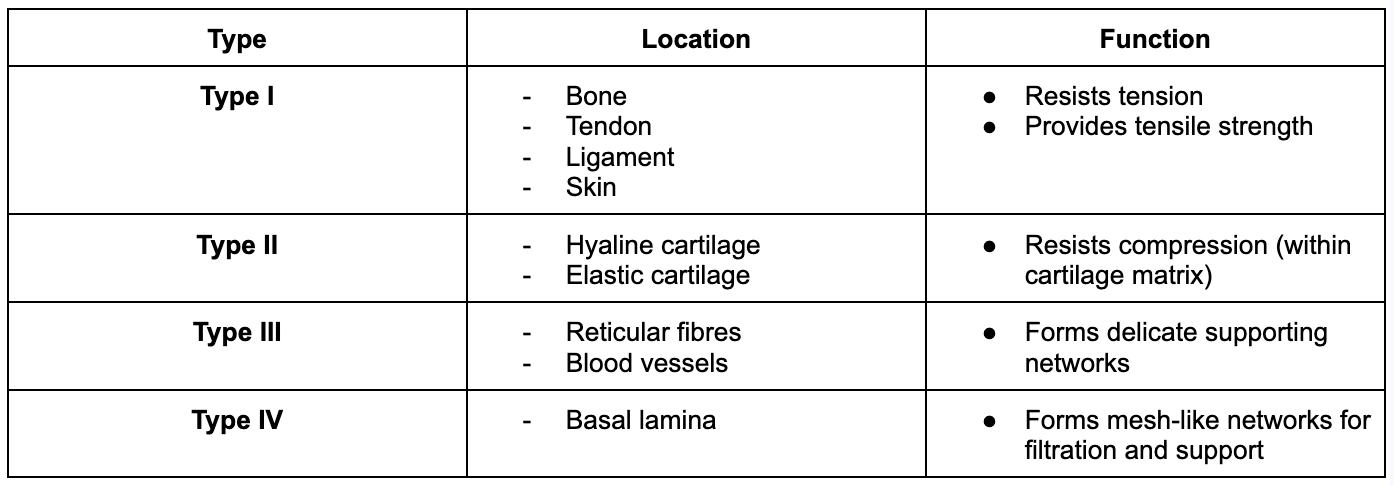
Genetic mutation in genes encoding collagen type I
pathology: insufficient and poor-quality collagen (improper coiling)
brittle bones, bone deformities, weak tendons, abnormal teeth/skin, hearing loss, blue sclerae
ranges from mild to severe/debilitating
debilitating: (of a disease or condition) making someone very weak and infirm
Stickler Syndrome
Genetic mutation in COL2A1 gene → defective collagen type II
flattened facial appearance (underdeveloped bones), nearsightedness, hearing loss, early-onset osteoarthritis and joint pain
Proteoglycans: The Soluble Polymers
a proteoglycan consists of a core protein + one or more covalently attached glycosaminoglycan (GAG) chains
GAG Characteristics
long, linear carbohydrate polymers
negatively charged due to sulphate and uronic acid groups
consists of repeating disaccharide units
function: fill space, act as hydrated gels, resist compression
Hyaluronan (Hyaluronic Acid)
the only GAG that’s not sulphated
ubiquitously expressed in the body
binds large amounts of water → important for tissue hydration, joint lubrication, and molecular diffusion

Aggrecan: Key Load-Bearing Proteoglycan
major proteoglycan of cartilage
rich in chondroitin sulphate and keratan sulphate GAGs
forms large aggregates by binding to hyaluronan (HA) via link protein
highly negatively charged → attracts water → forms a stiff gel
provides resistance to compressive loads in cartilage and intervertebral discs
loss of aggrecan occurs in osteoarthritis
ECM Turnover and Remodelling
cells produce and degrade ECM via proteases
collagenases: break down fibrillar collagen
ADAMTS: break down proteoglycans
ECM degradation and replacement occurs throughout life; dysregulation leads to disease