Nutrition Notes
Chapter 1-2 (half notes)
Nutrients- compounds in foods that sustain your body processes. 6 classes of nutrients: carbohydrates, fats (lipids), proteins, vitamins, minerals, and water.
Kilocalories - The measurement of energy in foods. Commonly referred to as calories.
Metabolism - the numerous reactions that occur within the cell. The calories in foods are converted to energy in the cells of the body.
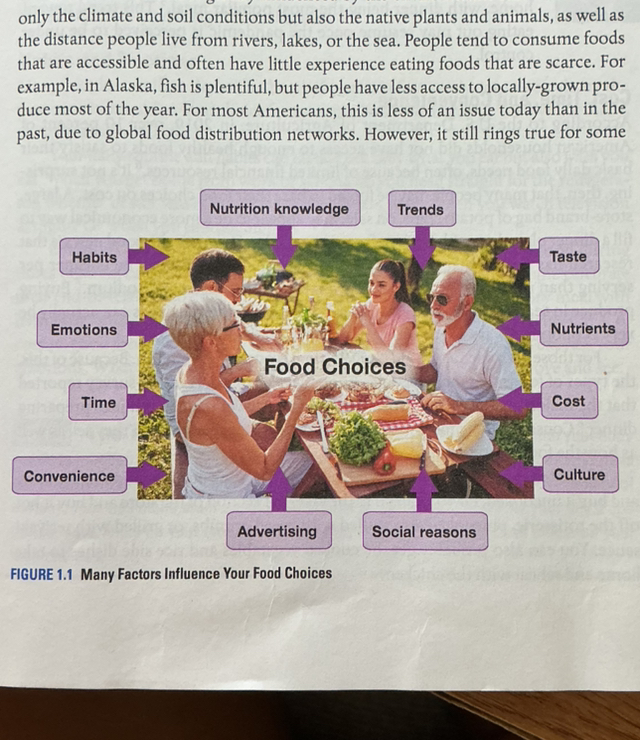
What makes up our food choices ↑
Learning outcomes ↓
LO 1.1 - Factors that influence your food choices: Food provides the nutrients that your body needs to function, and foods that are chosen are influenced by many factors. Taste is why our favorites are favorites. The availability of certain foods can make your culture be a habitual part of your day. Food trends, cost, limits on your time, convenience, and your emotions all influence food choices.
LO 1. 2 - Define the term nutrition: Scientific study of how the nutrients and compounds in foods nourish your body. Good nutritions reduces the risk of many chronic diseases and conditions. Long-term imbalances of many nutrients affect will your health
LO 1.3 - Differentiate between the 6 categories of essential nutrients found in food and in the body: carbs, lipids (fats), and proteins are called macronutrients because you need higher amounts of them in your diet. Vitamins and minerals -that are equally important- are micronutrients because you need them in lesser amounts. Water is the final nutrient that needs to consumed in great amounts daily to keep you hydrated.
Calories from macronutrients are used as energy during the process of metabolism, and many vitamins, minerals, and water are essential for this process. Vitamins and minerals are also needed for growth and reproduction and to help repair and maintain your body. All are important.
Chapter 3
Digestion - breaking down foods into absorbable components in the gastrointestinal ( GI ) tract. Multistep digestive process, softens with moisture and heat then broke down into smaller particles by chewing and exposure to enzymes.
GI tract: mouth, esophagus, small intestine and large intestine. Outside GI tract are accessory organs - pancreas, liver, gallbladder - that aid in digestion by secreting digestive juices through ducts into the small intestine. Muscular tube that coils and twists from mouth to anus. Nearly 30 feet long in a cadaver. 2 stories long. Cells in GI tract last 3-5 days then they shed into the lumen (interior of the intestinal tract) and replaced with new healthy cells
Main role: digest protein, carbs, and lipids from foods and beverages consumed; absorb the nutrients; provide a physical and immunologic barrier to prevent microorganisms or other harmful compounds consumed with food from entering the tissues of the body; and provide communication with the nervous system through the gut-brain axis.
*Forms of digestion: mechanical and chemical*
Mechanical digestion- chewing, grinding, and breaking food apart and moving it through GI tract.
Chemical digestion- digestive juices and enzymes break down food into absorbable nutrients that are small enough to enter the cells of the GI track, blood, or lymph tissue. Both mechanical and chemical digestion occur occurs in various organs throughout the G.I. tract. The G.I. check uses wave like actions of muscles to digest. The wave like actions are called peristalsis, segmentation, and pendular movement. The peristalsis occurs throughout the G.I. tract. It helps mix food and digestive secretions and propels, mixture now called a bolus from the esophagus through the large intestine. Segmentation and pendular movement occur in the small intestine segmentation is a sloshing motion that thoroughly mixes food with chemical secretions. It’s different from peristalsis because food is shifted back-and-forth along the small intestine to increase the time food comes into contact with the intestinal walls. And you are movement is a constrictive way that involves both forward and reverse movements and enhances nutrition absorption in a small intestine. This moves partially digested semi liquid food, mass, now called chyme at a rate of 1 cm/min.
Lumen – the interior of the intestinal tract through which food passes.
Peristalsis– the forward rhythmic motion that moves food through the digestive system. Peristalsis is a form of mechanical digestion because it influences motion, but does not add chemical secretions.
Pendular movement – a constrictive wave that involves both forward and reverse movements of chyme and enhances nutrition absorption.
Chyme– the semi liquid, partially digested food mass that leaves the stomach and enters the small intestine.
The G.I. chat consist of three segments, the duodenum, jejunum, and ileum which extends from the pyloric sphincterto the beginning of the large intestine. The first segment the duodenum is the shortest portion of the intestine. Followed by the jejunum, and finally, the longest segment the ileum. The dude is the primary site for food digestion within the human body. Most of the absorption of nutrients takes place within the jejunum and ileum.
The interior of the small intestine is covered with small projections called villi. The villi increase the surface area of the small intestine lining and mix the partially digested chyme with the intestinal secretions. Each individual villus is adjacent to a cluster of blood, capillaries, lymph vessels and nerve fibers.
The villi are covered by even smaller projections called micro Vili, which provide additional surface area through which nutrients are absorbed into the blood capillaries and lymph vessels.
Once the chyme has passed through the small intestine, it comes to the ileocecal sphincterwhich serves as a gateway to the large intestine. The purpose of this is to prevent backfill of fecal contents from the large intestine into the ileum.
Chemical digestion that takes place in the large intestine is due to the efforts of bacteria. The large intestine produces mucus that protects the cells and act as a lubricant for fecal matter the sales of the large intestine, absorb water and electrolytes, much more efficiently than do the cell of the small intestine.
Three segments of the large intestine: the cecum, colon and rectum. The cecum is small patch area that has the appendix hanging from one end. The middle section or the colon is the largest portion of the large intestine. (the terms: large intestine are not technically the same thing).