CHAPTER 4 : FORCE SYSTEM RESULTANT
MOMENT OF FORCE (SCALAR FORMULATION)
CROSS PRODUCT
MOMENT OF A FORCE (VECTOR FORMULATION)
PRINCIPLE OF MOMENTS
OBJECTIVE :
Understand and define moment
Determine moment on of a force in 2D/3D cases
MOMENT OF FORCE (SCALAR FORMULATION)
Moment is something similar to torque
Mathematically and dimensionally, yes. Conceptually and contextually, no.
Both share the exact same units and are calculated the same way—as a force multiplied by a perpendicular distance (M = F.d)
1. Torque (The Twisting Action)
Definition: A rotational force specifically applied to cause, change, or resist rotation about an axis.
Context: Dynamics, machinery, power transmission, and kinematics.
Examples:
The turning force of an engine crankshaft.
Tightening a bolt with a torque wrench.
A motor spinning a driveshaft.
2. Moment (The Bending or Rotational Tendency)
Definition: The general measure of the tendency of a force to cause a body to rotate about a specific point or axis, even if the object isn't actually spinning (often resulting in bending or shear instead).
Context: Statics and structural mechanics.
Examples:
A weight on the end of a cantilever beam causing it to bend (a bending moment).
Forces acting on a fixed support where the structure remains completely stationary in static equilibrium.
Summary: The Golden Rule
All torques are moments, but not all moments are torques.
Use torque when you are talking about rotational motion and power transmission (like gears, shafts, and motors).
Use moment when you are talking about static equilibrium, structural analysis, and bending effects (like beams, columns, and supports).
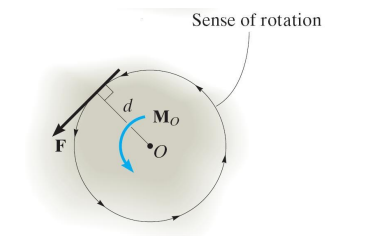
Mo is magnitude(nilai) of a moment
d = distance perpendicular to O
F = force/line of action
Direction of Mo can be either clockwise or counterclockwise.

Varignon’s Theorem : Mo = (Fy .a) - ( Fx b)
Fy = Horizontal component
Fx = Vertical component
a & b = Distance
CCW = + sign
CW = - sign

MOMENT OF FORCE (VECTOR FORMULATION)

Vector Product : Mo = r x F
r : Vector position
F : Force/line of action

well I cant type ts