Sensation & Perception
1. Sensation vs. Perception

Sensation
Sensation occurs when sensory receptors detect stimuli from the environment.
Sensory receptors = specialized neurons that respond to specific types of stimuli.
Receptors convert stimulus energy into neural signals.
This conversion is called transduction.
The resulting action potential travels toward the central nervous system.
Major sensory systems
👁 Vision — seeing
👂 Audition — hearing
👃 Olfaction — smell
👅 Gustation — taste
✋ Somatosensation — touch
⚖ Vestibular sense — balance
🧍 Proprioception — body position
🚶 Kinesthesia — movement
🔥 Nociception — signals of potential harm/pain
🌡 Thermoception — temperature
Perception
Perception is the way sensory information is interpreted, organized, and consciously experienced.
Two major types of processing:
Processing | Meaning |
Bottom-up | Perception is built from sensory information |
Top-down | Knowledge, experience, and expectations influence interpretation |
Easy way to remember:
Bottom-up = data → interpretation
Top-down = knowledge → interpretation
2. Absolute Threshold & Just Noticeable Difference
Absolute threshold
The minimum amount of stimulus energy needed for a stimulus to be detected 50% of the time.
Example:
Extremely sensitive visual receptors can detect a candle flame from a great distance on a clear night.
Subliminal messages
A stimulus can sometimes produce an action potential without reaching conscious awareness.
Just noticeable difference (JND)
The minimum difference between two stimuli that can be detected.
Example:
A phone screen lighting up in a dark theater is easier to notice than the same screen lighting up in a bright shopping mall.
⭐ Remember
Absolute threshold = Can I detect it?
JND = Can I detect the change?
3. Factors That Affect Perception
1. Sensory adaptation
A decrease in perception of a stimulus that remains relatively constant over time.
Example:
You enter a room and initially notice a clock ticking. After several minutes, you may stop noticing it even though the clock is still making the same sound.
2. Attention
What we pay attention to influences what we perceive.
Inattentional blindness = failing to notice something that is clearly visible because attention is focused elsewhere.
3. Motivation
What we want or expect can influence what we perceive.
Example:
Someone waiting for an important phone call might think they hear their phone ringing when it isn’t.
4. Beliefs, values & expectations
Existing attitudes can influence sensory judgments.
5. Culture & life experience
Our experiences and cultural backgrounds can influence how we interpret sensory information.
4. Müller-Lyer Illusion
The Müller-Lyer illusion demonstrates that perception can differ from physical reality.
Two lines can be the same actual length.
The arrows at the ends make one line appear longer.
Cultural and environmental experiences can influence susceptibility to certain visual illusions.

🌊 5. Waves: Amplitude, Wavelength & Frequency
Visual and auditory stimuli can occur as waves.

Amplitude
The height/intensity of a wave.
Wavelength
The distance from one wave peak to the next.
Frequency
The number of waves passing a point during a given amount of time.
Measured in hertz (Hz)
Long wavelength → low frequency
Short wavelength → high frequency
👁 6. Vision & Light
Humans see only a small portion of the electromagnetic spectrum.

Visible light
Humans can see approximately:
380–740 nm
Wavelength & color
Wavelength | Perceived color |
Longer | Reds |
Intermediate | Greens |
Shorter | Blues/violets |
Amplitude & brightness
Greater light-wave amplitude → brighter/more intense color.
👁 7. Anatomy of the Visual System
Light follows this general pathway:
Cornea → Pupil → Lens → Retina/Fovea → Optic nerve → Brain

Cornea
Allows light to enter the eye.
Pupil
Opening through which light enters.
Iris
Colored portion of the eye that controls pupil size.
Lens
Focuses incoming light onto the retina.
Fovea
Contains photoreceptors and provides high-acuity vision.
Optic nerve
Carries visual information toward the brain.
Blind spot
Area where the optic nerve exits the eye.
Contains no photoreceptors.
Therefore, visual information cannot be detected at that exact location.
🔵 8. Rods vs. Cones
Feature | Rods | Cones |
Best conditions | Dim/night | Bright/day |
Sensitivity | High | Lower |
Color | Limited | Color vision |
Acuity | Lower | High |
Location | Retina periphery | Fovea |
Movement | Important for peripheral movement | Less important |
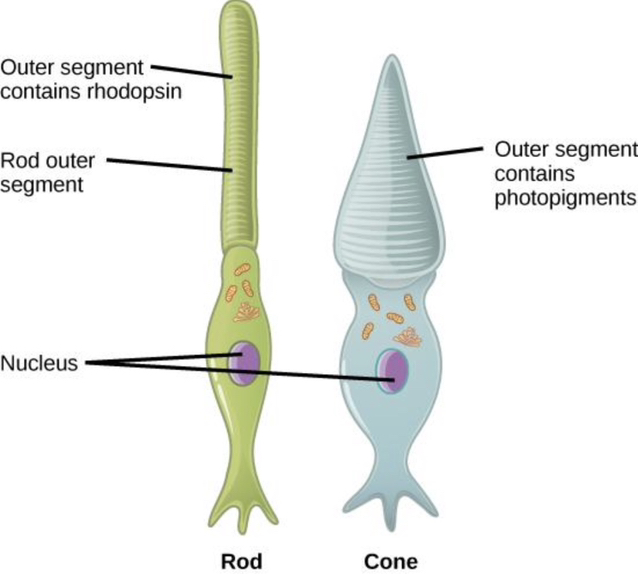
Rods
Scotopic vision = nighttime/dim-light vision.
Very sensitive to light.
Help detect movement in peripheral vision.
Cones
Photopic vision = daytime vision.
Work best in bright conditions.
Provide detailed, high-acuity color vision.
Concentrated in the fovea.
🧠 Memory trick
Rods = Road at night
Cones = Color
🧠 9. Optic Chiasm
The optic nerves from the two eyes meet at the optic chiasm.
Important pathway:
Eyes → Optic nerves → Optic chiasm → Occipital lobe
Information from the right visual field goes to the left hemisphere.
Information from the left visual field goes to the right hemisphere.
Visual processing occurs in the occipital lobe.

👀 10. Visual Pathways: WHAT vs. WHERE/HOW
After visual information is processed in the occipital lobe, it travels through two pathways.
“WHAT” pathway
Responsible for:
Object recognition
Object identification
“WHERE/HOW” pathway
Responsible for:
Location of objects in space
How we might interact with an object
🧠 Memory trick
WHAT = What am I looking at?
WHERE/HOW = Where is it and how do I interact with it?
🌈 11. Color Vision
There are two major theories discussed in the slides.

Trichromatic Theory
The retina contains three types of cones sensitive to different wavelengths.
The three primary cone categories correspond to:
Red
Green
Blue
The brain combines their activity to produce our perception of many different colors.
Opponent-Process Theory
Color is processed in opposing pairs:
Black ↔ White
Yellow ↔ Blue
Green ↔ Red
Some cells are excited by one color and inhibited by its opponent.
Afterimages
An afterimage is a visual sensation that continues after the original stimulus has been removed.
Staring at a colored stimulus can produce an afterimage involving the opposing color.
⭐ Exam tip
Both theories are supported, but they apply to different parts of the visual system.
📏 12. Depth Perception
Depth perception = ability to perceive spatial relationships in three dimensions.
Binocular cues
Require both eyes.
Binocular disparity
Each eye receives a slightly different view of the world.
The brain uses these differences to help determine depth.
Monocular cues
Require only one eye.
Examples from the slides:
Linear perspective
Parallel lines appear to converge as they get farther away.
Interposition
If one object partially blocks another, the blocking object is perceived as being closer.
👂 13. Sound & Hearing
Sound frequency = Pitch
High frequency → high pitch
Low frequency → low pitch
Sound amplitude = Loudness
Higher amplitude → louder
Lower amplitude → quieter
Loudness is measured in decibels (dB).
Examples from the slides:
Typical conversation ≈ 60 dB
Rock concert ≈ 120 dB
Potential hearing damage ≈ 80–130 dB
Pain threshold ≈ 130 dB
👂 14. Anatomy of the Auditory System

The ear has three divisions:
Outer ear
Pinna
Tympanic membrane
Middle ear
Three ossicles:
Malleus
Incus
Stapes
Inner ear
Cochlea
Basilar membrane
🔊 15. Auditory Transduction
The basic sequence is:
Sound waves → Auditory canal → Tympanic membrane → Ossicles → Cochlea → Hair cells → Auditory nerve → Brain
Step-by-step
Sound enters the auditory canal.
Sound waves hit the tympanic membrane.
The eardrum vibrates.
The three ossicles move.
The stapes presses against the oval window.
Fluid in the cochlea moves.
Hair cells are stimulated.
Hair cells generate neural impulses.
Signals travel through the auditory nerve.
The brain processes the sound.
🎵 16. Pitch Perception
There are two major theories.
Temporal Theory
Frequency is represented by the activity rate of sensory neurons.
Problem: Neurons cannot fire rapidly enough to represent the entire range of frequencies humans can hear.
Place Theory
Different parts of the basilar membrane respond to different frequencies.
Base → high frequencies
Tip → low frequencies
Both theories help explain pitch perception.
📍 17. Sound Localization
We determine where sounds come from using information from the ears.
Monaural cues
Use one ear.
Binaural cues
Use both ears.
Two important binaural cues:
Interaural level difference
Sound is more intense at the ear closest to the sound source.
Interaural timing difference
Sound reaches one ear slightly before the other.
🦻 18. Hearing Loss
Conductive hearing loss
Problem with the mechanical transmission of sound.
Can involve:
Eardrum
Ossicles
Hearing aids may help by amplifying incoming sound.
Sensorineural hearing loss
Problem transmitting neural signals from the cochlea to the brain.
Possible causes include:
Age
Genetic factors
Certain illnesses/infections
Autoimmune disorders
Repeated exposure to loud sounds
🧠 Memory trick
Conductive = conduction of sound is disrupted
Sensorineural = sensory/neural pathway is disrupted
👅 19. Taste — Gustation
The slides identify approximately six groupings of taste:
Sweet
Salty
Sour
Bitter
Umami
Possible fatty taste
Taste buds
Taste buds contain groups of taste receptor cells.
The receptor cells have hair-like extensions that extend toward the central pore.
Taste transduction
Taste molecules → receptors → chemical changes → neural impulses → brain
Taste receptor cells have a relatively short life cycle of approximately 10 days to 2 weeks.

👃 20. Smell — Olfaction
Olfactory transduction
Odor molecules → receptors → chemical changes → olfactory bulb → limbic system/olfactory cortex
Olfactory receptor cells contain hair-like extensions where odor molecules interact with chemical receptors.
Pheromones
Chemical messages released by another individual.
The slides note that many species respond to pheromones, often involving information about reproductive status.

✋ 21. Touch
Different receptors in the skin respond to different forms of touch.
Receptor | Detects |
Meissner’s corpuscles | Pressure & lower-frequency vibrations |
Pacinian corpuscles | Transient pressure & higher-frequency vibrations |
Merkel’s disks | Light pressure |
Ruffini corpuscles | Stretch |
🌡 22. Temperature & Pain
Thermoception
Perception of temperature.
Nociception
Sensory signaling that indicates potential harm and may produce pain.
These signals travel through the spinal cord toward the brain, including the:
Medulla
Thalamus
Somatosensory cortex
🔥 23. Pain Perception
Pain motivates us to move away from potentially damaging stimuli.
Inflammatory pain
Signals tissue damage.
Neuropathic pain
Caused by damage to neurons in the:
Peripheral nervous system, or
Central nervous system
Congenital insensitivity to pain
A rare genetic condition in which a person is born without the ability to experience pain.
These individuals can still detect temperature and pressure but don’t experience pain normally.
⚖ 24. Vestibular Sense
Vestibular sense contributes to:
Balance
Body posture
Detecting head movement
Responding to gravity
The sensory organs are located near the cochlea in the inner ear.
They contain:
Fluid
Hair cells
The hair cells respond to movement of the head and gravitational forces.
Maculae
Specialized for sensing linear acceleration, such as:
Tilting the head due to gravity
Moving the head in a straight line

🧍 25. Proprioception & Kinesthesia
Proprioception
Perception of body position.
Example:
Knowing where your arm is even when you can’t see it.
Kinesthesia
Perception of body movement through space.
Example:
Knowing that your arm is moving upward with your eyes closed.
Both interact with information from the vestibular system.
🧠 Memory trick
PROprioception = PROper body position
KINesthesia = KINetic movement
🧩 26. Gestalt Principles of Perception
Gestalt psychology proposes that the whole is different from simply adding up its individual parts.

The brain organizes sensory information in predictable ways.
Five major principles in the slides:
Figure-ground
Proximity
Similarity
Continuity
Closure
Figure-Ground
We separate a visual scene into:
Figure = object that is the focus
Ground = background
Our perception can switch depending on what we consider the figure.
Example: the vase/faces illusion.
Proximity
Objects that are close together tend to be perceived as belonging together.
Memory trick:
Proximity = nearby = grouped
Similarity
Objects that look alike tend to be grouped together.
Memory trick:
Similarity = same appearance = same group
Continuity
We tend to perceive smooth, continuous lines rather than broken or jagged ones.
Memory trick:
Continuity = keep the line going
Closure
We tend to perceive complete objects, even when portions are missing.
Memory trick:
Closure = brain closes the gaps
🧠 27. Implicit Bias & Perception
The final section emphasizes that perception isn’t determined only by sensory information.
Perception can also be influenced by:
Experiences
Biases
Culture
The slides present research concerning how racial stereotypes can influence perceptions of children and discuss possible implications for settings such as law enforcement, education, and juries. The specific study described in the slides involved 264 university students and reported differences in perceived age and innocence of Black versus White children.
Important concept
Perception is not always an objective reflection of the physical stimulus.
Our brain interprets sensory information using previous experiences, expectations, attention, and other influences.
⭐ Chapter 5 Must-Know Terms
Term | Definition |
Sensation | Detection of sensory stimuli |
Transduction | Conversion of stimulus energy into neural signals |
Perception | Interpretation and organization of sensory information |
Absolute threshold | Minimum stimulus energy detected 50% of the time |
JND | Minimum difference needed to detect a change |
Sensory adaptation | Reduced perception of a constant stimulus |
Inattentional blindness | Failure to notice something because attention is elsewhere |
Amplitude | Wave height/intensity |
Wavelength | Distance between wave peaks |
Frequency | Number of waves per unit of time |
Rods | Photoreceptors specialized for dim-light vision |
Cones | Photoreceptors specialized for color/high-acuity vision |
Optic chiasm | Location where optic nerve pathways cross |
Conductive hearing loss | Problem transmitting sound mechanically |
Sensorineural hearing loss | Problem transmitting neural signals from cochlea to brain |
Vestibular sense | Balance and body-position information |
Proprioception | Perception of body position |
Kinesthesia | Perception of body movement |
Gestalt psychology | Approach emphasizing organization of perceptual information |