Fluid Dynamics
Equations
density = mass / volume
pressure = force / area = (density)(gravity)(height)
absolute pressure = atmospheric pressure + gauge pressure
Buoyant Force = (volume of fluid displaced) (density of fluid) (g)
Mass flow rate (m / t) = density (Area) (velocity)
Area1(Volume1) = Area2(Volume2)
Q = Av Volume Flow rate
P1 + rho g h + ½ rho v² = P2 + rho g h + ½ rho v²
1atm = 101 kPa = 101000 pa
density of water = 1000 kg / m³
density of oil = 900
Density is a property, changing volume or mass will not change the density
Density is set so changing 1 variable will change the other as well
Same depth same pressure, force and area will not always be the same tho
Hydraulics - pressure in = pressure out = force / area (in) = force / area (out)
F_in / A_in = F_out / A_out
When there is neutral buoyancy (an object stays at rest) it has the same density of the fluid
Specific gravity = density of object / density of water
specific gravity = rho object / pho water
Volume Displaced / Volume object = Density object / density of fluid
V displaced / V object = rho object / rho fluid
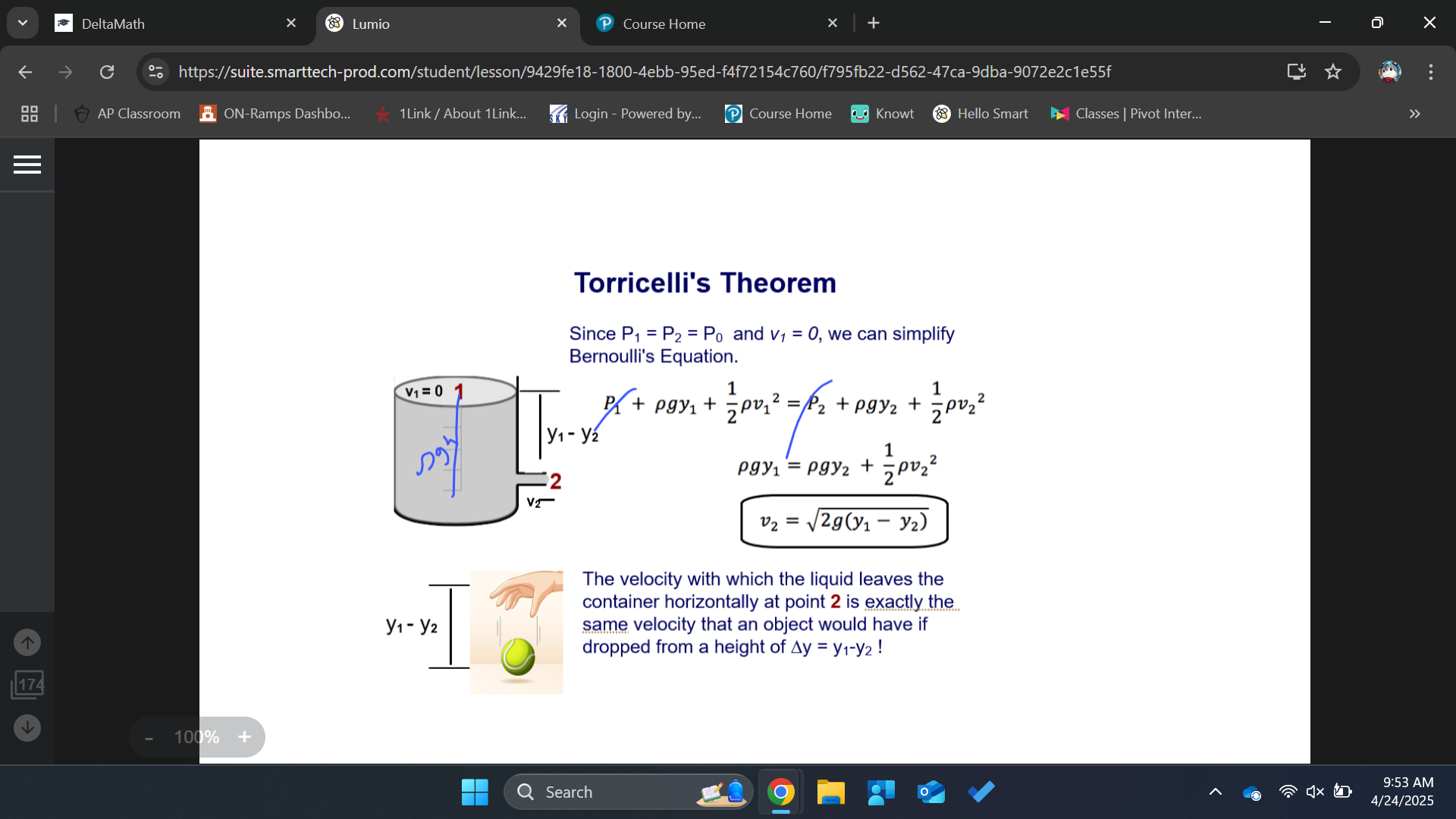
v = root 2 g (diff in h)
stream lines: closer = faster, velocity is tangent, lines never cross
Fluid Dynamics: Force proportional to pressure, lower velocity higher pressure, higher velocity lower pressure
FRQ REFLECTION
neutral buoyancy - density of object is equal to the density of fluid
Use forces to solve buoyancy problems, most of the time they will be at equilibrium meaning acceleration = 0 and forces are equal UNLESS IT SAYS SINK OR RISE
to confirm the density of an object (like to see if its real gold) solve for the buoyant force → use the buoyant force equation to solve for volume → plug into density equation
when given a percentage of volume floating use the V flu / V obj = Den obj / Den flu to solve for the objects density
free body diagrams for this unit are most of the time just W and FB with equal magnitude
be sure to include the total mass of the system when solving problems, unless it says negligable
REMEMBER TO USE KINEMATICS IT CAN BE USED TO FIND HEIGHT AND ACCELERATION
pressure will have a concave down graph with increasing height over time
ALWAYS REMEMBER TO CONNECT FORCES TO ACCELERATION AND ACCELERATION TO TIME
Bernouli’’s principal is similar to energy approach
USE FORCES AND ENERGY APROACH FOR MANY PROBLEMS SOMETIMES KINEMATICS
deriving velocity of water tank questions
similar to energy aproach
pgh = ½ p v²
gh = ½ v²
2gh = v²
root 2gh = v