sociology research methods
research
strengths and weaknesses
primary data: secondary data:
-expensive -less specific to needs
-time consuming -less reliable
-specific to researchers needs -cheap
-more reliable -takes less time
sampling methods : (see in first few pages of book for more info)
random sampling- researchers randomly choose participants from a population. All population members have an equal probability of being selected. This method tends to produce representative, unbiased samples.
stratified sampling- obtaining a representative sample from a population that researchers have divided into relatively similar subpopulations. Researchers use stratified sampling to ensure specific subgroups are present in their sample.
snowball sampling- a non-probability sampling method where new units are recruited by other units to form part of the sample. Snowball sampling can be a useful way to conduct research about people with specific traits who might otherwise be difficult to identify
systematic sampling- researchers select members of the population at a regular interval (or k) determined in advance. If the population order is random or random-like (e.g., alphabetical), then this method will give you a representative sample that can be used to draw conclusions about your population of interest.
quota sampling- relies on the non-random selection of a predetermined number or proportion of units, You first divide the population into mutually exclusive subgroups (called strata) and then recruit sample units until you reach your quota. These units share specific characteristics, determined by you prior to forming your strata.
Stages of research
identify problem
evaluate the literature
create hypothesis
research design
describe population
data collection
data analysis
report writing
Operationalizing concepts
turning abstract ideas into a measurable form.
Practical issues
-time
-cost
-access
-opportunity
-funding
-safety
-personal characteristics of the researcher
Ethical issues
-informed consent
-anonymity
-confidentiality
-privacy
-protection from harm
-right to withdraw
-sensitive topics
-deception of participants
-storage of personal data
Theoretical issues
-validity
-reiiability
-representitiveness
-hawthorne effect
-social desirability
Quantitive and qualititve methods experiments
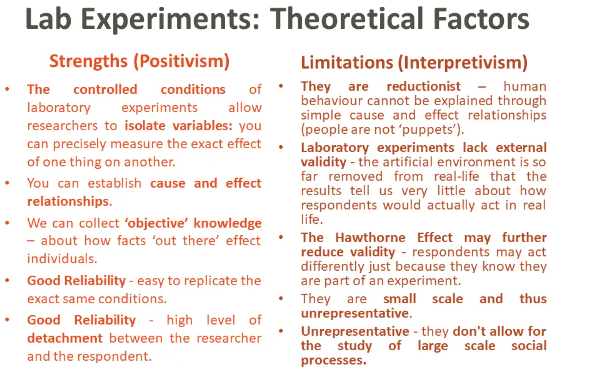
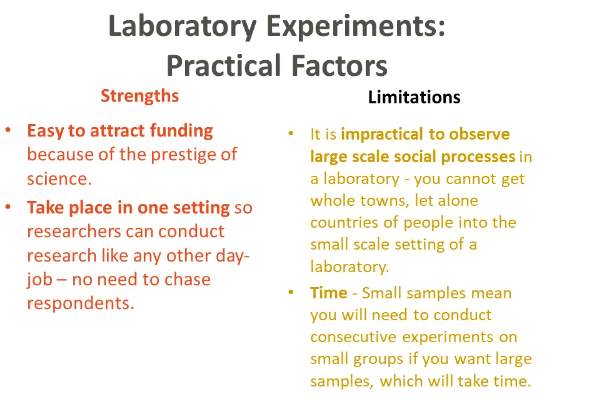
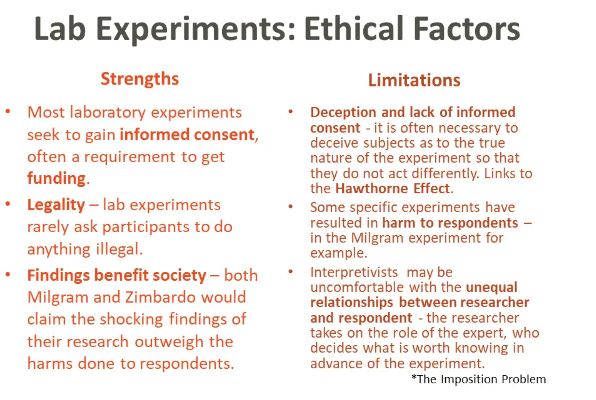
Lab experiments: take place in controlled environments
e.g Banduras bobo doll experiment
(ecological validity, operationalising concepts, independant dependant extraneous varibles, hypothesis, hawthorne effect)
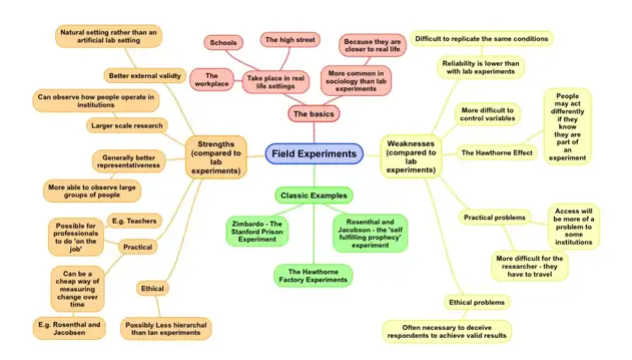
Field experiments: take place in real-life settings
e.g Rosenthal and Jacobs (study showed that children's performance was enhanced if teachers were led to expect enhanced performance from children. By the same token, if teachers were led to expect lower performance from children, then the children's performance would be diminished.)
Quantitive and qualitive questionnaires
e.g UK census, great british class survey
(open questions, closed questions, pre-coded question, leading questions, standardisation, imposition problem, response rate, social desirability, incentives, pilot survey)
written questionnaires
self completion questionnaires
mailed/ online questionnaires
interveiwer present questionnaires
Quantitive and qualitive interviews
e.g crime survey of england and wales, Anne Oakley ‘Becoming a mother’
(interveiwer effect, interviewer bias, social desirability, verstehen, rapport, status differences, conformity to group)
structured interview
unstructured interview
semi structured interview
group interview
Quantitive and qualitive observations
e.g venkatesh ‘gang leader for a day’, barker ‘making of a moonie’ , humphreys ‘tearoom trade’
(objectivity, subjectivity, getting in, staying in, getting out, verstehen, hawthorne effect, guilty knowledge)
participant
non-participant
overt
covert
Quantitive and qualitive secondary sources
e.g educational achievement data, census data
(authenticity, credibility, representitiveness, triangulation, manipulation, verification, replication, objectivity, subjectivity)
-official statistics
-personal documents
-public documents
-historical documents
-content analysis
Practical,ethical and theoretical issues affecting choice of topic
-influence of funding bodies
-purpose of research
-theoretical perspective
-methodological perspective
(researcher values, social issues,value freedom, value laden/ objectivity, structural theories,social action theories, conflict, consensus)