Primer on Infectious Disease
Bacterial Pathogenesis:
RM:
Restriction-modification systems are forms of immunity in bacteria
RM systems can have nucleases and methylases
RM systems attack viruses (phage DNA)
Nucleases identify and destroy phage DNA before it replicates or integrates
Methylation of host DNA allows it to not be degraded like phage DNA
Infectious Disease Timeline:
Fossil Record
Bone abnormalities in dinosaurs
Bacterial infection in hominids
Bone deformation of homo sapiens
Written record
-Appeared 2500-500 bc
Nippur medical tablet
Edwin Smith Papyrus
Nineveh Medical Encyclopedia
Semina Morbi:
Humorism (Hippocrates), miasma, and semina morbi were leading theories for ID
Golden Age of Bacteriology:
-Debunked the idea of spontaneous generation without common descent
Pasteur
- Swan-neck flask experiments

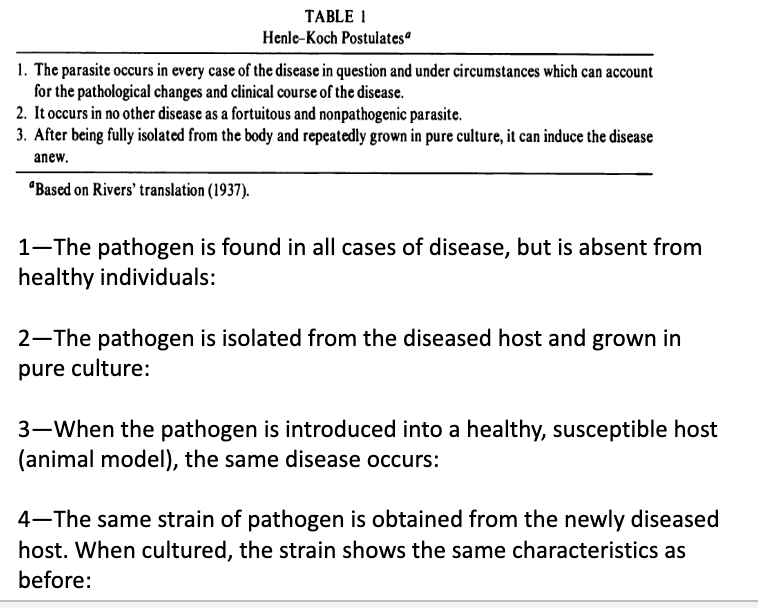
Koch
-Established criteria for postulates for a causative link between infectious agent and disease (germ theory of disease causation)
Koch’s postulates
Pathogen:
Pathogenicity is not a fixed trait of a microbe but an outcome of the interaction between a host and a microorganism
Ability of a microbe to be pathogenic (cause infection) is termed pathogenic potential

Virulence:
Morbidity and pp are not always proportional. Virulence is a measure of severity of infection and can be measured by mortality (case-fatality rate, CFR)
PP and virulence are determined by virulence factors and host immunity
Avirulence implies that virulence is a mistake and represents an imbalance in host and microbe relationship
Fit pathogens:
Determined by survival, replication, and transmission.
A fit pathogen must:
Gain entry into host
Attach to and/or invade tissues
Replicate and/or disseminate
Exit host

Damage:
Interaction of pathogen and VF’s with host tissue leads to damage, which causes symptoms and disease
Direct vs indirect transmission:
Direct transmission includes: 1. physical contact (e.g., STIs), 2. aerosolized respiratory droplets (coughing), 3. Vertical
Indirect transmission includes: 1. Fomites (non-living objects like phones), 2. Common source (food and water), 3. Vectors (insects), 4. Airborne (dust)
Virulence Factors:
Fitness of a pathogen depends on the virulence factors (VFs)
-Interaction of VFs with host tissues causes damage, symptoms, and disease. The effectiveness of these interactions is influenced by the pathogen's ability to adhere, invade, and evade the host's immune response.
Course of infection:
5 periods of disease progression
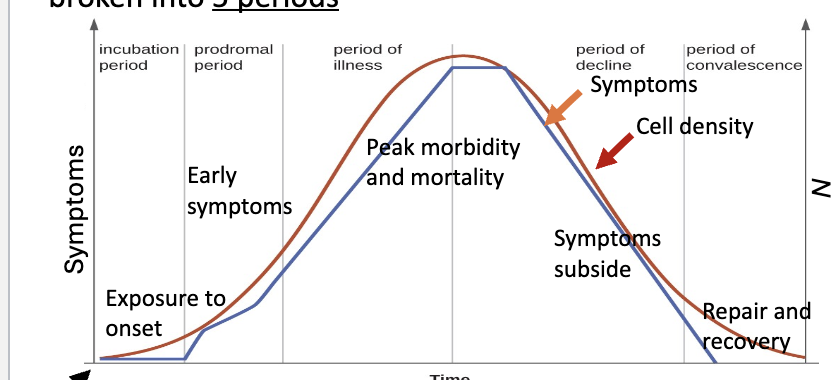
Some infections do not cause severe damage, and thus symptoms are subclinical (asymptomatic) and damage is delayed for a bit
Many subclinical infections are transmissible in carrier state hosts
Portals:
Pathogens must enter the body through portals such as mucosal (conjunctiva, respiratory tract, genitourinary tract), and cutaneous (skin)
Entry:
Mechanisms of entry are determined by the portal
Ingress is entry without crossing an epithelial barrier
Parenteral is entry through a break in the skin
-Any trauma that jeopardizes the physical barriers of the skin allows for entry
Attachment:
Attachment to host tissues allows pathogens to overcome anatomic shear forces using adherence factors

Colonization:
Attached pathogens can multiply to colonize tissues
Colonies can come together to form biofilms
Invasion:
Following attachment is used to:
Breach host tissue barriers
Subvert host immunity
Access nutrients
Replicate and/or persist
Strategies:
Pathogens use both passive and active mechanisms for invasion
Passive includes: Transcytosis and phagocytosis
Active includes: Paracellular, induced, and lateral
Most mechanisms traffic the pathogen into and through tissues with vesicles
Replication:
Pathogen fitness is largely determined by replication
Some infections cause localized infections (proximal to site of entry)
Some pathogens cause disseminated infections (Replicating at multiple anatomic sites) and often distal to the site of entry
-Many pathogens can cause both localized and disseminated infections
Exit and transmission:
Infection exit portals are the routes a pathogen uses to leave its host are often aligned with infection symptoms
Transmission mechanisms move pathogens between an infected host and a susceptible host
Bacterial Genetics:
Genomes:
B-form DNA
Organized in closed-circular, double-stranded haploid chromosomes
Includes plasmids and integrated viruses (prophages)
Nucleoid:
Bacterial genomes condensed into a Nucleoid by the action of nucleoid-associated proteins (NAPs) and topoisomerases
Replication:
Highly conserved
Bidirectional
Semiconservative model
The replisome contains several targets for antibiotic chemotherapy
Plasmid 101:
Extrachromosomal genetic element
Generally encodes accessory genes
Bacteriophage:
Viruses that infect bacteria are known as bacteriophages
The life history of phages is either lytic (virulent) or lysogenic (temperate) cycles
Lysogenic phage genomes integrate into bacterial genomes, becoming a prophage
Most phages are lytic but can switch to lysogenic
Operons:
Operons = A set of genes that are transcribed as a single polycistronic unit and expressed coordinately

Gene Expression:
Bacterial gene expression flows from DNA to RNA to protein following the central dogma
Regulation:
Most gene products are regulated
-Activation and repression enable bacteria to regulate production of specific genes in response to exogenous or endogenous signals
Regulators achieve regulation - activators upregulate gene expression
Repressors downregulate gene expression
Regulation is achieved through two mechanisms: 1. Cis- and 2. Trans-
Trans are extragenic to the gene they regulate
Cis regulators are intragenic to the genes they regulate
Genetic Diversity:
Is essential for maintenance of a species to adapt to change, disease, and natural selection
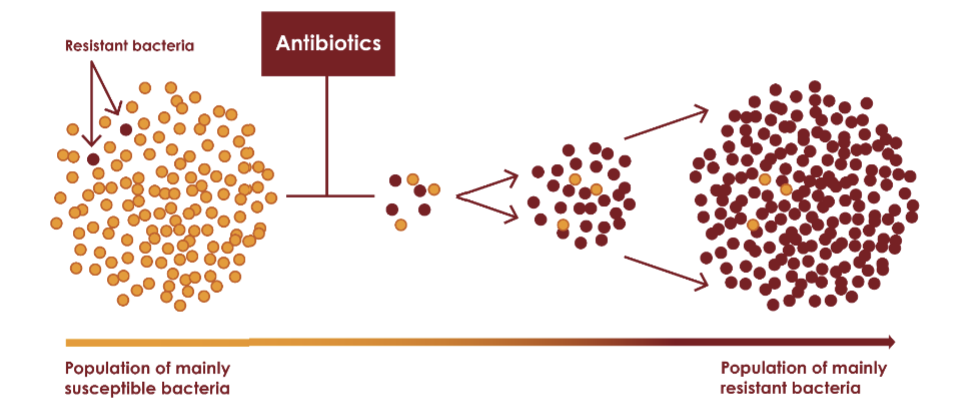
Genetic Erosion is the opposite of genetic diversity and may lead to species extinction by genetic drift, bottlenecks, founder effects, inbreeding and clonality, reduced gene flow, and natural selection
Gene flow:
In bacteria, genetic diversity is achieved by de novo mutation and gene flow (HGT)


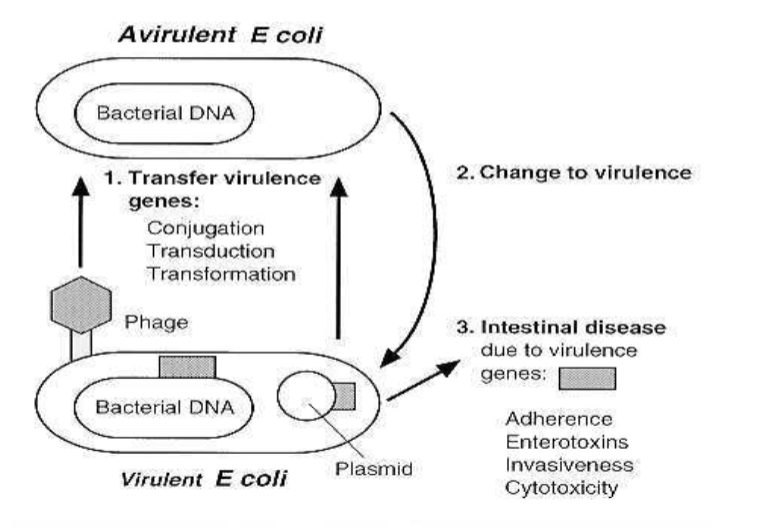
Conjugation: Requires contact and conjugative (transfer) plasmids that encode structural and regulatory genes from donor to recipient
Transformation: DNA is acquired exogenously from the environment by the recipient
-Bacteria that are competent for DNA transformation encode multiprotein membrane complexes that translocate DNA across the cell membrane
Transduction:
-Bacteriophages introduce DNA from donor bacteria into recipient bacteria through infection

Transformants:
Transformed DNA either integrates into the host genome or is destroyed,1` creating a transformant
Transductants:
Phage particles mistakenly pack their heads with bacterial DNA, transducing a new recipient - A transductant
-Integration may lead to lysogenic conversion of the recipient
Gene Transfer:
The fates of laterally acquired genetic material:
Destruction by nucleases
Replicon formation
Integration into genomic materials

Genetic exchange can alter the virulence of a species
Evaluation:
Used for diagnosis and treatment of ID
Case History:
Symptoms
Medical history (underlying or previous illness, surgeries, comorbidities & co.)
Risk Factors (underlying illness, comorbidities, behavior (ex. smoking, alcohol)
iatrogenic, & co
Medications and allergies
Social—occupation, activity, lifestyle & c
Physical Exam:
Vitals (temperature, pulse, respiration, blood pressure, O2 saturation & co.)
Palpation (wounds, nodes, skin and soft tissue, organs, joints, bones, & co.)
Percussion (lungs, abdomen & co.)
Visual inspection (skin, nodes, ENT & co.)
Specimens:
May be collected during physical exam
Should reflect the disease process and be collected in sufficient quantity
Specimen collection should minimize contamination (aseptic technique), use antiseptics, PPE, and aspiration, and be collected before abx administration*
Testing:
Can be performed in situ (point-of-care tests, POCT), e. meters, test strips and lateral flow, IAs, imaging, PCR & co.—or ex situ (off-site)
Diagnosis:
A presumptive diagnosis is made off of case history, physical exam, and POCT. Used to develop early treatment plans
A definitive diagnosis is made based on ex situ testing (ex., centralized lab,
private sector, gov. labs, universities & co.) and is used to refine the treatment plan