06 Material Considerations - Masonry & Concrete
03/11/2025
masonry: building a structure with stone, brick or similar material including mortar plastering which are often laid in, bound, and pasted together by mortar.
highly durable form of construction, BUT the quality of the mortar and workmanship, and the pattern of the units assembled can substantially affect the durability of the overall masonry construction.
why is stone used in building?
natural material,
can be reused,
robust (strong/vigorous). HOWEVER …
carbon emissions associated with processing and transport,
landscape degradation associated with quarrying,
finite resource.
structure, waterproofing, insulation and finishing.
bricks: 1. digging clay, 2. pressing clay into bricks, 3. brick ovens in exhaust chimneys, 4. transported by lorries.
what to consider for buildings?
useful thermal mass and fire resistance,
adaptable to many uses,
reused,
robust. HOWEVER …
carbon emissions associated with manufacture and transport,
relies on mortars and primary structures as a combined system.
STANDARD BRICK SIZE: 215mm (l) x 102.5mm (w) x 65mm (h)
size: 2 widths + 10mm = length
modularity: principle of dividing a system into smaller, independent parts are called modules that can be exchanged without affecting the rest of the system.
why thinking about modularity?
windows are the same height as bricks and mortar,
corners can be made by turning a brick 90 degrees, it'll fit!
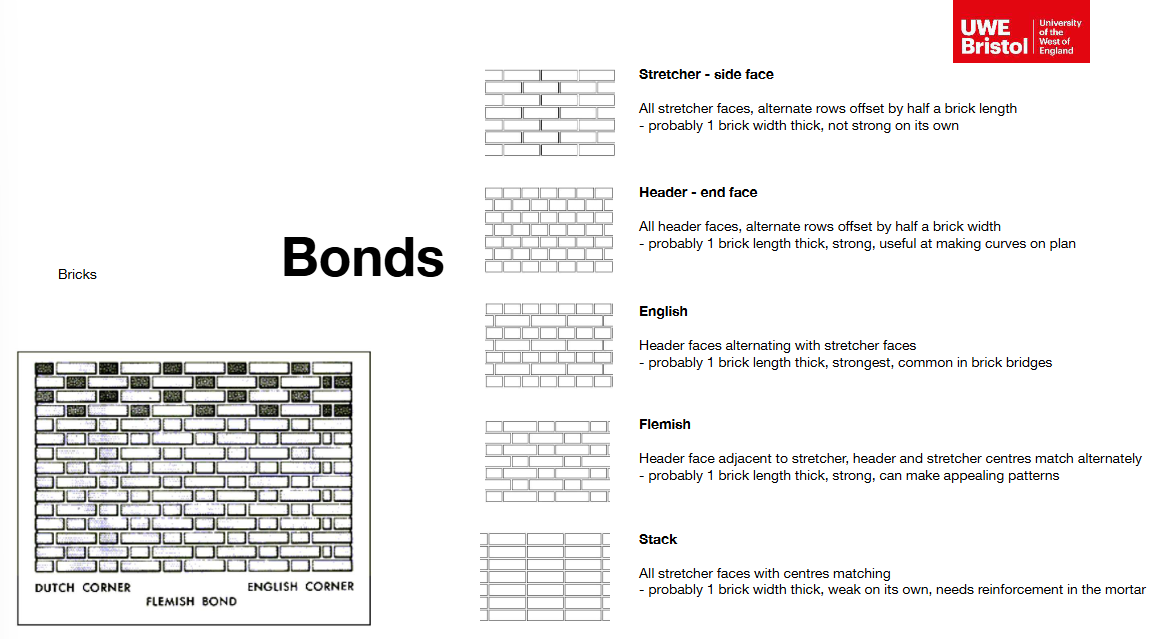
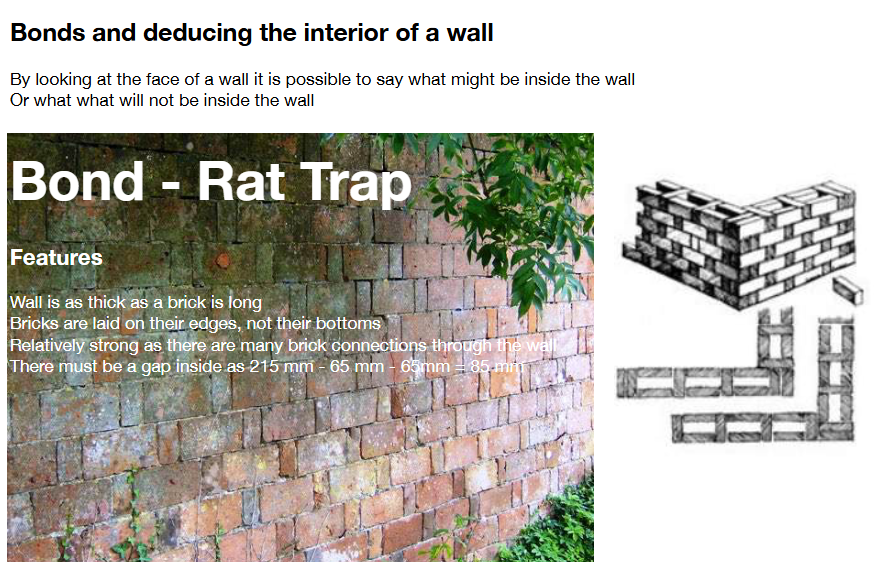
types of mortar:
lime based mortars - flexible, less strong, takes time to set.
cement based - brittle, stronger, sets quickly.
mortar provides a stable base for each brick or stone, to transfer load and the mortar should be less strong than each brick or stone to allow movement.
modular blocks: larger blocks are available in smaller ones such as bricks so they can be aligned.
AN INTRODUCTION TO CONCRETE CONSTRCUTION
concrete is a stonelike material (cement, sand and gravel or other coarse aggregate and water at careful proportions)
second most used material on earth after water,
8% of global CO2 emissions,
inexpensive material (at source) - £££ for the climate!
water creates a chemical reaction to set/cure the cement (does not by drying out)
high compressive strength (resists squeezing) - controlled by ratio of water to cement, but low tensile strength (pulled apart) - controlled by increase additives (like steel) to create reinforced concrete.
why do we use concrete in construction?
framing (primary structures)
cores, lifts and stairs (servicing and structure)
bracing, sheer walls and foundations (stability in the structure)
thermal mass (offsetting of energy loads)
resistance to fire (reduces construction costs)
sustainable concrete:
solidia - carbon cured cements, that absorb CO2
biomason - uses bacteria to grow cement bricks.
SUBMISSION ESSAY
The thermal performance of a building is an essential component for energy efficiency, comfort for its occupants, and meeting building regulations. In our project, the new external wall at UWE Frenchay is designed to achieve a U-value of 0.15 W/m²·K or less, in line with current sustainability targets. The U-value is a measurement of the rate of heat transfer through a building element; smaller U-values mean better insulation and less heat loss.
Our wall panel is designed as a cavity wall system, comprising an outer leaf of brickwork, a cavity with insulation within, and an inner leaf of concrete block, finished internally with plasterboard. The outer leaf comprises Ibstock Cattybrook Bristol Gold bricks, selected due to their durability, aesthetic quality, and local heritage. The inner leaf is formed in 140 mm concrete block to provide structural support and thermal mass, helping to regulate internal temperatures by storing heat and releasing it progressively.
The cavity between the two leaves is 150 mm wide, with 120 mm of rigid PIR insulation and a residual 30 mm air gap. This cavity provides a number of functions: it helps to improve thermal insulation, prevents moisture ingress from the external brickwork, and diminishes the possibility of condensation inside the building. Wall ties across the cavity connect the two leaves and provide structural stability to the wall while leaving the cavity clear to be used for insulation.
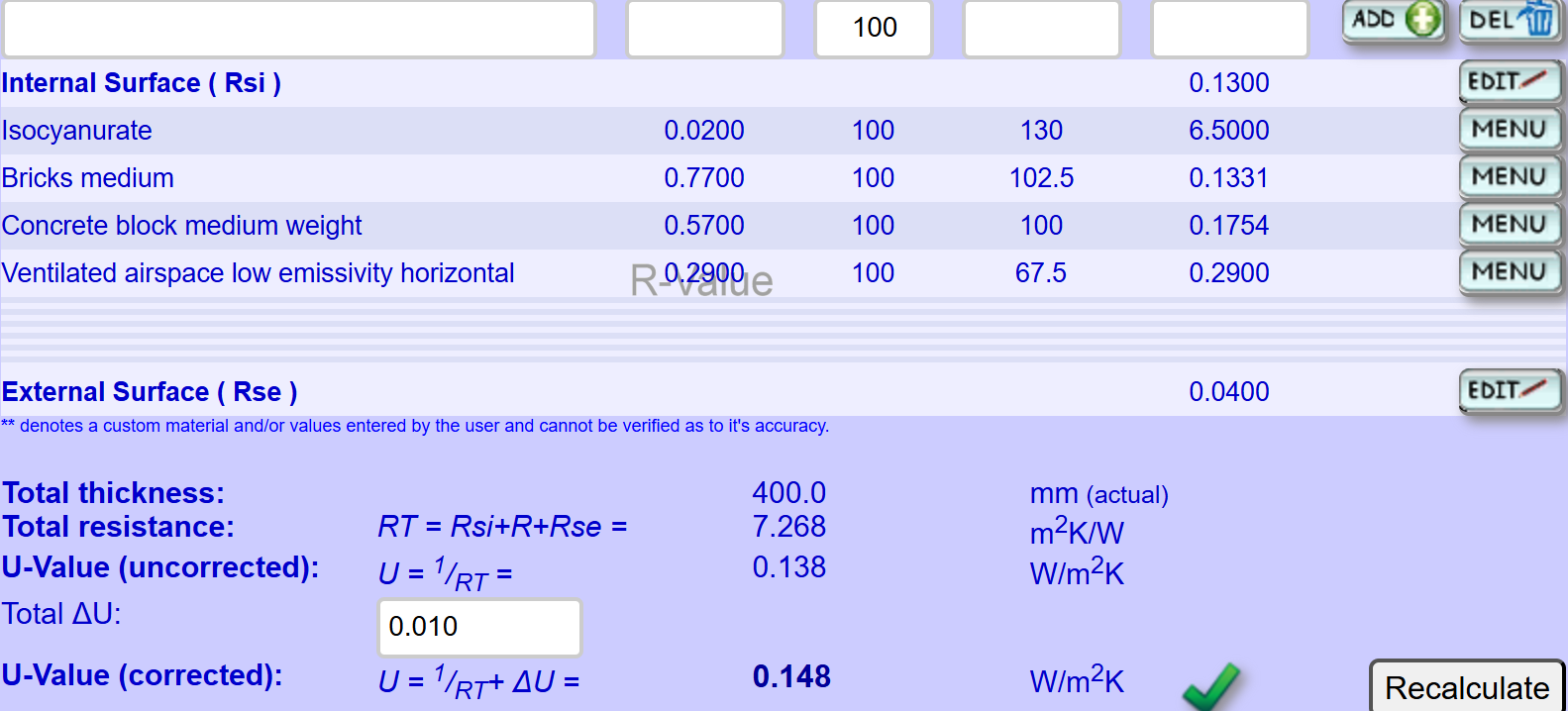
In order to determine the U-value, each of the wall layers had to be given a thermal resistance value. The formula given for R-value is: thickness of material (m) divided by yhr thermal conductivity
Plasterboard finish: 13 mm thick, λ = 0.25 W/m·K, R ≈ 0.052 m²·K/W
Concrete block inner leaf: 140 mm thick, λ = 1.13 W/m·K, R ≈ 0.124 m²·K/W
Cavity insulation (PIR): 120 mm thick, λ = 0.022 W/m·K, R ≈ 5.455 m²·K/W
Residual air gap: 30 mm, λ ≈ 0.18 W/m·K, R ≈ 0.167 m²·K/W
Brick outer leaf, 105 mm thick, λ = 0.77 W/m·K, R ≈ 0.136 m²·K/W
Including internal Rsi = 0.13 and external Rso = 0.04 surface resistances, the approximate value of total thermal resistance is 6.104 m²·K/W. Using the formula 1 / Rtotal, the wall achieves a U-value of 0.164 W/m²K. By slightly increasing insulation thickness to 130mm, the u value is reduced to 0.15, meeting the target.
Procedure: The wall achieves a U-value of 0.164 W/m²·K. Slightly increasing the insulation thickness to 130 mm results in a U-value of 0.15 W/m²·K, meeting the project target. This is a layered design that will allow the wall to balance structural stability, aesthetic appeal, and high thermal performance. The concrete block's high thermal mass moderates indoor temperature fluctuations, but the greatest contribution to thermal resistance comes from PIR insulation. The brick facing protects against the weather while providing durability, longevity, and visual identity for the Frenchay campus. In general, the wall panel design has carefully considered material selection, insulation strategy, and cavity wall construction to achieve excellent thermal performance. The calculated U-value proves that the selected materials and their thicknesses satisfy the project's targets and will guarantee a building that is energy-efficient, comfortable, and sustainable.
handmade bricks
high compressive strength,
low water absorption,
through coloured finish.
long format bricks
elongated,
sleek modern aesthetic,
strong horizontal lines.
stock bricks
traditional appearances,
soft-moulded texture,
natural colour variations.
waterstruck bricks
smooth texture,
natural look,
gentle imperfections.
wirecut bricks
uniformity,
precise edges,
clean lines.
the gilbert george centre
outer leaf: bricks
inner leaf: inner wall
brickwork design
context: uwe uses hanson brick on frenchay (+ kilkenny blue limestone)
design: catty brick, stack bond
thermal performance
u value: 1.48
construction
inner leaf:
brickwork support:
6 along, 7 up