Lecture 4 - Weathering and Sedimentary Rocks
Pre-Sedimentary Rocks
Before sedimentary rocks can be formed, sediments need to exist. And for sediments to exist, rocks have to be weathered, eroded, transported, and deposited.
Weathering
It simply means being exposed to weather - but not just “weather” as a meteorological concept, but rather the forces that may change it on earth - like rains, winds, moving body of water, animals, plants, etc.
Physical Weathering - process that transform rocks into soil, fractures and exposes more surface area of the rock for chemical weathering
Chemical Weathering - destroys mineral structures to weaken rocks for physical weathering to be easier
Weathering will result to sedimentary clasts (or solid fragments), ions in solutions (which can form minerals later on), and soil
Physical Weathering
Exfoliation
When the material over a rock is weathered and transported over time, the rock gets exposed and this also REDUCES the pressure the rock experiences
The loss of pressure allows the rock to expand and this creates cracks on the rock
Disrupting Forces
Forces due to ice and root wedging
Plants growing through rock cracks further expanding the crack
Water freezing inside rock cracks further expands when becomes ice
Crystal growth
Salt water infiltrates rocks, as the water dries, the salt grow in the rock and crack it
Not confined to coasts since most environments have salt in them
Unequal Temperature
Bending of rocks due to unequal heating and cooling may cause rocks to break
Chemical Weathering
Results from minerals undergoing chemical changes as they become unstable when exposed to the surface
Greatly dependent on the environmental conditions (normally, greatest at warm and wet climates) and minerals present
Two main types:
Minerals into other minerals (ex. Feldspar becomes clay minerals through hydrolysis)
Minerals getting dissolved into a solution (ex. Calcite can be dissolved by acidic solutions)
Chemical Weathering Agents
Carbonic Acid (H2CO3)
It needs water and carbon dioxide
In the air, only very weak carbonic acid can be made but having more CO2 in the soil can make water passing through it considerably more acidic
Oxidation
For ex., ferromagnesian silicates (Olivine, Pyroxene, etc.) can be altered so that its iron becomes dissolved iron and undergo oxidation to create iron oxides
Another ex. is sulfide minerals becomes sulfuric acid
Erosion
Removal of weathered materials
Helps weathering happen more as weathered materials are moved and thus exposing the rock again
Erosion has several agents including:
Gravity
Wind
Water
Waves
Animals
Transportation
It is the movement of sediment and/or dissolved ions from point A (point where it was eroded) to point B (point where it will be deposited)
Velocity of the medium (water or wind, mostly) is the key factor affecting which sediments it can move. Medium’s velocity depends on various factors including but not limited to:
Geometry of path including meanders, slopes, etc.
Season
Deposition - Transportation stops and sediments are deposited.
Terrestrial Depositional Environments
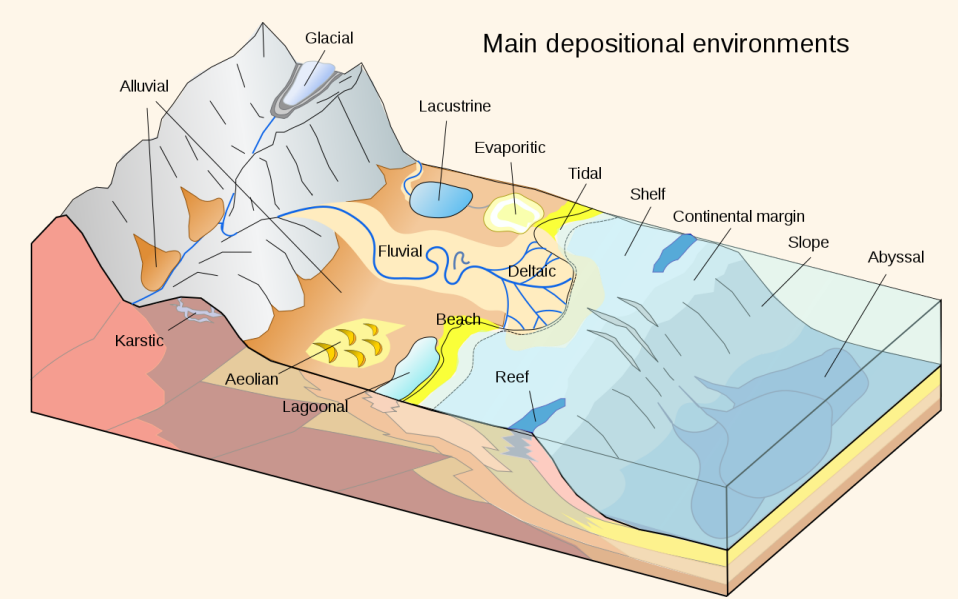
Lacustrine - Sediments (sand mainly on edges, silt, clay, organic matter) are moved by water flowing into a lake
Evaporitic - Much like lacustrine but lakes are situated in arid areas and sediments are mostly salts and clays
Aeolian - Sediments are sand and silt carried by wind into deserts and coastal areas
Marine Depositional Environment
Tidal - Sediments (silt and clay) are moved by currents/tides to tidal flats
Deltaic - Sediments (sand, silt, clay, organic materials) are moved by water into deltas
Beach - Sediments (gravel and sand) are carried by waves and longshore currents into the beaches and sand bars
Lagoonal - Sediments (typically carbonates) are almost not moved and settles to the lagoon bottom
Reef - Carbonates are carried by waves and tidal currents to be deposited in reefs and basins around it
Shallow Water Marine - Sediments (carbonates, sand, silt, clay) are carried by waves and tidal currents to shelves and slopes
Deep Water Marine - Sediments (clays, carbonate mud, silica mud) are washed by ocean currents into deep ocean abyssal plains
Submarine Fan - Sediments (gravel, mud, sand) are carried by underwater gravity flows into the slopes (before abyssal plains) and abyssal plains
Sedimentary Rocks
Formed from the lithification of sediments
For the weathered materials to become rocks, the following must occur (in order):
Burial - Newer sediments bury the older sediments at point B causing covering and compacting of material
Compaction - As they are buried, the sediments are squeezed/compacted together
Cementation - At depths of hundreds to thousands of meters, minerals crystalizes at pores and contact points of sediments, cementing together to form sedimentary rocks
Most common cementing materials are quartz, calcite, and iron oxide
Can be classified as:
Clastic - made up of sediments that were transported as solid fragments or clasts
Chemical - made up of sediments that were transported as ions in solutions
Clast
Rock or mineral fragment of various sizes
Clasts can be described based on its diameter size (based on Udden-Wentworth grain-size scale)
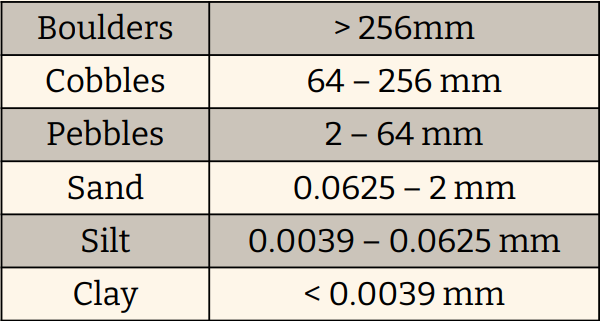
Clastic Sedimentary Rock Groups
Mudrock - has at least 75% silt or clay composition and form in very low-energy environment (lakes, deep parts of the ocean)
If it is mostly clay, then it is CLAYSTONE
If it is mostly silt, then it is SILTSTONE
If it has beddings/lamination, then the mudrock is SHALE which is fissile
Sandstone - Made up mostly of sand (other part is silt and clay)
If sandstone has:
Silt and clay <15%: “Clean Sandstone” or “Arenite”
Silt and clay is >15%: “Wacke”
Its sand-sized particle components are mostly made of Quartz, Feldspar, and Rock Fragments
Sedimentary rocks with significant amount of clasts bigger than 2mm will be known as:
Conglomerate - if the clasts are rounded (formed in high energy environments like swift rivers, hence the more rounded shape)
Breccia - if the clasts are angular (formed in environments where clasts not transported significantly, hence little effect on shape)
Coal - often classified as organic sedimentary rock due to its composition of decayed material (peat moss and humus).
Chemical Sedimentary Rock
Limestone
It is composed mostly of the minerals: calcite and aragonite, the crystal form of calcium carbonate
Forms when these minerals precipitate out of water containing dissolved calcium through biological or non biological processes
Can form around reefs as well as in deeper waters where there is abundance of carbonate shells of organisms
Chalk - a limestone composed of calcite minerals made from biochemical processes
Dolomite Rock
another carbonate rock primarily composed of mineral dolomite
dolomites are recrystallization of older limestones
Chert
some organisms like radiolarians and diatoms use silica to make their shell. When they die, the shells settle down and become chert
Chert is chemically precipitated silica from biological remains
Evaporites - In dry areas, when waters in lakes and rivers evaporate, they become concentrated with dissolved ions which then crystallize
Rock Salt - composed mainly of the mineral halite
Rock Gypsum - composed mainly of the mineral gypsum
Sedimentary Structures
Sedimentary rocks are usually observed in the environments as large sedimentary structures
These structures are formed at the time of deposition of sediments and follow some geological principles
Geological Principles for Sedimentary Structures
Principle of Original Horizontality - sediments are deposited and accumulated horizontally. Any layers that are tilted must have been subject to tectonic forces
Principle of Superposition - layers are deposited in sequence and older is always at the bottom (unless turned over by tectonic process)
Principle of Inclusions - any rock/fragment in a layer is older than the layer itself much like the rocks in a conglomerate is older than the conglomerate itself
Principle of Faunal Succession - fossils may be used to determine the age of the rock it is in
Sedimentary Structures
Bedding - layering of sediments that can be seen in changes in texture, color, composition, etc. It indicates changes related to the deposition of materials that may be due to seasonal, climates, or tectonic changes among others
Partings - narrow gaps in between layers shown in a bedding. These may indicate periods with no deposition
Cross-bedding - Bedding that has angled layers within horizontal beds. This forms due to the sediments being deposited by water or wind
Ripples - linked to cross bedding. Sediments in a flowing water body may become IMBRICATED — they tile towards one direction, with their tops tilting towards the direction of a flow
Graded Bedding - A bed where gradation/gradual change of grain size from large to small is seen as from bottom to top (known as normal graded beds). Some have large grains at the top and finer grains at the bottom known as reverse/inverse graded bed
Mudcracks - when a shallow body of water dries up, the mud at its bottom dries up and cracks due to the clay in the mud shrinking as it dries
Engineering Considerations
Weathering
Most engineering projects are situated in shallow depths, within the zone of weathering — where rock properties are greatly altered.
Even fresh rock excavated by engineering works are eventually exposed to weathering
Rocks in zones of weathering are highly variable and may change within the lifespan of the project
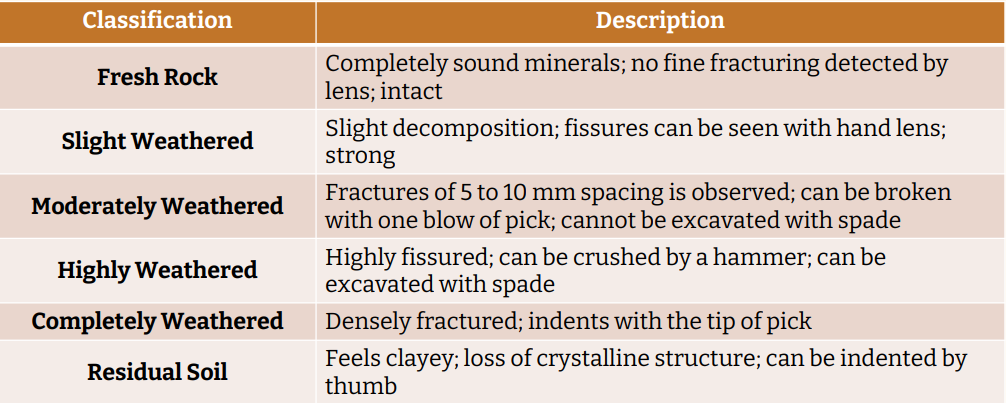
Grades of Weathering
Slaking of Mudstones and Shales
Slaking is the deterioration of a rock after exposure, often by excavation
Mudstones and shales that are not fully cemented (called compaction shales) often are deficient of shear strength and experiences slaking
Additionally, compaction shales loosen when wet and approximates soil behavior
Sandstones and Conglomerates
Clastic sedimentary rocks with large sediments tend to have higher compressive strength
Moisture content of sandstones may indicate degree of compaction. Higher moisture content have generally poorer compaction
Hydraulic conductivity of sandstones are usually measured and is an indicator of degree of cementation
Dissolution of Limestone and Evaporites
Limestones and evaporites are composed of minerals that are soluble in acidic water
Dissolution of these rocks depends on the solubility and solution rock properties with local waters
Older formations are less soluble than younger counterparts
This poses problems in water storage projects and foundations. Often, engineers may choose to select another site with better subsurface conditions than deal with soluble rocks
Karst Topography and Sinkholes
Karst is a topography formed from dissolution of soluble rocks. It is characterized by underground drainage with sinkholes and caves
A sinkhole is a depression or hole in the ground caused by some form of collapse of the surface layer
Limestone as Construction Materials
Crushed limestone and dolomite are used as aggregates in concrete and bitumen
Limestone serves as source of lime in making cement