Lesson 1 History
- The beginning 1866
- Religous Affairs Specialist position was first created in : 1866
- What did the first religous affairs specialists do? They cared for the Chaplains property.
- What was the only requirement for the first religious affairs specialists? “High moral character”
- Commanders would often assign soldiers who needed improvement.
- 1939-1945
- Army Regulation (AR) 60-5 provided for Religious Affairs Specialist
- Official classification was “clerk typist”
- Religious Affairs Specialists:
- Typed, maintained records, prepared reports
- Drove/maintained vehicles
- Played organ/led choirs
- Set up altars
- Carried weapons
- Chaplains earned over 2,000 decorations
- 1950-1953
- Korean War
- First official Religious Affairs Specialists
- 4-week training conducted at Fort Dix, NJ
- Admin-based
- Maximum pay grade: E7
- All trainees were volunteers
- 1965
- Revision to AR 611-201 prompted change in MOS
- MOS changed from 71B to 71M
- 1972
- 71M MOS implemented into Non-Commissioned Officers Education System (NCOES)
- Awarded same degree of professionalism as other enlisted specialists
- 1984
- Titled changed from Chapel Activities Specialist to Chaplain Assistant
- “Chapel Activities Specialist” did not adequately describe the role
- 1985
- Chaplain Assistant Branch receives its own insignia
- 1986
- Chaplaincy designated as a regiment
- Regimental crest developed for all members of Chaplaincy Regiment
- 1989
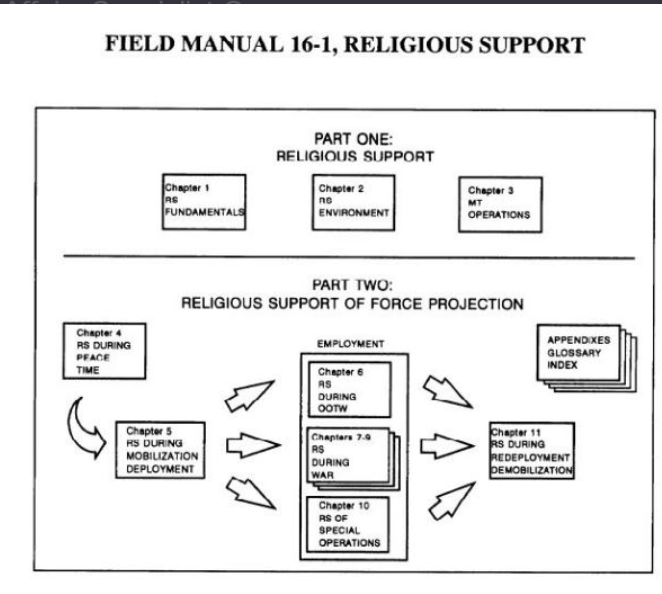
- Field Manual (FM) 16*1, “Religious Support”, published
- Doctrinal guide for Chaplains and Religious Affairs Specialists
- Outlines responsibilities of Unit Ministry Team (UMT) at each level
- 2001
- MOS changed to 56M
- Determined Religious Affairs Specialists would serve in standalone career management field
- Religious Affairs Specialists work with Chaplains to provide support to Soldiers and families worldwide
- 2015
- 56M MOS name changed from 'Chaplain Assistant' to 'Religious Affairs Specialist'
- \
History of the Chaplain School
There are a few important dates to remember about the chaplain assistant school. In 1933, the first unofficial school was formed. Then in 1961, the Chaplain Assistant School was founded. In 1966, the United States Army Chaplain Center and School was formed. The school moved once in 1974 and again in 1979, before moving for the last time in 1995 to Fort Jackson, South Carolina, where it still stands today.
- 1933: First unofficial school
- 1961: Chaplain Assistant School founded
- 1966: United States Army Chaplain Center and School (USACHCS) formed
- 1995: USACHCS moved to Fort Jackson, SC
Unofficial Religious Affairs Specialists
The first unofficial Religious Affairs Specialists, then referred to as Chaplain Assistants, were assigned in 1866. The Army determined that Soldiers who were found competent to teach common school subjects should do so under the guidance of a local Chaplain, who often served as schoolmaster. These assistants typically fulfilled their role simply by caring for the Chaplain's property. The only requirement for the position was a "high moral character"; however, many Commanders assigned Soldiers who they felt needed improvement to the position, hoping that the Chaplain's influence would reform them.
- First assigned in 1866
- Assisted Chaplains by caring for Chaplain’s property
- Only requirement was “high moral character”
- Commanders often assigned Soldiers who needed improvement
Official Establishment
In December of 1909, 43 years after the MOS's unofficial inception, the War Department issued General Order #253. Paragraph 1 of this order authorized one Soldier to be assigned to the Chaplain in order to assist with the performance of the Chaplain's duties. In addition to caring for the Chaplain's property, the assistant would act as a clerk and help with educational, religious, and entertainment programs. Thus, the Religious Affairs Specialist Military Occupational Specialty, 71B, was established.
- General Order #253 issued in 1909
- Para. 1 officially authorized Soldiers as Chaplain Assistants
- Served as clerks
- Offered aid with:
- Educational programs
- Religious programs
- Entertainment programs
- MOS established: 71B
World War II (1939-1945)
Army Regulation 60-5, which outlines general provisions for Chaplains, did not include Religious Affairs Specialists until World War II. At that time, they were classified as clerk typists; however, the job was much more involved than its classification implied. In addition to typing, maintaining records, and preparing reports, Religious Affairs Specialists drove and maintained vehicles such as jeeps and trailers, played the organ and led choirs, set up altars, and carried weapons for the protection of themselves and their Chaplains. They also acted as intermediates between Chaplains and troops, as their enlisted status enabled them to provide Chaplains with an insider's view on unit morale. Chaplains earned over 2,000 decorations during the war - even in one of our nation's darkest times, the positive effect of Chaplains and Religious Affairs Specialists was immeasurable to the men and women they served.
- Army Regulation (AR) 60-5 provided for Religious Affairs Specialists
- Official classification was “clerk typist”
- Religious Affairs Specialists:
- Typed, maintained records, prepared reports
- Drove/maintained vehicles
- Played organ/led choirs
- Set up altars
- Carried weapons
- Chaplains earned over 2,000 decorations
Vietnam War (1955-1975)
During the Vietnam War, Chaplains and Religious Affairs Specialists were deployed to forward operating bases and patrol bases. Although they were active in combat, their impact reached beyond the battlefield. With the help of troops, along with churches and organizations in the United States, Chaplains and Religious Affairs Specialists provided the Vietnamese people with clothing and food, as well as funding institutions such as schools and orphanages. For our Soldiers, Religious Affairs Specialists often set up altars on jeeps or in clearings and constructed chapels for worship at remote outposts. Even in the midst of a world torn apart by war, ministry to United States troops was foremost on the collective mind of the Chaplain Corps.
- Chaplains and Religious Affairs Specialists deployed to:
- Forward operating bases
- Patrol bases
- Worked with U.S. churches and organization to aid in providing:
- Clothing
- Food
- Funds for schools, orphanages, etc.
- Set up altars/constructed chapels for U.S. Soldiers
Today’s Religous Affairs Specialist
- Religious Affairs Specialists have played their crucial roles in combat ministry operations during every conflict in our nation's history, from Grenada and Panama, to Kuwait and Iraq during Desert Shield and Desert Storm, and beyond. Wherever American troops have been deployed, Religious Affairs Specialists have been there beside them, aiding in operations of stability and support, peace-keeping, and nation-building. These operations have required, and will always require, extensive Unit Ministry Team, or UMT, involvement in Civil Military Operations, humanitarian assistance, and engagements between religious leaders and commanders.
- Religious Affairs Specialists have been active in:
- Grenada
- Panama
- Kuwait
- Iraq
- Somalia
- Haiti
- Bosnia-Herzegovina
- Kosovo
- Afghanistan
- Aid in operations of:
- Stability and support
- Peace-keeping
- Nation-building
- Current Roles: Currently, a Religious Affairs Specialist is a combatant trained in tactical, religious support, and administrative skills. Under the direction of the Chaplain, the Religious Affairs Specialist coordinates and synchronizes all religious support for the unit. In the Chaplain's absence, the Religious Affairs Specialist continues the Unit Ministry Team, or UMT, mission for the Commander as a staff representative, but does not assume the religious leadership role of the Chaplain.
- Combatant trained in the following skills:
- Tactical
- Religious support
- Administrative
- Coordinates and synchronizes religious support
- Continues Unit Ministry Team (UMT) mission as staff representative in absence of Chaplain
- Does not take over religious leadership in absence of Chaplain
- Summary: Although the specifics of the position may have evolved over the years, the importance of the Religious Affairs Specialist's role has never changed. Understanding our history is the first step in knowing our value. In this topic, you learned about the foundation of the Religious Affairs Specialist MOS, as well as the roles with which Religious Affairs specialists have been tasked throughout the branch's history.
- Foundation of 56M MOS
- Roles throughout branch history
Topic 2 Significant Religous Affairs Specialists
- Introductions
- To understand where your duties as a Religious Affairs Specialist will take you, it is important to know the stories and accomplishments of previous members of 56M. An important question to ask is how can these real-life examples help you perform your duties? These histories will help guide you through responsibilities you may have to face as member of the 56M Military Occupation Specialty, or MOS. This topic will introduce you to significant Religious Affairs specialists in history and the ways they have impacted your specific MOS. With their stories in mind, you can understand the impact you are capable of having serving our Soldiers and our country.
- Private Eldridge Smith
The earliest Religious Affairs Specialist known by name was Private Eldridge Smith of Company E, 1st Minnesota Infantry. Private Smith served during the Civil War, volunteering to help the Union Hospital Chaplain W. W. Meech at Newport News, Virginia in August 1862. Due to the high volume of casualties in the Peninsula Campaign, numbering over 15,800 killed, injured, or missing, Private Eldridge took it upon himself to assist writing letters home for these Soldiers. In addition, Private Smith helped to draft the plan for the Union Army burial grounds in order to honor fallen heroes for their sacrifice.
First recorded Religious Affairs Specialist:
- 1862: Volunteered under Chaplain W. W. Meech at Union Hospital
- Wrote letters home for fallen and injured Soldiers
- Assisted in drafting plan for Union Army burial grounds
- Corporal Calvin Titus
Another historic Religious Affairs specialist is Corporal Calvin Titus of Company E of the 14th U.S. Infantry. He is the most highly decorated Religious Affairs Specialist in branch history. Corporal Titus, a musician in Company E, assisted Chaplain Leslie Groves with worship services as well as performing his combat duties. During the Boxer Rebellion in 1900, Corporal Titus volunteered to lead the scaling of Beijing, China's, city's walls in order to open the gates for the allied army to advance. Titus heroically and successfully carried out his mission, and in 1902 he was awarded the Medal of Honor by President Theodore Roosevelt. The next frame will introduce you to the second most highly decorated Religious Affairs Specialist.
- Company E, 14th U.S. Infantry
- Assisted Chaplain Leslie Groves in worship services
- Scaled city wall of Beijing during Boxer Rebellion
- Received Medal of Honor from President Theodore Roosevelt
- Corporal Greene W. Strother
Corporal Greene W. Strother of Company G, 11th Infantry Regiment, 5th Division, American Expeditionary Force is the second most highly decorated Religious Affairs Specialist. During World War I, Corporal Strother was serving under his regimental Chaplain when an attack was ordered near Vieville, France, on 12 September 1918. Granted permission by his Chaplain to join the attack, Strother advanced against a German entrenchment covered by machine gun fire. During the attack the Corporal and one other Solder captured 14 German prisoners and secured their machine guns. For his heroic actions, Corporal Greene Strother was awarded the Distinguished Service Cross in 1919
- Company G, 11th Infantry Regiment, 5th Division, American Expeditionary Force
- 12 September 1918: Volunteered to join attack near Vieville France
- Captured 14 enemy Soldiers and secured machine guns
- 1919: Awarded Distinguished Service Cross
- Staff Sergeant John Proctor
There are times in every Soldier's life when they are called to serve beyond the usual responsibilities of their position. How they handle those situations can mean the success or failure of the mission and affect the lives of many others. Staff Sergeant John Proctor is responsible for assembling the first and only all 56M convoy during combat operations. Late in Operation Iraqi Freedom, or OIF, the 2nd Brigade Combat Team, 82nd Airborne Division consolidated most of its combat power in Forward Operating Base, or FOB, Falcon, situated on Highway 8, commonly referred to as the "Highway of Death," in Baghdad, Iraq. Due to lack of manpower to staff tactical Religious Support convoys, Staff Sergeant John Proctor, the Brigade Non-commissioned Officer in Charge, or NCOIC, of the 56M branch, began assembling all-56M convoys. The responsibility to man the convoy machine guns frequently fell to the 56Ms that SSG Proctor had trained on weapons systems. Specialist Jay Velasquez, 2-319th Airborne Field Artillery, being without an assigned Chaplain, and Private First Class Brian Christopher, 407th Forward Support Battalion were the first Religious Affairs Specialists habitually employed in this way.
- Tactical Standing Operating Procedures, or SOPs, require each platform to have three personnel and each convoy to have at least two platforms with a machine gun on the lead and tail platforms. SSG Proctor himself spent most of the war manning a turret-mounted squad automatic weapon, or SAW, but assigned the turret gun to others when he began leading convoys without his Chaplain. After consolidation of most units at the FOB, SSG Proctor began assembling all 56M combat convoys with Religious Affairs Specialists driving, manning machine guns, operating radios, and commanding. These convoys were usually assembled to bring Catholic Chaplains to the three basic combat training locations for services and then return them to their own units. According to the official records at the U.S. Army Chaplain Corps, there is no record of any all-Religious Affairs Specialists combat missions prior to the ones led by SSG Proctor. SSG Proctor served as convoy Commander for more than 35 missions, most of these including several Religious Affairs Specialists, and several of those consisting of over a dozen members of 56M.
- Led the first all 56M convoy during Operation Iraqi Freedom (OIF)
- Due to lack of available manpower, used 56M personnel to lead convoys
- Trained 56M members to man convoy machine guns
- SSG Proctor spent most of the time manning turret-mounted squad automatic weapon (SAW)
- Convoys assembled to bring Catholic Chaplains to 3 basic training locations
- Convoy Commander over 35 missions
- Command Sergeant Major Bridgette Y. Smith
Command Sergeant Major Bridgette Y. Smith served as the first female Command Sergeant Major of the U.S. Army Chaplain Corps. Smith served the U.S. Army Chaplain Center and School in Fort Jackson, SC, from February 2005 to July 2009.
- First Female Command Sergeant Major of U.S. Army Chaplain Corps
- Served as Command Sergeant Major February 2005 - July 2009
- Sergeant Major Monica Dixon
Sergeant Major Monica Dixon was the first female Jump Master for 56M. Dixon received her Jump Master wings as a Staff Sergeant in 1995 while assigned to DISCOM, 82nd Airborne Division, Ft Bragg, NC. In order to even qualify for Jump Master School, a Soldier needs to have a combination of over 25 tactical, combat, and night jumps. Jump Master School is considered to be one of the most mentally challenging courses offered by the Army. Many of those who enter do not finish the course.
- DISCOM, 82nd Airborne Division, Fort Bragg, NC
- First Female Jump Master for 56M
- Command Sergeant Major Marylena McCrimmon
Command Sergeant Major Marylena McCrimmon is the only Religious Affairs Specialist to serve in all three of the the major positions at the U.S. Army Chaplain Center and School. McCrimmon served as Drill Sergeant in 1995, as 1st Sergeant from 2000 to 2001, and Command Sergeant Major from 2009 until 2011. She is also the only female 1st Sergeant to serve at the Chaplain Center and School.
- Only Religious Affairs Specialist to serve in all three major positions at Chaplain Center and School
- Served as Drill Sergeant 1995
- Served as 1st Sergeant 2000-2001
- Served as Command Sergeant Major 2009 - 2011
- Fallen Religious Affairs Specialists
It is important to remember that the duties of Soldier are perilous. It is also to remember the sacrifice that our fellow Soldiers gave. The year 1966 saw the first Religious Affairs Specialist lose his life in the line of duty. Specialist 4th Class Raymond L. Bowen, Jr., died serving in the Vietnam War. Seven other Religious Affairs Specialists died during the time the Army served in Vietnam. Sergeant Larry Bowman of the 42nd Rainbow Division, New York National Guard was killed 11 September 2001. Bowman made three trips in and out of the World Trade Center towers delivering victims to safety. Sergeant Bowman entered on a fourth trip in attempt to rescue additional victims, but never came out. Staff Sergeant Christopher T. Stout, 1-508th Parachute Infantry Regiment, 82nd Airborne Division was killed by enemy fire in 13 July 2010 in Kandahar City, Afghanistan. Stout was the member of 56M to be killed in the line of duty since 1970.
- Vietnam
- First Religious Affairs Specialist to die in combat: Specialist 4th Class Raymond L. Bowen, Jr. Killed in action 1966
- First death of a Religious Affairs Specialist in combat
- 7 other Religious Affairs Specialists died
- World Trade Center Terrorist Attacks - Sergeant Larry Bowman of the 42nd Rainbow Division, New York National Guard, killed 11 September 2001 rescuing victims from World Trade Center
- Summary
In this topic you have learned about significant members in 56M history. You also learned about the fallen Soldiers of the branch and the ways in which they served. The history of the 56 MOS is filled with proud men and women who have a desire to assist their fellow Soldiers and serve their country. It is from them that we draw upon for knowledge and examples to help us better serve, protect, and administer aid to those around us.
- Significant members in 56M history
- Fallen Soldiers
Topic 3:
- Introduction
As a Religious Affairs Specialist, you have a distinct role in today's Army. Supporting the religious needs of our nation's Soldiers is a daily duty. But how does this duty manifest in everyday life? What are the responsibilities of a Religious Affairs Specialist?
- Religious Affairs Specialist
The official Military Occupation Specialty, or MOS, was established by General Order 253 on December 28th, 1909. Paragraph one addresses the assignment by stating, "One enlisted man will be detailed on special duty, by the commanding officer of any organization which a chaplain is assigned for duty, for the purpose of assisting the Chaplain in the performance of his official duties." In simplistic terms, this description is still accurate today. Your overall duty is to assist the Chaplain in providing religious support to our Soldiers.
- A Religious Affairs Specialist is a combatant, trained in tactical, religious support, and administrative skills. He or she possesses a SECRET clearance to coordinate with other staff sections within the unit's operations center. The specialist integrates the Unit Ministry Team, or UMT, into the unit security mission and accompanies the Chaplain throughout the area of operation. Under the direction of the Chaplain, the Religious Affairs Specialist coordinates and synchronizes all religious support for the unit. If a Chaplain is absent, a Religious Affairs Specialist continues the UMT mission for the Commander as a staff representative, but does not assume the religious leadership role of the Chaplain.
- MOS established by General Order #253 - December 1909
- ”One enlisted man will be detailed on special duty, by the commanding officer of any organization to which a Chaplain is assigned for duty, for the purpose of assisting the Chaplain in the performance of his official duties.”
- Assist Chaplain in providing religious support to Soldiers
- Combatant trained in tactical, religious support, and administrative skills
- Possesses SECRET clearance
- Integrates Unit Ministry Team (UMT) into unit security mission
- Coordinates and synchronizes all religious support for the unit
- Continues UMT mission as staff representative in absence of Chaplain
- Does not take over religious leadership in absence of Chaplain
- Mission of Religious Affairs Specialists
- The mission of Religious Affairs Specialists involves much more than assisting the Chaplain with religious support. These missions include advising both the Chaplain and Non-Commissioned Officer, or NCO, Chain, serving Battle Staff functions, teaming with the Non-Commissioned Officer in Charge, known as NCOIC, and performing Garrison Staff functions.
- Advises Chaplain and Non-Commissioned Officer (NCO) Chain
- Performs Battle Staff functions
- Collaborates with Non-Commissioned Officer in Charge (NCOIC)
- Performs Garrison Staff functions
- Tasks of Religious Affairs Specialists
In order to perform their overall mission, Religious Affairs Specialists are responsible for a variety of specific tasks. These duties include coordinating religious support planning, training, and operations; coordinating Unit Ministry Team, or UMT, movement plans; participating in unit briefings; assessing Soldier and unit morale and advising the Chaplain; performing pre-counseling interviews; and assisting the Chaplain in conducting traumatic event management. On the next slide, we will being to further break down the responsibilities of a Religious Affairs Specialist.
- Tasks:
- Coordinates religious support planning, training, and operations
- Coordinates UMT movement plans
- Participates in unit briefing
- Assesses Soldier morale and advises Chaplain
- Performs pre-counseling interviews
- Assists Chaplain in conducting traumatic event management
- Additional tasks include participating in staff planning, tracking, and execution of current and future operations; procuring contracts for goods and services for religious support; and coordinating and executing the Command Master Religious Plan, or CMRP.
- Participates in staff planning, tracking, and execution of current and future operations
- Procures contracts for goods and services for religious support.
- Coordinates and executes Command Master Religious Plan (CMRP)
- Provides training in suicide prevention
- Leads performance counseling
- Plans, briefs, and executes operational training with other Staff NCOs
- Differences in Chaplain and Religious Affairs Specialist Duties
- Although Chaplains and Religious Affairs Specialists work very closely together, their duties are slightly different. Your duty as Religious Affairs Specialist is to assist the Chaplain in ensuring the free exercise of religion for all Soldiers. It is key to note the differences in responsibilities in regard to religious support. Chaplains perform religious services and practices which Soldiers are otherwise unable to perform themselves, as well as providing religious support to the Soldiers they serve. It is the duty of the Religious Affairs Specialist to assist in providing this support, not to perform the services.
- Chaplains:
- Perform religious services
- Provide religious support
- Religious Affairs Specialists:
- Assist in providing religious support
- Do not actually perform religious support
- Counselee Screening
- Another important duty of a Religious Affairs Specialist is the screening of prospective counselees for the Chaplain. This is essentially an intake interview with the Soldier. The interview could be as simple as greeting the individual and escorting them to the Chaplain's office. The interview may also be more intensive that this. The reason for this is to build rapport with the individual, get an accurate reading on their potential needs, and determine the urgency of the need. It will be up to you and your Chaplain to decide on the process that best serves the unit's needs.
- Screening: an intake review with the individual before the Chaplain sees them
- Develops rapport with the individual
- Accurate understanding on their potential needs
- Assess the urgency of the need
- Respond to a Distressed Individual
- Screening: an intake review with the individual before the Chaplain sees them
- The mental health of our nation's Soldiers is something that should be taken seriously. One of the responsibilities of a Religious Affairs Specialist is to respond to individuals that show signs of distress. Whether in the field, or in the Chaplain's office, knowing how to handle a delicate situation is essential. Understanding how to diffuse critical situations and respond to all parties accordingly is an important skill to possess.
- Mental health of Soldiers is taken seriously
- Understand how to diffuse situations and respond accordingly
- Provide Support for Worship Service
- Assisting with worship ceremonies is an important duty of the Religious Affairs Specialist. Supporting a worship service includes the physical setup of the room, ensuring the congregants needs are met, producing bulletins, and providing worship materials for various religious practices.
- Physical setup
- Ensure congregants’ needs are met
- Produce/reproduce bulletins
- Provide worship materials
- Summary
In this topic, you have learned about the roles and responsibilities of Religious Affairs Specialists and how their job is reflected in today's Army. In the following lessons, you will explore many of these topics in depth. 56M has a proud tradition of serving the United States and their fellow Soldiers. Be sure to keep this in mind as you enhance your understanding of the roles and duties of a Religious Affairs Specialist.
- In this lesson, you learned about:
- Tasks of Religious Affairs Specialists
- Missions of Religious Affairs Specialists
- Responsibilities of Religious Affairs Specialist and Chaplains