Cells: The Working Units of Life - Part 2
Cells: The Working Units of Life - Part 2
What Features Characterize Eukaryotic Cells?
Eukaryotic cells are distinguished by several key features, including the endomembrane system that encompasses:
Plasma Membrane: A biological membrane that separates and protects the cell from its external environment.
Nuclear Envelope: The double membrane surrounding the nucleus.
Endoplasmic Reticulum (ER): A network of membranes involved in protein and lipid synthesis.
Golgi Apparatus: An organelle that modifies, sorts, and packages proteins and lipids.
Lysosomes: Organelles that contain digestive enzymes to break down waste materials and cellular debris.
Vesicles: Tiny, membrane-surrounded structures that transport substances between the various components of the endomembrane system.
How the Endomembrane System Works
Protein Synthesis and Processing:
Proteins are synthesized on ribosomes.
Proteins are then modified in the ER.
After modification, proteins are packaged in the ER.
In the Golgi apparatus, proteins receive tagging to indicate their final destination.
Finally, proteins are distributed via vesicles to where they are needed in or outside the cell.
Plant Cell vs Animal Cell
Distinctive Features:
Plant Cells:
Have cell walls, which provide a rigid shape.
Contain a large central vacuole that stores water and maintains turgor pressure.
Contain chloroplasts for photosynthesis, classified as autotrophs.
Lack centrosomes and lysosomes.
Animal Cells:
Do not have cell walls, resulting in an irregular shape.
Contain numerous small vacuoles instead of a single large one.
Lack chloroplasts, are classified as heterotrophs.
Contain centrioles/centrosomes and lysosomes.
Endoplasmic Reticulum (ER)
The Endoplasmic Reticulum is a network of interconnected membranes in the cytoplasm which provides a large surface area for metabolic activities.
Rough Endoplasmic Reticulum (RER):
Characterized by the presence of ribosomes attached to its surface.
Newly synthesized proteins enter the RER lumen where they undergo modification and folding before being transported to other regions.
Smooth Endoplasmic Reticulum (SER):
More tubular and devoid of ribosomes.
Functions include:
Chemical modification of small molecules (e.g., drugs, pesticides) primarily in the liver.
Breakdown of carbohydrates in animal cells.
Synthesis of lipids and steroids.
Golgi Apparatus
The Golgi Apparatus consists of flattened membrane-bound sacs known as cisternae, along with small membrane-enclosed vesicles.
Functions:
Receives proteins from the RER.
Modifies, concentrates, packages, and sorts proteins.
In plant cells, it synthesizes polysaccharides necessary for building cell walls.
Exhibits distinct faces:
Cis Face: Closest to the nucleus and receives vesicles from the ER.
Trans Face: Faces the plasma membrane and sends vesicles to their final destinations.
Lysosomes
Definition: Lysosomes are spherical organelles that contain digestive enzymes responsible for breaking down various cellular components and materials taken in from outside the cell.
Functions:
Breakdown excess or worn-out cell parts.
Involved in destroying bacteria and viruses, hence contributing to the cell's defense system.
Often referred to as the cell’s digestive system.
Phagocytosis
Phagocytosis: This process involves a cell engulfing a particle and is essential for nutrient intake.
Process:
Food molecules enter the cell, forming a phagosome.
Phagosomes subsequently fuse with primary lysosomes to form secondary lysosomes.
Enzymes within secondary lysosomes hydrolyze (break down) the food molecules for cellular use.
Autophagy
Definition: Autophagy, from Greek meaning "self-eating," is a process where cells digest their own contents.
Function:
Delivers cytoplasmic waste materials to lysosomes for recycling, thus supporting cell health and functionality.
Mitochondria
Often referred to as the powerhouse of the cell, mitochondria produce energy by converting nutrients into adenosine triphosphate (ATP) through cellular respiration.
Definition: Cellular respiration is the process of using oxygen to break down glucose, primarily occurring within the mitochondria.
Characteristics:
Cells that require high energy levels, such as muscle cells, contain numerous mitochondria.
Mitochondria possess two membranes; the inner membrane is folded into structures called cristae, increasing the surface area for cellular respiration reactions.
The mitochondrial matrix contains essential enzymes and its own DNA and ribosomes.
Plastids
Definition: Plastids are double-membraned organelles found in plant and algal cells, functioning as storage units.
Functions:
Manufacture and store food, often containing pigments for photosynthesis and coloration.
Types of Plastids:
Chloroplasts: Sites of photosynthesis, converting light energy into chemical energy.
Chromoplasts: Contain red, orange, and yellow pigments, contributing to the coloration of fruits and flowers.
Leucoplasts: Colorless plastids, primarily involved in the storage of starches, lipids, or proteins, commonly found in non-photosynthetic tissues.
Vacuoles
Definition: Vacuoles are large fluid-filled organelles, predominantly found in plant and protist cells.
Functions:
Serve as storage units for waste products and toxic compounds that deter herbivores.
Provide physical structure and support, maintaining turgor pressure due to osmotic water uptake.
Store anthocyanins, which attract pollinators through pigmentation.
Contain digestive enzymes for the hydrolysis of stored food during seed growth.
Cytoskeleton
Definition: The cytoskeleton is a structural framework within the cell that supports and maintains cell shape.
Functions:
Holds organelles in position, facilitates organelle movement, and is involved in cytoplasmic streaming.
Interacts with external structures to anchor the cell in its environment.
Components:
Microfilaments (Actin filaments): Thin filaments that support the cell’s shape.
Intermediate Filaments: Provide tensile strength to cells.
Microtubules: Hollow tubes involved in cell division and organelle transport.
Extracellular Matrix (ECM)
Definition: An extracellular matrix surrounds many animal cells, composed mainly of fibrous proteins and gel-like proteoglycans.
Functions:
Holds cells together in tissues, influencing the properties of tissues like bone, cartilage, and skin.
Filters material passing between tissues and orients cell movement during development and repair.
Participates in chemical signaling between cells.
Origin of Eukaryotic Cells
Eukaryotic cells are believed to have first appeared approximately 1.5 billion years ago, marking a key evolutionary development in life's history known as compartmentalization.
Endomembrane System Origin: Proposed to originate from the inward folding of the prokaryotic plasma membrane leading to enclosed compartments for enhanced chemical reaction efficiency.
Symbiosis: The Endosymbiotic Theory suggests that mitochondria and plastids arose from a symbiotic relationship where one cell engulfed another.
Evidence: Observations of single-celled eukaryotes like Hatena ingesting green algae (Nephroselmis), which subsequently lost most characteristics and functioned similarly to chloroplasts, provide support for this theory.
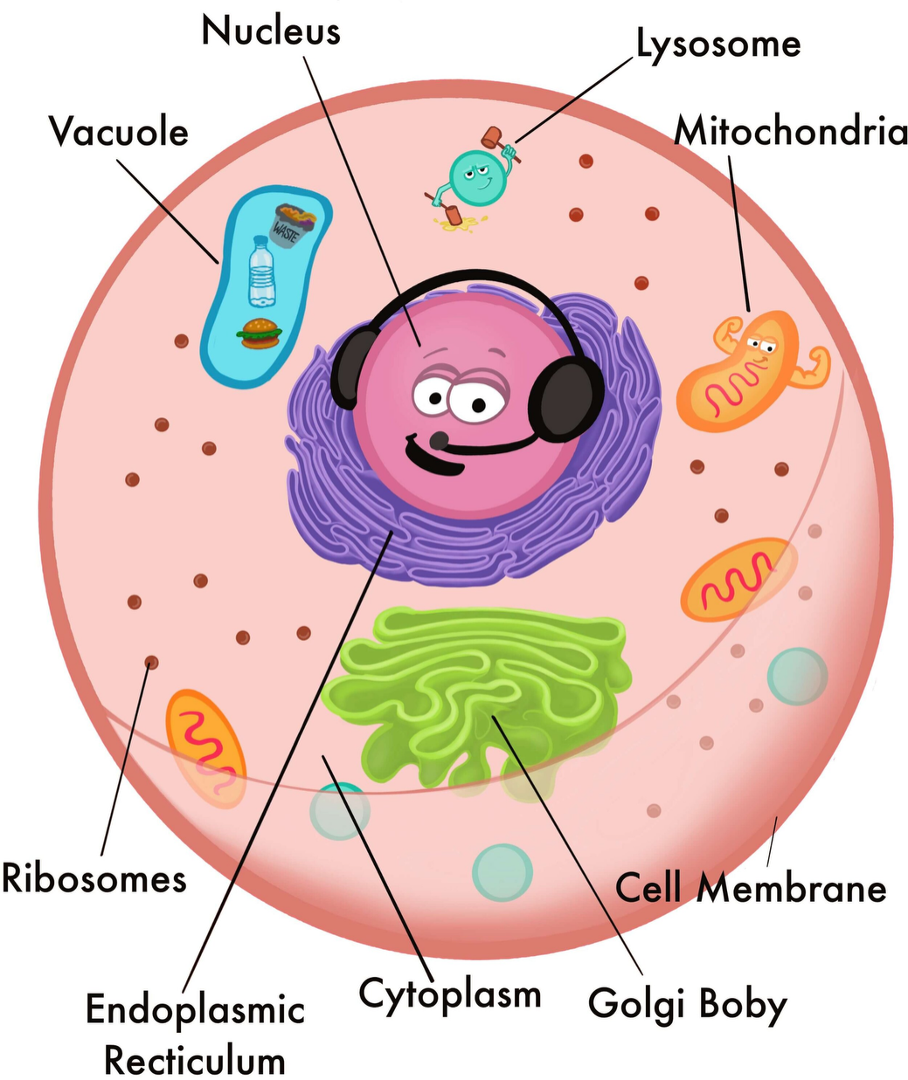
Summary of Eukaryotic Cell Components
Nucleus: The "brain" of the cell, containing genetic material and coordinating cellular activities.
Cell Membrane: Functions in containment and communication between the cell and external environment.
Endoplasmic Reticulum: Acts as the protein outfitter (RER) and lipid factory (SER).
Golgi Apparatus: Responsible for processing, packaging, and shipping proteins and lipids.
Lysosomes: Function as recycling centers for cellular debris.
Mitochondria: The power plants that generate ATP through cellular respiration.
Cytoskeleton: Provides structure, facilitates movement, and serves as transport pathways within the cell.