GENCHEM 1 | 0103 • V12
Lesson 1.3: Pure Substances and Mixtures [UNIT 1]
Classification of Matter
⤷ Matter may be classified according to their state or phase.
The Three States of Matter
— solid (rigid & have a definite shape), liquid (definite volume but no definite shape), and gas (no definite shape and volume.
⤷ Matter may be classified according to their properties.
[ Properties are characteristics that a certain material possess which makes it unique. ]
General Properties of Matter
• Physical Properties: or characteristics are observable even without changing the composition of matter.
• Chemical Properties: possesses characteristics that can be observed once a material undergoes chemical reaction.
⤷ Matter may be classified according to their composition.
• Substances have fixed or definite composition.
• Mixtures are combinations of two or more substances.
— — — — — — — — — — — — — — — — — — — — —
PURE SUBSTANCE is a kind of matter with a definite or fixed position.
• made up of atoms, however, can be composed of a specific type of aromor combination of atoms.
• has a definite physical & chemical properties such as appearance, melting point, and reactivity.
Pure Substances are Classified into:
× ELEMENT - simplest form of matter made up of one kind of atom, or two or more of the same atoms that are chemically combined. | also considered as building blocks of matter.
(Ex. of Elements: copper and iron)
× COMPOUND - made up of different kinds of atoms that are combined through a chemical reaction.
!! Compounds have different properties from the elements that make them up:
a. atoms of an element
b. molecules of an element
c. molecules of a compound
— — — — — — — — — — — — — — — — — — — — —
[ Metals are good conductors of heat and electricity, they possess ductility and malleability(most). ]
01 × Metals: start at the left of the periodic table.
02 × Nonmetals: right part of the periodic table.
03 × Metalloids': lie between metals and nonmetals.
(#3 are also called as semimetals, they can conduct heat & electricity but not as good as metals, that is why these are known as semiconductors.)
— — — — — — — — — — — — — — — — — — — — —
ORGANIC COMPOUNDS are substances that contain one elements carbon and hydrogen.
• “organic“ is often associated with the word natural as it was believed that only living things can produce organic compounds.
• present in foods (carbohydrates, proteins, lipids, and nucleic acids)
INORGANIC COMPOUNDS are substances that do not have carbon-hydrogen bonds.
• (Ex. carbon dioxide, water, and table salt)
— — — — — — — — — — — — — — — — — — — — —
MIXTURES consist of two or more substances that are combined physically.
× HOMOGENEOUS MIXTURE: consists of particles that are evenly spread out or distributed.
• components of homogeneous cannot be distinguished from each other (because particles of the components are so small that cannot be seen by the naked eye.)
• they are also known as solutions.
SOLUTION is composed of a solute and a solvent.
⤷ Solute is the substance that is dissolved by another substance.
⤷ Solvent is the dissolving medium in which the solute dissolves.
⤷⤷ Substances that dissolve in a given solvent are called soluble.
⤷⤷ Liquids that are soluble in each other at all proportions are miscible.
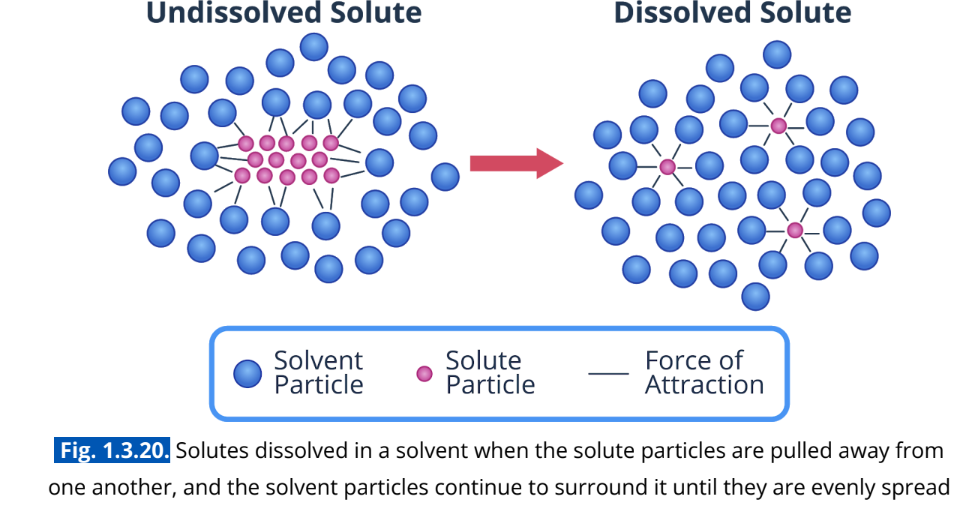
Solutions in which the solvent is water is known as aqueous solutions.
Solid solutions are called alloys or mixtures of metals with other metals or nonmetals.
× HETEROGENEOUS MIXTURE: consists of particles that are not evenly distributed throughout.
• components of heterogeneous can be distinguished from each other.
• can be classified as suspensions or colloids.
COLLOIDS are heterogeneous mixtures with particles that are bigger than those of solution but smaller than those of a suspension.
( The particles of colloids do not settle even after being left to stand for a long time.)
!! That is the reason why colloidal particles can exhibit Tyndall effect. !!
Tyndall effect, a phenomenon wherein light is scattered.
(Ex. of Colloids: Mayonnaise, hair gel, and blood.)
SUSPENSIONS are heterogeneous mixtures with suspended particles that are large enough to be seen by the naked eye.
• due to the size of the particles of a suspension, they are greatly affected by gravity, causing them to settle at the bottom of the container.