Chapter 13 Uses and gratifications
a.) background
In 1940s: Berelson claims futures of communcation research is a bleak
1950: Elihu Katz introudced another new theory. Not asking what do media do to people instead asks “what do people do with media”
Uses and gratifications (U and G) purpoorts individual difference causes us to seak out different content, use it differently and respond to it uniquely. This shift in focus emphasizes the active role of audiences in media consumption, recognizing that personal motivations and social contexts significantly influence how individuals interpret and utilize media. This approach has led to a deeper understanding of media effects, highlighting that consumers are not passive recipients but rather active participants who seek to satisfy specific needs such as information, personal identity, integration, and social interaction. How we apporach media and there altnever effect on our behaviors can vary greatly based on our individual preferences, cultural backgrounds, and specific situational contexts.
b.) 5 key of assumptions
individual difference to media used motivations to media use behavior to media effect
example
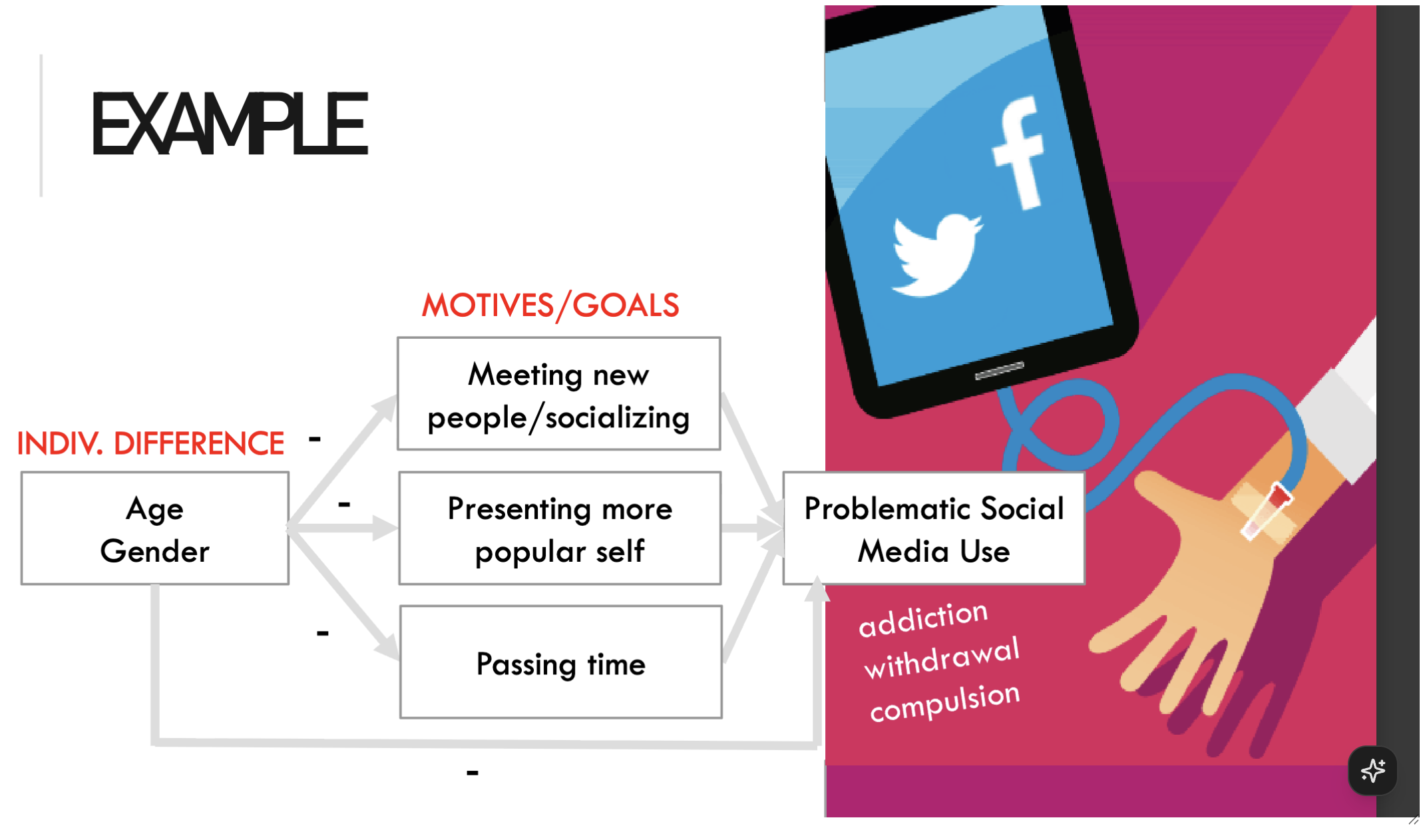
age is negative correctilated to used socialmedia, so when you get older u will use less soical media because of this reasons:
meeting new people and sociallizing
presenting more popular self
passing time
staying updated with news and trends, as younger users tend to be more engaged with current events through these platforms.
people have need they seeks to gratify through media use , including the desire for social connection, entertainment, and information.
Places a strong limitation on theorizing about any form of straight-line effect of media content on attitudes and behavior
U&G: We can’t predict people’s responses from media content alone; need to understand which needs a person is trying to satisfy
example
why are scary movie s popular among certain audiences is that they fulfill the need for excitement and adrenaline, allowing viewers to experience fear in a controlled environment.
researcher shows that people who’ve recently experienced loss often seak out horro movies becayse the narrative are centered around grief and withnessing someone work through their own gried narrative can be healing
Excitation transfer theory. Experiencing emotional response to hoor can deel good when threats are resloves (jump scared)
allow for gender stereotypical role playing between viewers , as individuals may find comfort in embodying traditional characters or exploring power dynamics in a safe space, ultimately leading to an enhanced viewing experience.
Media compete for our time and attention
They compete with each other (e.g., TikTok vs. Instagram)
They compete with other sources of need satisfaction (i.e., face-to-face communication, socialization, meditation, exercise, class!)
Sometimes we choose a ‘healthy’ option for satisfying our needs (e.g.,
Zoom call with a friend when feeling sad/lonely/depressed)
Sometimes we choose an ‘unhealthy’ option (e.g., bingeing a show alone)
Helpful to understand which needs we’re seeking to gratify in order to make optimal choices for ourselves
media affect different people dofferently
not everyone derives enjoyment form certein media (video games, social media and scary movies, news)
what drives our voluntray exposure also changes it effect on us
People can accurately report their media use and motives
Beginning of long tradition of surveys asking how much time people spend with different media & why
Continued debate over validity of self-reported needs/motivations
c.) Type of Uand G
Classification scheme that shorts large number od sepcific instances into manageble categories
Cognitive needs
social needs
emotional needs
habitual needs
example of it is whay we watch the tv?
We often turn to television as a source of entertainment, seeking to fulfill our emotional needs through storytelling or connection with characters. We also used it for
Passing time
Companionship
Escape
Enjoyment
Social interaction
Relaxation
Information
Excitement
Exampe parasoical realtionships
A sense of friendship or emotional attachment that develops between mdia audience member and media personalitles which can enhance the overall experience of consuming media and provide a sense of belonging.
fictional character (TV, Books, and Movies)
celebraties on social media
youtube and influencer
AI Boyfriend (A virtual companion or digital persona that offers users companionship and emotional support, often leading to the creation of strong attachments and fulfilling social needs. ) This interaction fosters a unique bond, as users may begin to treat these digital entities as real friends, which can significantly affect their emotional well-being and satisfaction with media consumption.
Alied is something we know the relationship arent real but we feel like the are on a gy level anyway powerful
Predictive value of theory- Fandom forwaerd (fka the harry potter aliande celebs asking to support an org)
background:
Studies examining SNSs have added new gratificatoon to typology
tv mostly for entertainment, facebook mostly for maintaing relationships
other snss is the knowlegdeges about others, expressive information sharing professional advancemewnt, creative project diy and organization
IG more about the personal identity than relational identity
most popular post- selfies
most personal, lasting content vs, Twitter (eg, photos of friends and groups, home life)
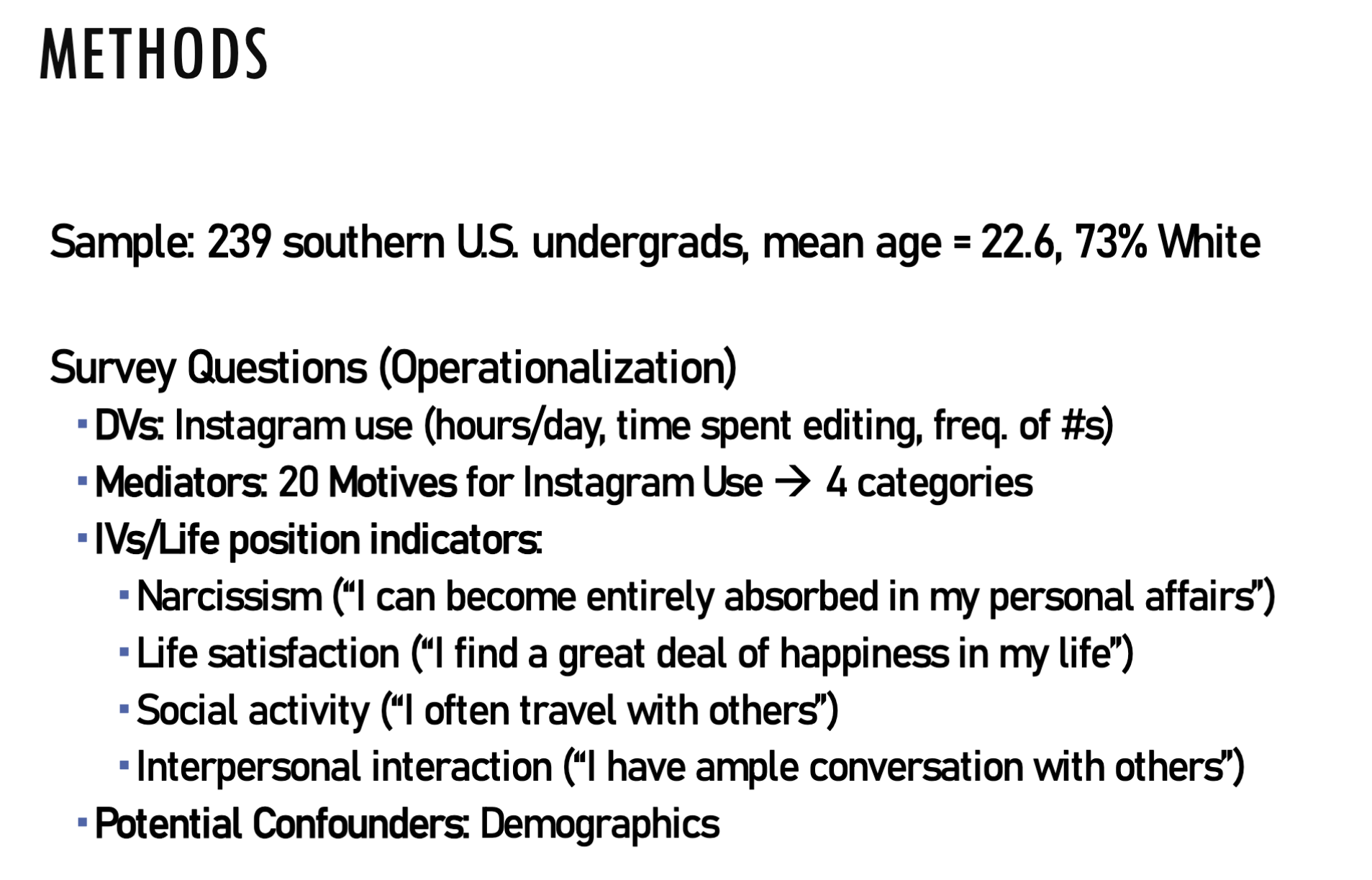
Life satisfaction and narcissim may predict IG uses
Life satisfaction negatively associated with time spent playing FB games (Sheldon, 2014)
Narcissism positively related to posting personal photos on FB (Kapidzic, 2013)
Rusults
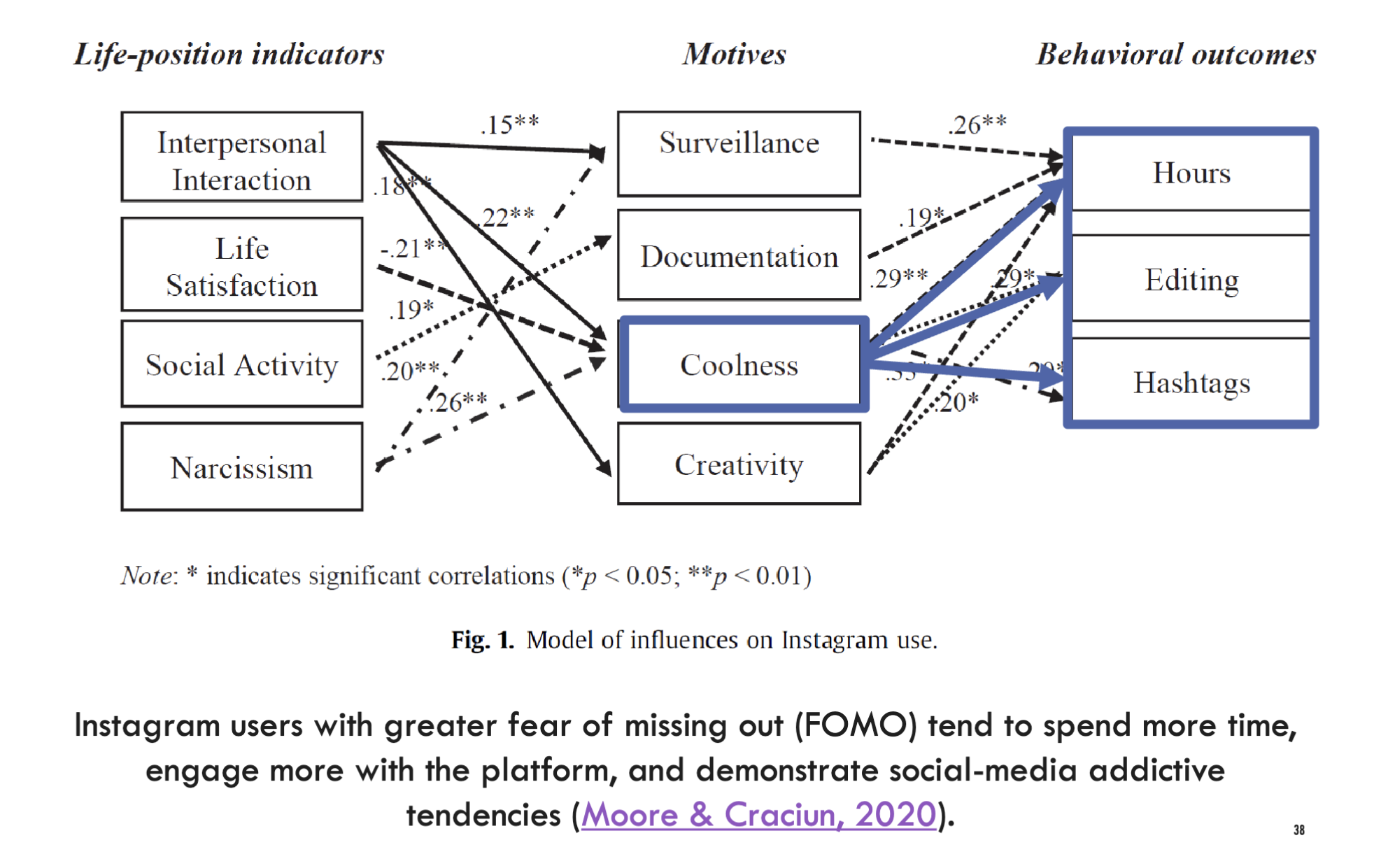
Narcissism add assoicated with
using instagram to appear coll, for surviellance
time spent editing photo before posting
likes, followers validate feeling poular
Social activity + associated with
Using Instagram as a means of documentation
Women more likely to use than men; motive to be ‘cool’ predicts all Instagram behaviors
Seeking social connection: users often engage on Instagram to foster relationships with friends and family, sharing moments and experiences.
reinforing sprials modles
Differs in its perspective on understanding the relation of media and attitudes from theories of message influence and persuasion, as the ELM & SCT, which address ways certain messages may help form or change attitudes and behavior. Similar to Cultivation Theory (CT)! RSM & CT are concerned with media systems & their role in developing and maintaining durable beliefs and attitudes. RSM is well-suited to studies of socialization/formation of personal & social identities, esp. for adolescents & young adults
Similar to cultivation theory (CT)! RSM and CT are concerned with media system and their roles in developing and maintain durable beliefs and attitudes.
RSM is well-suited to studies of socialization/formation of personal & social identities, esp. for adolescents & young adults
The study guide on Uses and Gratifications (U&G) theory shifts the focus from what media do to people to what people do with media, emphasizing the audience's active role. It states that individual differences drive media consumption behaviors and effects, as people seek to satisfy specific needs like information, personal identity, integration, and social interaction.
5 Key Assumptions of U&G Theory
The theory is built on five core assumptions:
Individual differences influence media use motivations, behaviors, and effects. For instance, age negatively correlates with social media use, with older individuals using it less for reasons like meeting new people or presenting a popular self.
People have needs they seek to gratify through media use. These needs, such as excitement from scary movies or healing from grief narratives, limit theorizing about straight-line media effects.
Media compete for our time and attention both with other media (e.g., TikTok vs. Instagram) and with non-media activities (e.g., face-to-face communication, exercise). Choices can be 'healthy' (Zoom calls) or 'unhealthy' (binging shows).
Media affect different people differently. Not everyone enjoys the same media, and voluntary exposure changes its effect.
People can accurately report their media use and motives, though the validity of self-reported needs is debated.
Types of Uses and Gratifications
U&G classifies needs into manageable categories:
Cognitive needs
Social needs
Emotional needs
Habitual needs
Examples of why people watch TV include passing time, companionship, escape, enjoyment, social interaction, relaxation, information, and excitement. A key concept is parasocial relationships, a sense of friendship or emotional attachment to media personalities (fictional characters, celebrities, influencers, even AI companions), which enhances media experience and fulfills social needs.
Instagram and U&G
Studies on social networking sites (SNSs) like Instagram reveal new gratifications. While TV is often for entertainment and Facebook for maintaining relationships, Instagram focuses more on personal identity (e.g., selfies). Life satisfaction is negatively associated with time spent on FB games, while narcissism is positively related to posting personal photos. On Instagram, narcissism is associated with using the platform to appear 'cool,' for surveillance, and with extensive photo editing, where likes and followers validate popularity. Social activity is linked to using Instagram for documentation. Women are more likely to use Instagram than men, with the motive to be 'cool' predicting various behaviors, including seeking social connection.
Reinforcing Spirals Models (RSM)
Reinforcing Spirals Models (RSM) differ from theories like ELM and SCT, which focus on message influence and persuasion. Instead, RSM is similar to Cultivation Theory (CT), as both are concerned with media systems and their role in developing and maintaining durable beliefs and attitudes. RSM is particularly well-suited for studies of socialization and the formation of personal and social identities, especially among adolescents and young adults.