System Redesign and Strategic Strategy Development - Module 21
# Redesigning Systems for Better Outcomes
Definition of System Redesign: Redesigning a system involves changing the system structure specifically to alter its behavior or the outcomes it produces. Question 6 in the analytical framework prompts the exploration of how to change or redesign a system to achieve a desired outcome.
The Power of Choice: When attempting to change a system to produce different behaviors or results, there is almost always a wide range of choices available. It is rarely a single-path solution; multiple variables can be manipulated.
Donella Meadows' Perspective: System thinking is described as a tool that helps practitioners see the vast range of choices before them. The goal is not just to act, but to "choose wisely" among available options.
The Two Pillars of Strategy: Objectives and Actions
Decision Categories: When developing solutions, policies, or strategies, there are two distinct sets of choices to be made: * Objectives (Goals): These are the specific things that must be achieved to bring about the desired outcome. These are chosen because they exert the greatest causal influence on the problem. * Actions: These are the specific tasks, programs, or interventions implemented to achieve the objectives. Actions provide the mechanism to change the variables identified in the objectives.
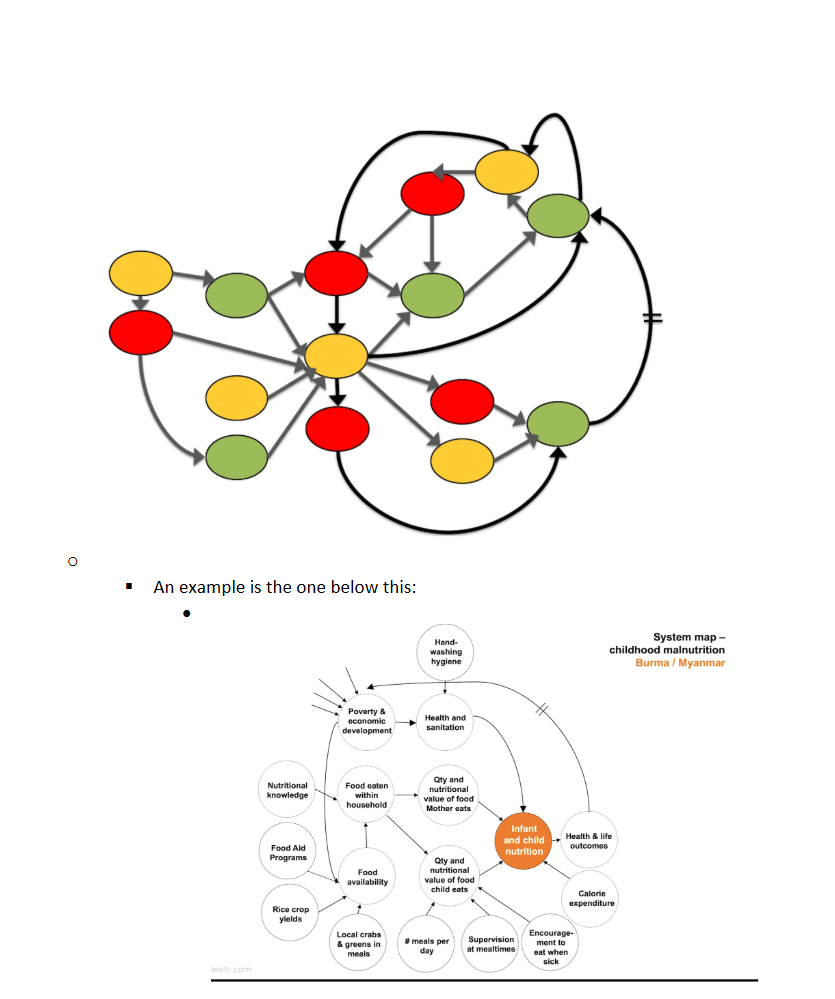
Application to System Mapping: In the context of a system map (causal loop diagram), these choices can be visualized as: * Objectives: Determining which "bubbles" or variables in the map need to be strengthened or weakened. * Actions: Working out the practical methodology for how those variables will be strengthened or weakened.
Case Study: Reducing Medication Errors in Nursing
The Problem: Nurses in a San Francisco hospital were making medication mistakes due to a lack of concentration.
The Objective: After analyzing the causal structure, the most sensible objective identified was to reduce interruptions. Increasing concentration and focus would serve as a proxy for reducing errors.
The Range of Possible Actions: * Action Option A: Dispensing medicines in pairs (one nurse dispenses while the second fields questions and checks doses). * Action Option B: Dispensing medicines in a small, quiet, dedicated room before taking them to the ward. * Action Option C (Selected): Requiring nurses to wear high-visibility (high-vis) vests while dispensing medication.
Rationale for Selection: The hospital chose the high-vis vests because they were a fraction of the cost of hiring double staff and easier to implement than constructing quiet rooms for every ward. The vest served as a signal to others not to interrupt.
Result: The redesign of the system by adding the high-vis vest successfully reduced interruptions and improved outcomes.
Global Case Studies in Childhood Malnutrition
India Strategy: * Objectives: Improve the nutrition knowledge of mothers and increase food availability for families. * Actions: Direct nutritional training provided to mothers and supplementary food provided to families. * Outcome: This strategy was effective within the specific system context of India.
Bangladesh (The Failure of Replicated Strategy): * The Issue: The same strategy used in India failed in Bangladesh because the system structure was different. * Systemic Difference: In Bangladesh, it was typically not the mothers who went to the market to buy food or who distributed food among family members. Therefore, targeting mothers with training did not influence the causal chain of the system.
Burma (Myanmar) Strategy: * Objective: Reduce the daily calorie expenditure of children. * Action: Introduction of water pumps to communities. This prevented children from having to spend hours carrying heavy buckets of water to rice paddy fields, thereby preserving their caloric intake for growth and health.
Vietnam Strategy: * Objectives: Encourage families to adopt five specific behaviors (five objectives) related to nutrition and hygiene. * Action 1: Provision of soap and clean water to households in need. * Action 2: A program where families visited a volunteer's house once every fortnight for hand hygiene training and instructions on catching and preparing small crustaceans for nutrition.
The Symbiotic Relationship Between System and Strategy
Defining the System: The system is the total sum of all interconnected parts working together to produce a behavior. It includes everything: training, aptitude, equipment, shift lengths, processes, and historical context.
Defining the Strategy: The strategy is the specific plan for what will be changed or redesigned within that system structure to improve performance. It is the "well-oiled machine" logic applied to the system.
Complementary Nature: System and strategy are intertwined but distinct: * The System informs the Strategy by showing where interventions are needed. * The Strategy then changes the System structure. * The newly changed system informs the next iteration of the strategy.
Symbiosis: This relationship is symbiotic and requires constant monitoring. One cannot neglect the rest of the system (e.g., equipment or training) just because a specific strategy (e.g., high-vis vests) is implemented.
Causal Mapping and Insight Generation
Scale of Maps: System maps can range from simple (less than variables) to extremely complex. * Simple Maps: Useful for developing immediate insights and reading direct causal relationships. * Detailed Maps: Examples include the UK Foresight map on obesity and the Afghanistan counterinsurgency dynamics map. These are often impossible to "read" at a glance.
Techniques for Analyzing Complex Maps: * Order of Separation: Look only at variables that are one, two, or three orders of separation away from the central variable of interest. * Controllability Filter: Rule out factors that are outside of your control and focus on the remaining variables you can influence. * Traffic Light Overlay: Use color-coding to identify weak points or problematic feedback loops that contribute to poor performance. * Key Variable Identification: Identify variables with many incoming or outgoing arrows (high centrality), as these often have the most significant influence on the system.
Best Practices for Mapping: * Use any tool: paper, whiteboards, PowerPoint, or specialized drawing software. * Iterate: Maps should be built through multiple drafts. * Involve Stakeholders: Building a map with a diverse group ensures a richer, more robust model that incorporates multiple perspectives. * Model Warning: "Rubbish in gives rubbish out." A map is only as good as the understanding it represents.
System Patterns and Archetypes
System Archetypes: Even though systems like hospital errors, malnutrition, and counterinsurgency appear different, they often exhibit universal patterns called archetypes.
Focus on Interactions vs. Physical Parts: * There is a common tendency to focus on adding or removing physical parts (e.g., hiring more people or buying new gear). * Changing how existing elements interact can have a significantly larger effect. For example, in a dysfunctional organization, changing how business units work together is often more effective than reorganization. * In the nurse example, the high-vis vest changed the interaction between the nurse and the surrounding environment.
The Power and Peril of Goal Setting: * Systems inherently strive to meet the objectives or goals for which they are incentivized. * Caveat: Goals must be designed with extreme care. If not, systems may "game the system," meeting the technical goal while violating the spirit of the intention. This is addressed in Question 8 of the analytical framework.
Conclusion and Iterative Design
Structure Determines Behavior: The core tenet of systems thinking is that system structure determines behavior. If the outcome is undesirable, the structure must be redesigned.
Engineering Outcomes: If a system is not consciously designed, it will form naturally, and the outcome will be the byproduct of whatever haphazard system exists.
Innovation: Innovation lies in the cleverness of the strategy chosen to redesign the system.
Uncertainty and Adaptation: While system design improves the probability of success, it does not guarantee it due to inherent uncertainties. Strategies must be iterative, shifting from design to learning and adaptive management (Question 17).
Diagrams