The Electromagnetic Spectrum
Electromagnetic Waves are electric and magnetic distrubances that can be used to transfer energy from a source to an absorber. They do not transfer matter, and the energy they transfer depends on the wavelength of the waves, which explains why waves of different wavelengths have different effects.
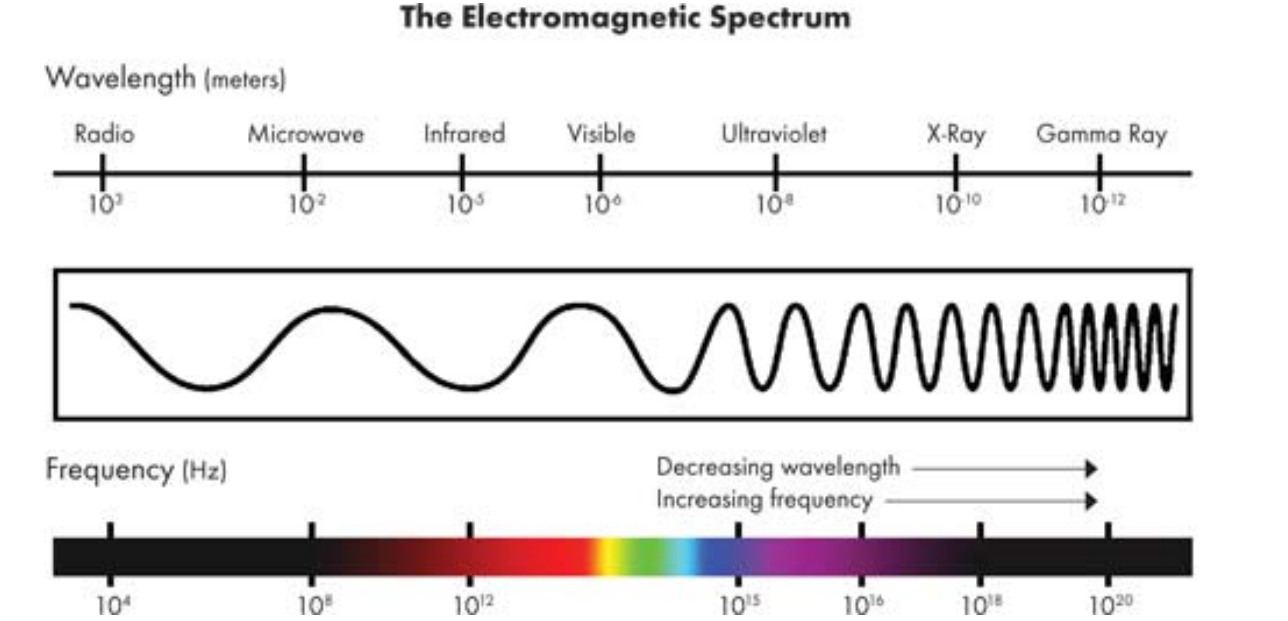
Electromagnetic waves can be displayed on the Electromagnetic Spectrum, with each wave having specific uses
Radio Waves
Radio Waves Facts
Radio Waves have the longest wavelengths and lowest frequencies in the electromagnetic spectrum
Radio Waves can be produced by oscillations in electrical circuits
The waves are emitted by a transmitter
They are detected by a reciever aerial, they create an alternating current with the same freuqency as the radio wave itself, so radio wavs can themselves induce oscillations in an electrical circuit
Devices such as radios convert these electromagnetic signals into sound waves
The Frequency Range is 105 - 1010 Hz
The Wavelength Range is 103 - 10-2 m (103 = 1000)
They travel at the speed of light 300 000 000 m/s
They can travel as “sky” waves (3-30 MHz). Those waves reflect off the ionosphere - a charge d layer high in the atmostphere. However at lower frequencies (<3 MHz) the waves travel as “ground” waves - following the Earth’s surface for shorter distances.
Uses of Radio Waves
Broadcasting television
Radio
Communications
Satellite transmissions
Microwaves
Facts about Microwaves
Microwaves have shorter wavelengths and higher frequencies than radio waves
Microwaves can pass through brick, glass, plastic and other household materials
The Frequency Range is 1010 - 1011Hz
The Wavelength Range is: 10-2 - 10-3m
They travel at the speed of light 300 000 000 m/s
It is important to be shielded from microwaves, as they can also heat human body tissue
They can be detected by an antenna and a reciever, with the antenna collecting the incoming radiation and the reciever measuring the collected electric signal
Uses for Microwaves
Communication
Radar
Cooking Food
They are useful for satellite communication as microwaves pass easily through the atmosphere, carrying signals to satellites orbiting the Earth. These signals can then be passed on to other satellites or to their destination.
They are useful for mobile communication as signals are sent to and from mobile phones by microwaves and they can pass through a lot of thing
They are useful for cooking food as water molecules in food absorb microwaves. The absorbed energy makes the water get hot. Metal screens inside microwaves reflect the electromagnetic radiation which keeps the microwaves inside the oven
Infrared Radiation
Facts about Infrared Radiation
All hot objects emit infrared radiation, with hotter objects emitting more IR radiation
Too much exposure to IR radiation can harm the skin, causing burns
Frequency Range: 1011 – 1014Hz
Wavelength Range: 10-3 - 10-6 m
They travel at the speed of light 300 000 000 m/s
They can be detected by special cameras and used to create images.
Uses of Infrared Radiation
Heat energy is transferred by infrared radiation, which is utilised in toasters, grills, and electric fires
Thermal imaging
Remote controls because of their low penetrating power making them useful for sending signals over short distances
Astronomers can use infrared radiation to determine the temperatures of planets and stars
Visible Light
Facts about Visible Light
Visible light is the part of the electromagnetic spectrum that is visible to the human eye
Frequency Range: 1014 - 1015Hz
Wavelength Range: 106 - 10-7m
They travel at the speed of light 300 000 000 m/s
‘White’ light is a combination of the seven colours in the visible spectrum; red, orange, yellow, green, blue, indigo, and violet
Visible light canbe detected by photographic film and sensors in digital camaras, useful for photography and video recording
Uses of Visible Light
We use it to see
Lasers are used to read information from compact discs. DVD players use a 650 nm red laser, while Blu-ray players use 405 nm blue/violet lasers.
They are useful for photography and video recording because visible light can detected by photographic film and sensors in digital cameras
Visible light is used in fiber optics, useful for sending signals e.g broadband and in the use of endoscopes (cameras used to look inside the body)

Ultraviolet
Facts about Ultraviolet
Ultraviolet (UV) light is higher frequency than visible light - i.e it has higher frequencies than the biolet end of the visible spectrum
Frequency Range: 1015 - 1016Hz
Wavelength Range: 10-7 - 10-8
They travel at the speed of light 300 000 000 m/s
The Sun emits UV radiation, and small amounts of it help to produce vitamin D in our skin
However too much can cause sunburn and blistering, eye problems and even skin cancer
Most UV from the Sun is absorbed by the ozone layer in the Earth’s atmosphere
UV can be detected by changes in our skin, like tanning, burning or freckling or by specialised sensored
Uses of Ultraviolet
UV light causes skin to tanning
It causes some chemicals to fluoresce when exposed to UV light
Fluorescence is useful for security marking, e.g marking valuable items or security marks on passports and driving licences and money
X-Rays
Facts about X-rays
X-rays are high frequency, low wavelength electromagnetic waves
Fequency Range: 1016 - 1018Hz
Wavelength Range: 10-8 - 10-10m
They travel at the speed of light, 300 000 000 m/s
X-Rays are produced by X-ray tubes, and stars also emit X-rays
Over-exposure to X-rays is dangerous and can cause damage to living cells, and can potentially cause cancer
They can be detected by X-ray machines
Uses of X-rays
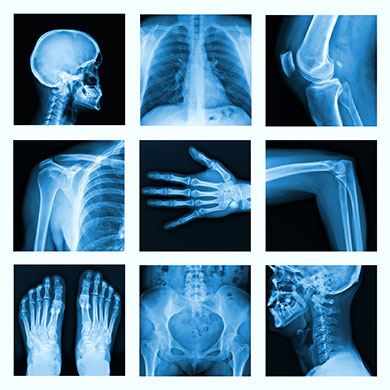
X-rays rays pass easily through skin and muscle tissue, but cannot penetrate bone. This enables X-rays to be taken with X-radiography, enabling doctors and dentists to see where fractures or breaks have occured, or just to check the structure
Patients use lead lined clothing and radiographers can stand behind lead screens to shield patients from overexposure
X-ray are also use to check the internal structure of buildings, machines and welds
Airports can use x-rays to check for objects in baggage
Gamma Rays
Facts about Gamma Rays
They are high frequency, low wavelength electromagnetic waves
Frequency Range: 1018 - 1021Hz
Wavelength Range: 10-10 - 10-14m
Gamma rays are emitted during radioactive decay
They are highly penetrating
Small doses of gamma rays can cause damage to living cells, causing mutations in genes than can lead to cancer
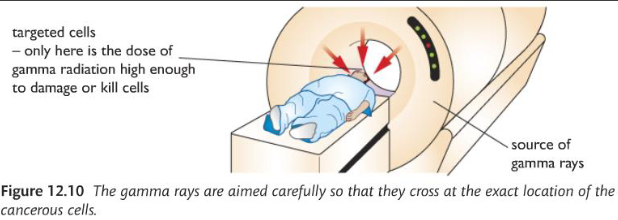
Larger doses of gamma rays can kill cells. Cancerous cells can be targeted in this way.
Uses of Gamma Rays
Sterilise food and medical equipment, with radiation killing micro-organisms that cause food to degrade
When electrons change energy level they move up or down electron shells. Atoms absorb electromagnetic waves so they can gain energy. This energy is given to the electrons so they can change orbits.