Environmental Degradation
Deterioration on the environment through depletion of resources such as air, water and soil
Pollution
Contamination of the environment
Incidental pollution: one-off incident
Chernobyl, 1986: reactor 4 exploded producing 400x radiation of Hiroshima bomb, 100,000 people died, 2,600km2 exclusion zone
Sustained pollution: long term impacts
Global warning and ozone depletion
Land pollution
Nature: deposition of solid and liquid wastes on land or underground in a manner that contaminates the soil, groundwater, threatens public health, is an eyesore
Causes
Mining: slag heaps leave scars, dust kicked up, soil erosion, destruction of forests
Industry: solid toxic waste by-products dumped on land, land is too expensive to reclaim when factor closes so is left to crumble
Energy production: overland oil pipelines leak and are an eyesore, coal ash from power stations dumped
Domestic waste: HICs throw more away, buried in landfills, methane produced as a result, rainwater leaks through waste moving toxins to aquifers
Canadian Oil Sands: size of England, 3rd largest in the world, holds 170bn barrels (11% worlds oil), 80% is 75m sub-surface, produces 2-3m barrels per day, produces 3x GHGs than normal oil harvesting
Solutions
Energy from waste plants: in New York, 450-600 tonnes waste is collected and transported by ship to plants as far away as Ohio and South Carolina. Burnt for energy, costs $430 per year
Education: organisations such as Green Peace educate locals and the Clean India Mission aims to ensure proper sanitation exists across India
Legislation: as with all pollution, legislation can be introduced at local and global levels to reduce land pollution. UK has the Environment Act 1995 that prosecutions can be based on, and described what should happen with/to prevent contaminated land
Air pollution
Nature: the presence of substances in the atmosphere that are harmful to the health of humans, other living beings, or that cause damage to the climate/materials
Causes
Industrial processes: produce SO2, NOx, particulate matter, and VOCs
Vehicles: produce NOx, particulate matter, CO, Pb and VOCs
Energy production: burning fossil fuels produces harmful CO2 and SO2, causing global warming and acid rain
These chemicals have a range of effects, from respiratory disease and cancers to deaths
China: 1.42 million premature deaths due to air pollution and nearly 400,000 extra as a result of burning household solid fuels. PM2.5 concentration is 4x higher than WHO recommendation. Coal generated pollution killed 366,000 in 2013
Solutions
Direct air carbon capture: sucking fans and chemical processes filter air to remove carbon. Carbon Engineering plant in British Columbia does work equivalent to 40 million trees. Prolongs dependence
Catalytic converters: mandatory in most HICs. Precious metals such as Rhodium and Palladium remove harmful gasses. Reduce CO2 by 87% and NOx emissions by 62% over the vehicles life
Reduce fossil fuel use: simply reducing dependence and use of fossil fuels will reduce CO2. CO2from industry and energy makes up 65% of all GHGs
Water (inland) pollution
Nature: the release of substances (including heat and radioactive material) into groundwater, lakes, streams and rivers that interferes with the beneficial use of the water or natural functioning of ecosystems
Causes
Industrial waste: toxic chemicals and non-normal temperature water are discharged
Mining activities: toxic elements and heavy metals released from mining mix with water
Chemical fertilisers: an excess causes eutrophication, where algae blooms consume all oxygen, killing fish
Sewage leakage: contaminates ground water stores and aquifers, making it unsuitable to drink
Harbin, China: explosion at photoelectrical plant in NE China led to Benzene levels in the river being 108x the limit. 5 dead, 60 injured, 10,000 evacuated
Solutions
Legislation: ban or re-route waste pipes from factories and power stations, or send water through cleaning and cooling process
Development: untreated sewage kills 2.2 million people each year, sewage systems should be priority
Land use restrictions: limit fertiliser use in the area 10-20km from a river, water source or known aquifer to reduce the risk of eutrophication
Water (ocean) pollution
Nature: the release of substances (including heat and radioactive material) into estuaries and oceans that interferes with the beneficial use of the water or natural functioning of ecosystems
Causes
Ship discharge: some cruise ship discharge waste directly into the sea
Land runoff: overland flows during storms pick up man made and harmful contaminants, and drain to the ocean
Litter: plastic debris cannot decompose, and so remains suspended in the ocean for many years
Sewage: discharged directly off the coast, or as river runs into the sea. Toxins kill wildlife, and nutrients cause a reduction in oxygen
BP Deep Water Horizon (Gulf of Mexico): blowout preventer failed in 2010, killing 11. 200m gallons spilled into ocean for 80 days. 30bnclean−upcostsand30bnclean−upcostsand20bn compensation and image recovery for BP. 400 species threatened including pelicans
Solutions
Oil spill clean-up: in situ burning, dispersion chemicals in water, booms to collect surface old and pull together so it can be sucked up or skimmed
Ocean Clean-Up Project: aims to clean up the 5 trillion pieces of plastic in the ocean (in garbage patches). Aims to remove 50% of Great Pacific garbage patch within 5 years
Legislation: US Clean Water Act (section 311), prohibits hazardous waste being disposed off from ships
Water Demand and Supply
Water stressed areas: supply is less than 1700m3 per person per year
Surplus: more water than necessary to meet demand
Deficit: insufficient water supply to meet demand
Demand: water is essential for human life (survival and industry)
Agriculture: if precipitation levels are too low to maintain crops, then farms must be irrigated
Locational variation: 3% UK, 80% Malawi
Seasonal variation: Arizona Alfalfa farmers use 10x more water in June, compared to February
Industrial: large amounts of water are needed for power production and manufacture
Locational variation: 75% UK, 5% Malawi
Seasonal variation: Ghanaian beverage plant uses between 12,000 (May) and 7,000 m3 (July)
Domestic: water must be consumed daily by humans, otherwise we dehydrate and could die. It is also used in cooking, cleaning and sanitation
Locational variation: 22% UK, 15% Malawi
Seasonal variation: stayed almost constant at 400,000m3 in the UK 2012-13
Supply: the provision of water by public utilities, companies, community endeavours or individuals
Surface water: from rivers and lakes. Reservoirs are a form of surface storage, where a dam wall is built across a river
Groundwater: water can be trapped in underground aquifer rocks, accessed by boreholes/wells
Desalinisation: techniques such as reverse osmosis can turn undrinkable sea water into fresh water, but is very expensive, and so only HICs use it (eg. Dubai)
Public utilities: treat water (add chlorine and fluorine) from the above sources and deliver it to buildings via a series of pipes
90% of the world’s urban areas’ piped water is from publicly owned utilities
May limit water use in droughts, or issue boil water guidance in the case of disasters
Factors influencing water balance
It is important to maintain a sustainable balance to meet current needs, while not threatening future supply (eg. desertification, wildlife loss)
Precipitation: greater chance of deficit if low precipitation levels (< 500mm/yr)
Proximity of rivers to source: the Nile River Valley, Egypt is fed by precipitation in Ethiopia (up to 6,000km away)
Water bearing rocks: subsurface aquifers can provide a water source even in deserts
Evapotranspiration: in hot, dry environments up to 90% of water is lost to evaporation and transpiration
Agriculture: heavy irrigation can reduce proportion of water available for human consumption
Economic development: deficits can be induced as factories and power stations require huge amounts of water
Population density: the more domestic demand placed on water supply, the greater the chance of a deficit
Effects of Supplying Water
Uneven access: enough water falls on Earth, but it’s uneven distribution means those who need it most, get the least
60% of global population gets only 25% of all rain
Arid regions make up 40% of Earth, but get 2%
Droughts: prolonged periods of low rainfall, leading to a shortage of water
South Africa: 9.6 million people food insecure due to crop failures, almost hit day zero (no running water)
Over abstraction: more water is removed from water sources than is sustainable, leading to droughts and water scarcity
Asia: 90% of abstraction is for agriculture
Africa: 88% of groundwater abstraction is for agriculture, but has no protective legislation in place
Water scarcity: lack of fresh water supply to meet demand
Physical: 110,000 km3 falls on Earth’s surface, but most goes wasted or uncaptured, so is unusable
Economic: a population does not have enough money to utilise a sufficient water supply
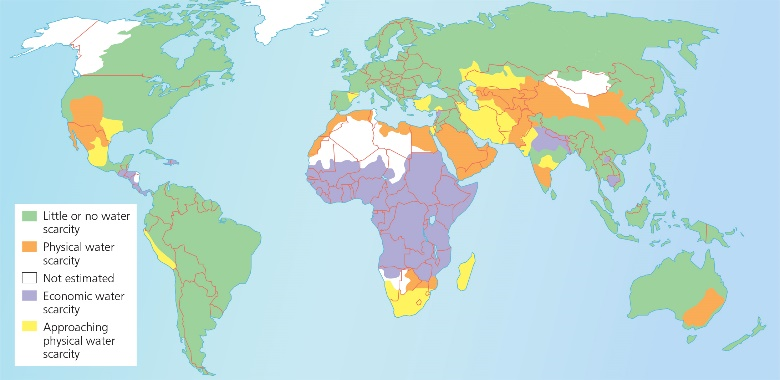
Water security: the capacity of a population to manage sustainable access to acceptable quality water for wellbeing, development, politics, the environment and for preventing disease. Limited worldwide
½ worlds hospital beds for water-borne diseases
140m hours/day spent by women and children collecting water
750m people lack access to safe water – 82% rurally
Denied access: due to economic, political, social issues
Detroit: 40,000 resort to nightly ‘water-tapping’, as they cannot afford water bills
Bolivia: French owned water company deemed too expensive, so 200,000 people did not connect
Water Quality
Water types
Green water: part of total precipitation absorbed by soil and plants, that is released to atmosphere
Blue water: part of total precipitation that collects in rivers, lakes, wetlands and ground water – can be consumed
Grey water: wastewater without faecal contamination
Potable water: suitable for human consumption – free from diseases and clean (free of sediment)
Sewage treatment plants in HICs and MICs turn raw sewage into clean water for discharge, or to be returned as drinking/fresh water
Virtual water: the amount of water used to produce food or products, and is therefore embedded in item
1 steak: 4500 litres of water
1 coconut: 2500 litres of water
Measuring water quality: is important to decide if it is safe for consumption, irrigation or discharge
Turbidity: size and number of sediment particles
Biological: bacteria and viruses living in the water
Chemical: concentrations of chemicals in water
Contamination: leads to disease from water, which kills roughly 500,000 people each year
1997: 369 cases of cryptosporidiosis occurred, caused by a contaminated fountain in the Minnesota zoo. Most of the sufferers were children
1.8bn people are estimated to drink faecally contaminated water worldwide
Damage to Rural Environments
Overpopulation: available resources are unable to support a population. Population size cannot be maintained to meet needs of the current, without compromising the needs (resources) of the future
Cause: rapid economic development as a nation moves to stage 2 of the DTM (huge death rate drop)
Issues
Unemployment: too many people per farm means there are more people than work – although lots of manpower could be useful for manual labour
Reduced food/water: if everyone farms subsistently, then may run out of food
Worse sanitation: more people using the same poor, undeveloped toilets and water leads to higher cases of water borne diseases like Cholera
Triggers: overgrazing and deforestation to make enough food, and room, respectively
Solutions (may encourage damage)
Rural-to-urban migration: accounted for 80% of Chinese and Thailand city growth, 59% Namibia
Investment: further drives economic development, reducing the birth rate, and improving conditions
Greater land exploitation: aims to feed more people, but at the expense of soil quality and forests
Green revolution: to increase food production
Poor agricultural practices (overgrazing): plants and soil is exposed to excessive grazing for extended periods of time, with/out sufficient recovery periods
Cause: intense crop production. No fallow period, or fertilisers leads to all of the nutrients being stripped from soil. Therefore crops can’t grow in spots, and soil erodes by wind and rain
Issues
Food shortage: 690m people worldwide go hungry
Global warming: reduced foliage means less carbon dioxide capture, contributing to GHG effect
Soil degradation: 1 to 6bn hectares land degraded
Solutions
Sustainable practices: manage livestock and crop rotations to ensure soil stays in good condition
Livestock: feed with stored fodder and control time land is exposed to trampling
New technology: combine scientific developments with local expertise to reach an appropriate solution
Deforestation: the action of clearing a wide area of trees, so that the land can be used for other purposes
Cause: forests are cleared because people have no choice. Overpopulation means more food must be produced, and overgrazing means no land is available to do it; so new agricultural land must be created
Issues
Global warming: responsible for 20% of global greenhouse as emissions, contributing to 0.5°C rise
Run out of fuel: current fuelwood usage exceeds the growth rate, so will run out
Landslides: the removal of trees also means the removal of the roots that bind soil together, reducing its total shear strength
Triggers: water quality issues and soil degradation
Solutions
Legislation: ban slash and burn techniques
Reforestation: fund the planting of new trees
Reduce consumption: of products that require deforestation – eg. meat, paper, palm oil
Urban environments: cause rural degradation from polluted water, excessive water abstraction, air pollution from power stations/factories etc…
Damage to Urban Environments
MICs
Urbanisation: the increase in the number of people living in towns and cities
Cause: primarily due to a huge influx of rural residents migrating to urban areas, as they’ve been pushed (no jobs, bad living standards) and attracted to the bright city lights – hopes of a better future
Issues
Informal housing: poor planning and provisions means most houses are in squatter settlements. 80% of Addis Abba homes are slums due to deterioration, population density and infrastructure
Sanitation: extremely poor due to no official access to mains water or sewage treatment. Slum children are 50% more likely to be stunted
Food distribution: little money means food is hard to access, but city pollution due to industry may mean it is disrupted, or not safe to eat
Solutions
Recognise shanty towns: leads to provisions of water supplies, electricity and waste treatment. 60km of cables in Rocinha has increased electricity provisions by 30%
Self-help schemes: Favela Bairro Project in Rocinha, Rio de Janeiro provides land and services
Healthcare: 8000 kits deployed in Rio shanty towns to detect 20 common diseases, since only 55% have access to healthcare, and life expectance is only 45
Industrial development: the period of social and economic change that transforms a society from agrarian (farming) to industrial (manufacture)
Cause: technological and scientific developments allow for automation and the use of machines, leading to an explosion in productivity, and jobs
Issues
Environmental degradation: toxic emissions and by-products released with little regard for nature
Poor working conditions: people forced to work 14 to 16 hours per day. Foxconn factory workers only paid a maximum of $10k per year, 3x less than US
Overcrowding: huge influx of workers to a small area leads to high population density and disease
Solution: bring in legislation to protect workers and the environment, without harming the economic benefits of the industrialisation period
HICs
Inadequate infrastructure: the outwards migration of shops and services from the inner-city leaves it disconnected and promotes degradation
Cause: as HIC cities get busier, traffic routes such as ring roads are needed to cope – causing a ‘doughnut’ ring of good accessibility, services follow, leaving the inner city with few transport links and services
Issues
No investment: derelict nature of the inner-city creates a spiral effect of no investment, so further degradation, so even less attractive to investment
Urban sprawl: ‘doughnut’ will keep growing in size as the further away from the inner-city, the cheaper and more accessible the land, so more homes
Solution: investment in transport will cause a revival. Manchester given £1.5bn from fund, borrowed £1.2bn for roads; created 57 mile long Metrolink
Ageing buildings: over time, buildings become derelict – not cared for, and in a bad condition (crumbling)
Cause: rapid outwards growth of cities means that the newest buildings are in the periphery zones, and older, central buildings age without maintenance
Issues
Cracked walls: plaster and brick work naturally degrades with weather exposure over time becoming unstable
Roof leaks: wooden beams rot and slates loosen
Unsuitable for humans: may contain hazardous substances such as asbestos, or is at risk of collapse and therefore is a hazard to human lives
Solutions
Investment schemes: New Islington, Manchester underwent 21 year scheme to turn it from a council estate to an area where houses cost > £300k
City buy-back: local council buys the property off the reluctant property developers and re-develop it
Social segregation: proportions of population rates of two or more populations are not homogenous (the same) in a city. Eg. different income levels, ethnicity
Cause: rich and affluent leave the inner-city for new, modern sub-urban developments, leaving only the poorest, or certain ethnic groups if some leave
Issues
Low tax income: if only the poorest remain, there will be little to no income for the city, and therefore buildings cannot be repaired – further degradation
Racial tensions: the isolation of ethnic groups (China town etc), may give rise to conflict, failure to integrate and language barriers
Solutions
Inclusive planning schemes: city planners, event managers and property developers should aim to achieve a blend of cultures and income levels; which could mean taking on the cost of developing undesirable properties for affluent buyers
Deindustrialisation: the reduction of industrial activity or capacity in a region (an urban area) or economy
Cause: globalisation and rising incomes in HICs has resulted in the outsourcing of manufacture to MICs
Issues
Derelict factories: closure means an end to maintenance, so buildings begin to crumble, reducing the value of the land in the area
Unemployment: low-skill workers no longer needed since factories shut down, sudden surge in poverty and then crime
Solutions
Regeneration: Manchester mills turned into flats that sell for up to £400k (Hilton Street, Gotham City)
MICs and HICs
Inadequate waste management: poor stores, collection and sanitation of solid and liquid waste
Cause: direct link with development. The richer the city, the more consumable products used and therefore waste produced. Likewise, in cities with rapid development, waste management can not develop at the same rate of waste production
Issues: landfill sites and waste transportation
Landfill chemicals leach into soils and water stores
Atmospheric pollutants (methane from landfill = 35% of the UK’s total methane emissions) and very bad odour produced as material decomposes
Garbage trucks add to city congestion
Loose material in landfills moved by winds to other locations, causing risks elsewhere
Plastics take 450 years to decompose
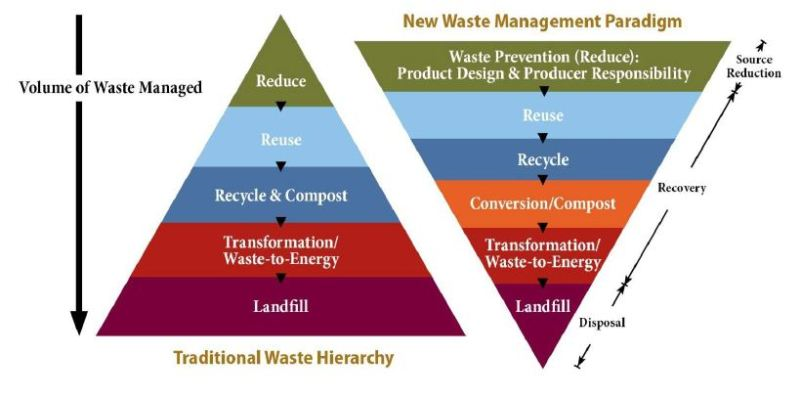
Solutions: reduce volume to landfill
Energy from waste plants: in New York, 450-600 tonnes waste is collected and transported by ship to plants as far away as Ohio and South Carolina. Burnt for energy, costs $430 per year
Compositing: 40% of household waste is biodegradable, can produce biogas
Recycling/Reuse: plastic bottles easily sterilised and reused, uses 20x less energy to recycle aluminium cans than make from scratch
Policy: IOM aims by 2022 to recycle 70%, energy from waste 25% and only 5% to landfill
Rural environments: cause urban degradation due to runoff from fertilisers and pesticides, deforestation and high levels of rural-to-urban migration – ‘urbanisation of poverty’
Improvement constraints
Common to both rural and urban environments
Environmental: considerations to sustainable practices, climate change and natural hazards must be made. Soil quality must be maintained in rural areas
Economic: often the investment needed to fix an area far exceeds the amount the area could possible afford
Political
Civil war: can halt development by decades
Corruption: rife in LICs, and some HICs
Social
Population growth: high, putting pressure on environments
Migration: rural-urban applies more pressure to urban areas, but also pressure to rural areas, as a loss of workforce may lead to unsustainability in farming
Poor management: leaves problems unsolved
Protection of at-risk Environments
At regional and local scales it is important to protect at-risk environments, as there could be social, economic, and environmental impacts otherwise.
Need for: defining what can be sustainably achieved to protect the environment, while not hindering social or economic progress.
Measures: the policies and actions to be taken.
Outcomes: the level of success those policies and actions have achieved