4) The first world war
War and Revolution
August 1914: Russia entered the First World War.
Initially, tensions in Russia seemed to disappear.
Tsar Nicholas II appeared popular, and there was a surge of patriotism.
The initial support was short-lived.
Soon, the Tsar began to lose backing from key parts of Russian society.
In August 1914, Russia entered the First World War, and for a brief period, tensions in the country seemed to ease. Tsar Nicholas II appeared genuinely popular, and there was a wave of patriotic enthusiasm among the people. However, this initial support did not last long. Over time, the Tsar began to lose the support of important sectors of Russian society, setting the stage for growing unrest and instability.
I. The army
Russian army was huge and mostly conscripts.
Soldiers initially enthusiastic, motivated by defending Russia rather than loyalty to the Tsar.
Fought bravely but poorly led and ill-equipped; shortages of rifles, ammunition, artillery, shells, and even boots.
Aristocratic officers treated soldiers badly.
September 1915: Tsar Nicholas II took personal command of the army.
Nicholas was not an effective commander; people blamed him for defeats and mistakes.
Heavy losses continued through 1916.
By 1917, army discontent was widespread.
The Russian army was massive, made up largely of conscripted soldiers. At first, the troops were enthusiastic, fighting to defend Russia rather than out of loyalty to the Tsar. Despite their bravery, they were poorly led, badly treated by aristocratic officers, and lacked essential equipment, including rifles, ammunition, artillery, and even boots. In September 1915, Tsar Nicholas II took personal command of the army, but his lack of military skill meant defeats continued, and the public increasingly held him responsible. By 1917, the army was deeply discontented due to ongoing losses and poor conditions.
Source 1:
Army lacked basic supplies: wagons, horses, first aid.
At Warsaw station, ~17,000 wounded soldiers crowded together.
Soldiers left on the cold, dirty platform without straw or proper care.
Wounded cried out for medical attention; some went unattended for five days.
Report by Michael Rodzianko, president of the Duma, highlights the appalling conditions.
Michael Rodzianko, president of the Duma, described the terrible conditions faced by Russian soldiers during the war. At Warsaw station, around 17,000 wounded men were left on a cold, filthy platform without straw, wagons, horses, or first aid supplies. Many went unattended for five days, crying out for help, showing how badly the army was organised and cared for.
Figure 1:
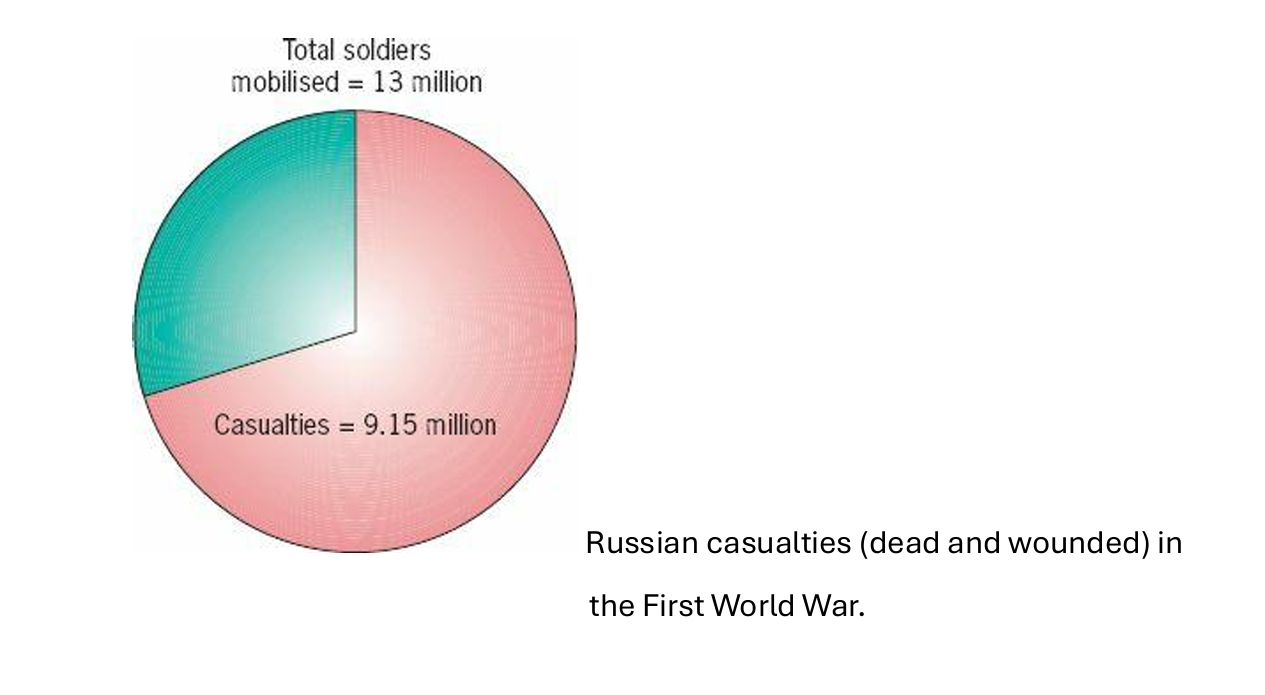
II. Peasants and Workers:
War casualties created many widows and orphans; state pensions often not paid.
Food production stayed high until 1916, but government could not always pay for it.
Government considered taking food by force but feared widespread revolt.
By 1916, cities faced major discontent: 3.5 million new industrial jobs (1914–1916) with little extra pay.
Overcrowding worsened; fuel and food shortages persisted.
Rail network unable to meet army, industry, and city needs.
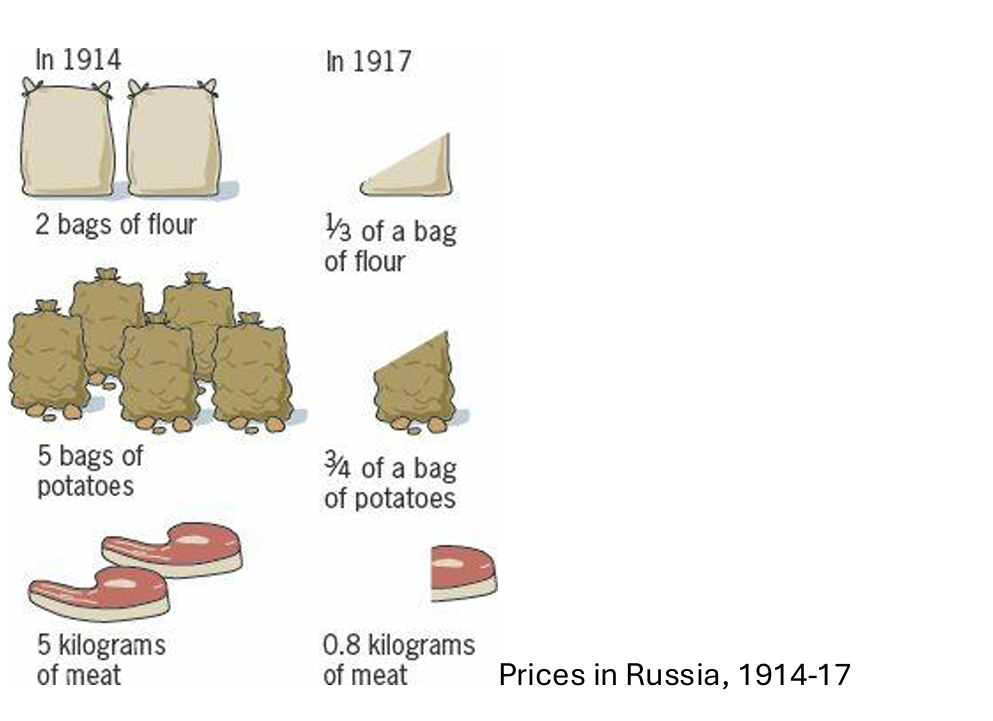
Prices rose sharply; workers queued for bread and blamed the Tsar.
The strain of war caused growing discontent among Russian peasants and workers. Many widows and orphans struggled to receive state pensions after the heavy casualties. By 1916, although food production remained high, the government often could not pay for it and feared taking food by force might trigger revolt. Cities suffered from overcrowding, fuel and food shortages, and rising prices. War contracts created millions of industrial jobs, but wages remained low. Long bread queues and daily hardships left workers increasingly frustrated, blaming the Tsar for their suffering.
III. The middle classes
Middle classes less directly affected than peasants/workers but unhappy with Tsar by 1916.
Zemstva activists created medical organisations (like Red Cross) and war committees, often more effective than government agencies.
Industrialists complained of shortages of raw materials and fuel, limiting ability to meet war contracts.
In 1915, Duma politicians formed the Progressive Bloc, urging Tsar to work in a more representative government.
Tsar dismissed the Duma a month later, ignoring their demands.
By 1916, the middle classes had also grown frustrated with the Tsar. Zemstva activists set up medical organisations and war committees that were often more efficient than the government. Industrialists struggled to meet war contracts due to shortages of raw materials and fuel. In 1915, the Progressive Bloc of Duma politicians urged the Tsar to adopt a more representative style of government to unite the people, but Nicholas dismissed the Duma a month later, increasing middle-class discontent.
IV. The aristocracy
By late 1916, the Council of the Nobility called for the Tsar to step down.
Junior army officers (mostly aristocrats) suffered heavy war losses.
Conscription of 13 million peasants left estates short of workers.
Leading aristocrats disliked Rasputin’s influence over the government.
Tsar left Petrograd (capital at the time) to command the army; his German wife Alexandra controlled the country, causing rumours.
Rumours included possible affair between Alexandra and Rasputin.
Ministers were dismissed and replaced frequently.
Rasputin was murdered by leading aristocrats in December 1916 due to concerns about his influence.
By late 1916, the aristocracy had turned against the Tsar. Junior officers suffered heavy losses, and the conscription of millions of peasants left estates without workers. Many aristocrats were alarmed by Rasputin’s influence and the rumours surrounding Alexandra, who controlled the government while Nicholas commanded the army. Ministers were dismissed and replaced often, increasing instability. Ultimately, a group of aristocrats murdered Rasputin in December 1916 to remove his influence.
Source 2:
Source 3:
Rodzianko warned the Tsar about Rasputin’s influence at court.
Claimed Rasputin undermined confidence in the monarchy.
Suggested Rasputin could harm the dynasty and turn people against the Tsar.
An order was issued to send Rasputin to Tobolsk in March 1916.
Empress Alexandra demanded the order be cancelled, which it was.
In March 1916, M. Rodzianko, president of the Duma, warned the Tsar that Rasputin’s influence at court was dangerous. He argued that Rasputin undermined confidence in the monarchy and could harm the dynasty, turning the people against the Tsar. Although an order was issued to send Rasputin to Tobolsk, the Empress intervened and had it cancelled, showing her strong control and the Tsar’s inability to limit Rasputin’s power.
ACTIVITY:
Use the information on The Army, The Workers, The Middle Classes and the Aristocracy to fill in the table to answer the question: How far was the Tsar weakened by the First World War? (use the sources as evidence if appropriate)
Group | Impact of war and how far was the Tsar weakened by their situation |
The Army | The army suffered massive losses, was poorly equipped, badly led, and lacked boots, rifles, and ammunition. Nicholas II took personal command in 1915, making him personally responsible for defeats. This caused widespread discontent and weakened his authority among soldiers. (Source 1 supports poor conditions.)
|
The workers | Food and fuel shortages, overcrowded housing, low pay despite extra industrial work. Long queues for bread and poor conditions led to growing anger toward the Tsar. Workers’ loyalty declined, increasing opposition to his rule.
|
The Middle Class | Middle-class activists tried to support the war independently via medical aid and supplies, showing government inefficiency. Industrialists struggled with raw material shortages. Duma politicians (Progressive Bloc) urged the Tsar to cooperate; he ignored them, showing he had lost middle-class support.
→ he ignored them, which showed that he lost middle-class support |
The Aristocracy | Junior officers (mostly aristocrats) suffered heavy casualties. Landlords lacked peasants to work estates. Rasputin’s influence over the Empress caused distrust and anger. Some aristocrats even plotted and assassinated Rasputin, highlighting serious dissatisfaction within the elite and further weakening the Tsar.
→ highlighted serious dissatisfaction in elite → weakened further the Tsar and his power over control |