Chapter 3: Gains from Trade
interdependence: depending on strangers from around the world to provide things.
Almost everything you have was made or grown, or assembled in different parts of the world.
Example: bread and cheese
Jacob and Tara both like bread and cheese. Jacob only produces bread and Tara produces cheese. If one was self-sufficient they would get bored just eating only bread or only cheese, so they would trade.
People trade to get a greater variety of goods and services in their lives.
Imagine Tara produces good cheese, but terrible bread, she would leave it to Jacob to make the bread. Because that is his specialization.
Production without trade
assuming Jacob and Tara both only work 8 hours a day and can spend this time making bread, cheese, or any combination of the two.

the first two columns show how much it takes to make one unit of each food. The last two columns show how many units they can make in a day if they only make one type of product.
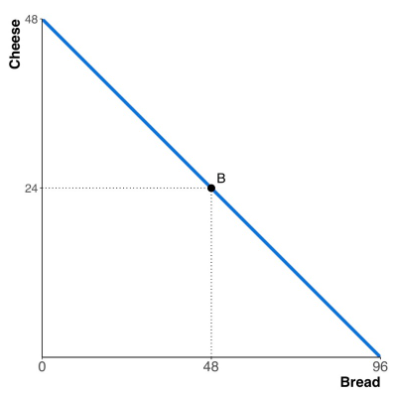
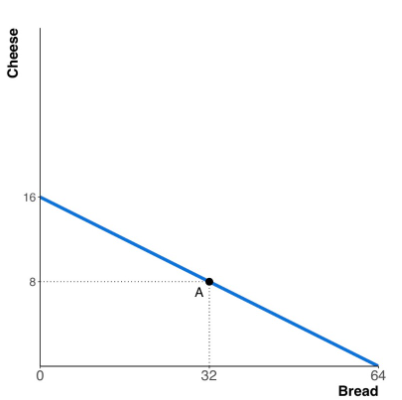
The two graphs show each person’s PPF and trade-offs if they were to make a certain amount of each product
Production with Trade
Now imagine that they want to trade. Jacob only makes bread and trades with Tara who only produces cheese. If Jacob makes 64 loaves in one day and gives 30 to Tara in exchange for 10 pieces of cheese. Rather than 32 loaves and 8 pieces of cheese if he was self-sufficient. So with trade Jacob can consume more of each good with the same amount of effort as before.
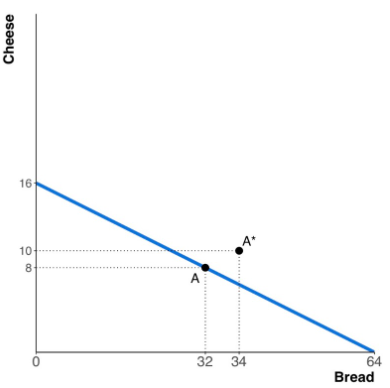
Jacob won this trade, but that doesn’t mean Tara lost. Suppose Tara spent 6 hours making cheese and 2 hours making bread. She would end up with 36 pieces of cheese and 24 loaves of bread. After she trades 10 pieces of cheese for 30 loaves of bread, she ends up with 16 pieces of cheese and 54 loaves of bread. So she will consume more of both goods rather than she was self-sufficient.
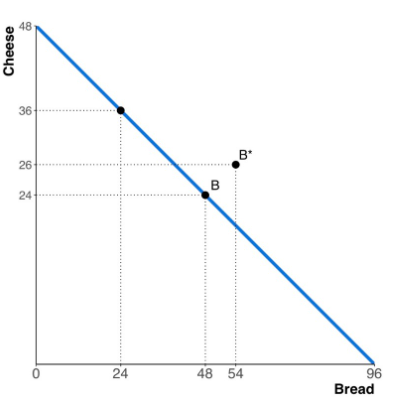
B = without trade
B* = with trade
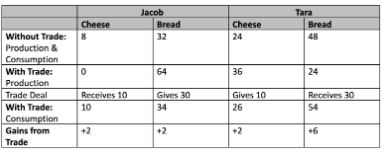
Trading with another country with a comparative advantage in a good can benefit both and go over the PPF line.
Comparative Advantage and Specialization
if Tara is better at making bread and cheese than Jacob, how can she gain from trades? The answer is comparative advantage.
comparative advantage: the ability to make more goods or services at a lower opportunity cost than another producer.
To figure out comparative advantage you have to find who can make the product at the lowest cost. Do this two ways
- Absolute advantage: if someone who uses the least amount of inputs to produce a good.
Tara has an absolute advantage in both bread and cheese over Jacob since the only input is time. Tara only needs 10 minutes to make cheese whereas Jacob needs 30. Tara can make a loaf of bread in 5 minutes when Jacob needs 7.5.
- Comparative advantage: when someone can produce a good at a lower opportunity cost than another producer.
Tara’s opportunity cost to make a loaf of bread is 0.5 pieces of cheese. (She spends 5 minutes making bread, which is 5 minutes away from her needing 10 minutes to make a piece of cheese. so she would only make half the cheese). Jacob’s opportunity cost of making 1 loaf of bread is 0.25 pieces of cheese. The opportunity cost of the other way around would be just that. Tara’s opportunity cost of 1 cheese is 2 loaves of bread. And Jacobs's opportunity cost of 1 cheese would be 4 loaves of bread.
Comparative Advantage and Trade
Economic Pie: when each country specializes in the good they have the comparative advantage in.
When jacob and Tara both make the product they specialize in the production of bread increases from 80 to 88 and cheese 32 to 36
Jacob is buy 1 piece of cheese at the price of 3 loave, which is lower than if he didn’t trade, the cost would be 4. Tara buy 1 loaf for 1/3 of a piece of cheese. they are both benefitting.
Trade and price
Jacob and Tara trade 1 mpiece of bread of 3 pieces of cheese, it is between Tara (2 loaves) and Jacob’s (4 loaves) opportunity cost. The price did not need to be in the middle, but it did have to be between 2 and 4.
countries, like individuals, benefit from trade.
importing: a country buys a good from another country
exporting: when a country sells a good to another country
a country can have a better opportunity cost than another based on land and the resources in it.