Task 2
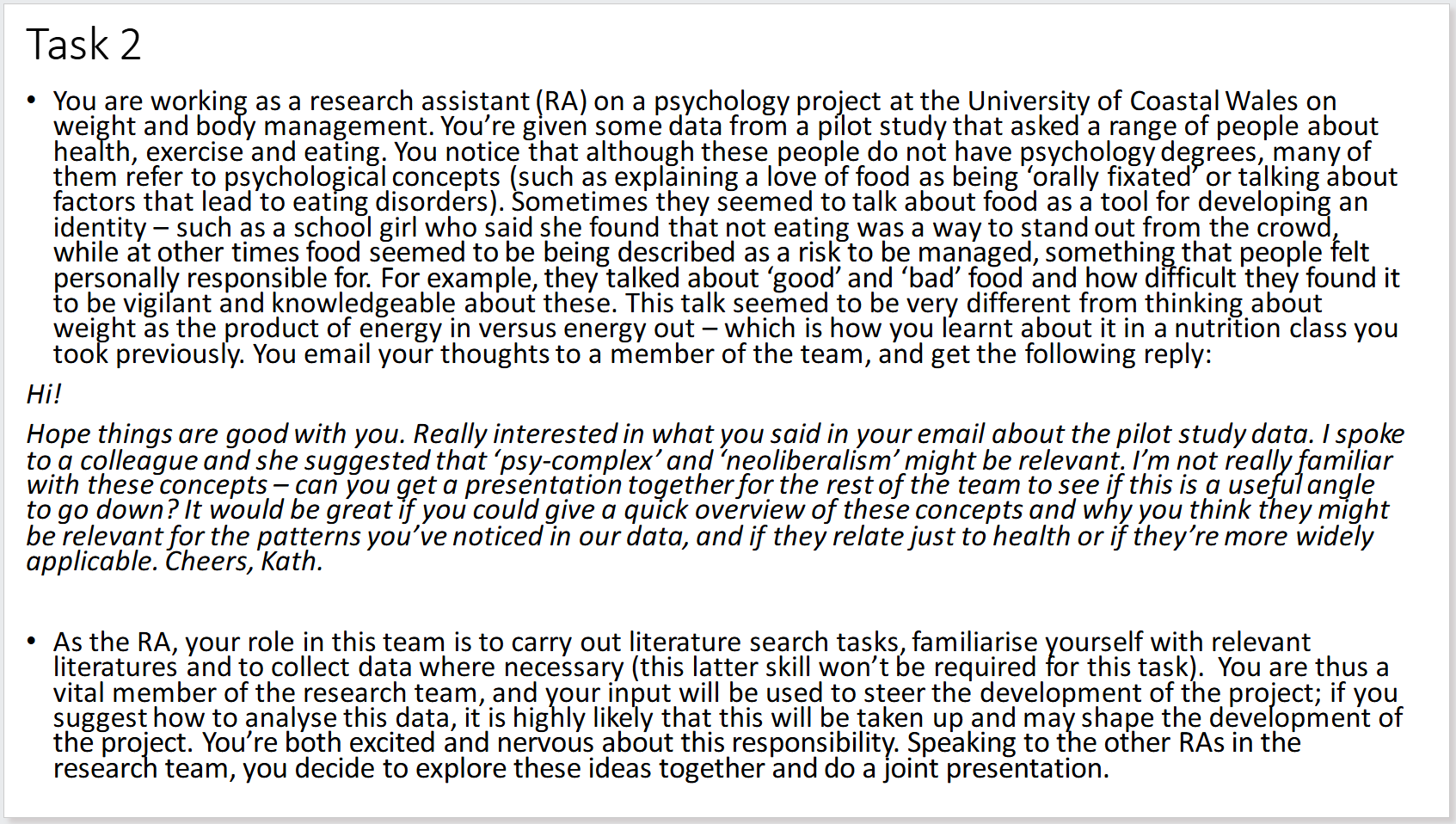
Breaking down the task
How can we make sense of the way people talk about food and eating?
Think about taken for granted knowledge about food
From your task 1 presentation, write down one concept from social constructionism
Using this concept, what can we say about the sense making in the data set?
Critical stance towards taken for granted knowledge
Meanings are arbitrary relational multiple changeable
Socio-historically located (linked to power – knowledge/power
Produced through social processes (macro/micro)
Linked to action – what people can say think and do
Create subject positions e.g. good health citizen
Required elements for presentation
introduce task and topic (how people talk about food in contemporary times)
define governmentality, neoliberalism, and psy-complex
social constructionist perspective and links to languages of governmentality
application to real world example
reference page
We can ask questions like:
How are people talking about food? i.e. what meanings (discourses) are they using? psychology, identity, risk, inner self dictates the behaviour and appearance
What socio-historic context enables these?
What social processes circulate these meanings?
What are the consequences for using them?
How are people talking about food?
Psychological/psychoanalytic concepts
(e.g. love of food is being ‘orally fixated’)
Developing an identity
(e.g. the girl who stands out by not eating)
As a responsibility/risk to be managed
(e.g. talking about ‘bad food’)
What is the context that enables such talk?
Psy-complex and neoliberalism – concepts that can help you think about they ways that people talk about food
What are the consequences?
We don’t know yet – but they will impact on how people make sense of health and eating
Governmentality
Overarching concept → neoliberalism and psy-complex come under this
Refers to the "art of government" or the "conduct of conduct," describing how modern power operates through dispersed, non-coercive techniques to guide, shape, and influence the actions and self-regulation of populations
Modern power works through psychology and concepts of the self
People take up discourses of the self and apply them to themselves, acting as their own guards
Disciplinary power: people taking up discourses of the self and making them their own
Sovereign power – visible, power over death
Democracy – need to govern by consent
Governments developed disciplinary power – power over life itself
Collected information, knowledge, statistics to create norms, optimize productivity, and encourage self governance
‘not everything is bad, but everything is dangerous’ (Michel Foucault)
State provided schools, hospitals, universities all concerned with measurement that creates norms
How you measure people renders them ‘knowable’ – it conceptualizes them in particular ways (.e.g. big families = a drain on the system)
These subject positions enable making sense of the self - by self and others
Provides the tools for directing behaviour that doesn’t look coercive: people avoid negative stigma to be ‘normal’
People (and society) think that having a smaller family is a rational ‘choice’
Powerful social norms
Conformity to norms achieved through emotions:
Shame at not ‘belonging’
Satisfaction or joy in meeting expectations
Fear of being shamed or stigmatized
Hope that we might meet normalized goals in the future
Most of the control exercised to mould who we are and what we do is done by ourselves
(Wendy Stainton-Rogers, 2011, p.73)
But just because we do this to ourselves does not mean it is genuinely ‘choiceful’ since we are produced through discourses in our culture
But language is multiple, contested, and there is always room for resistance…
Governmentality continued
Managing people makes them knowable in particular ways
Creates discourses of subjectivity and subject positions
People then manage themselves in relation to those discourse/desired subject positions
Disciplinary power – since discourse structures what we can say think and do
Requires ways of conceptualising the person – ‘languages of government’
Two contemporary ‘languages of government’
Psy-complex: a psychological view of subjectivity, a language of the individual’s interior driving behaviour
Neoliberalism: autonomous rational individual responsible for themselves, managing risk, engaged in a constant process of self-improvement or transformation
Psy-complex
The set of professions dealing with the psyche: psychology, psychiatry, psychoanalysis, psychotherapy, psychiatric nursing, and psychiatric social work. The term derives from the work of Michel Foucault and French poststructuralists such as Jacques Donzelot and Robert Castel, who analysed the role of the social and ‘psy’ professions in regulating family life,
sexuality, mind, and rationality. A Dictionary of Sociology, Oxford University Press
Psy-complex study of historical and contemporary production of psychological concepts, and the consequences of taking them up
Historic and contemporary production of psy-complex
e.g. ‘true’, internal, bounded self that can be found
How we came to think that this is normal or natural
e.g. tracing the rise of asylums, psychiatric movements
Cahill (1995) argues that this interior reflection and sense of self is relatively new socio-historically
Psychological language is normal and pervasive.
It is part of our situated, ‘taken for granted’ knowledge that structures what we can say, think, and do
But it can problematise, categorise, medicalise, and stigmatise
Consequences of taking them up to make sense of themselves
What possibilities does it open up or shut down?
Part of governmentality because psychology defines ‘what people can think about themselves’(Goodley & Parker, 2000, p.4)
We use psy-complex to make sense of ourselves in ways that reproduce therapy culture – we look inward and then ‘confess’ our inner thoughts and emotions e.g. Jeremy Kyle, MBTI
Part of disciplinary power – we learn to think about ourselves in psychological ways and act in line with these (normalization and confession)
Psy-complex and food
Accounting for herself
Confessional of the interview
Psychological terms
‘True’ self
Responsible/knowledgeable person (for self/health)
Disciplinary power – eating healthily?
Neoliberalism
Neoliberalism is a dominant political and economic ideology that advocates for free-market capitalism, minimal government intervention, privatization, deregulation, and reduced public spending. Originating in the late 20th century, it promotes competition, individual responsibility, and the belief that markets are the most efficient way to allocate resources.
Late modern political philosophy:
Free market
Deregulation
Minimal government interference
Reduced welfare state
Individual responsibility and agency
Operates through a ‘multiplicity of networks, nodes, and modes (Venugopal, 2015, p.170)
A different language of governmentality:
People encouraged to see themselves as autonomous, rational, risk managing beings, responsible for their own destinies
Self directed project of self improvement
Requires scrutiny and work
Often through consumption
Outcome is your responsibility
What’s the problem with neoliberalism?
Creates a ‘blame the victim’ culture – moral dimension to people’s behaviour
Locates problems at the level of the individual rather than institutions i.e. encouraging people to make ‘healthy choices’ rather than creating a healthy food and exercise environment
All pervasive – difficult to think outside its logic
There is a particular and painful focus on the body – appearance and health that encourages regulation of diet
Neoliberalism has produced the discursive context for problematic eating:
When I first started dieting if I found out something was healthy, I had to have it. I felt that I was being different to most people eating chips and I suppose in a way that I would get recognized for being healthy. I don’t know why this felt good, it’s as if people would think I was doing good’ (Ruth) ‘For many of our participants, weight loss, dieting…constituted techniques through which they could be recognized as demonstrating autonomy, self-control and achievement’ (Rich & Evans, 2008)