Unit 7: Evolution
Slogan: Continuity and Change
Critical Unit notes
!!!INDIVDUALS DO NOT EVOLVE !!!
Evolution is driven by DNA Mutation
7.1: Introduction & Evidence of Evolution
Domains: The taxonomic groups that are even bigger than kingdoms
Archaea
Bacteria
Eukarya
Theory vs. Scientific theory
A scientific theory is backed by research, evidence, and enable valid predictions
A popular definition for theory would be “guess“ or “hunch“
Examples of different types of theories ↴
Atomic Theory- Chemistry
Fundamental Theory of Calculus- Calculus
Cell Theory- Cellular Biology
Evolution
↳ Defined as descent with modification (change OVER TIME)
↳ Evolution occurs within POPULATIONS of the same species over time
!!!!! REMEMBER !!!!!! IMPORTANT !!!!!
!!!INDIVDUALS DO NOT EVOLVE !!!
!!! POPULATION EVOLVE AND ADAPT !!!
*Go to page 3 for examples on evolution and how it occurs*
Jean Baptiste Lamarck
Believed in Spontaneous generation
Things evolved from dead matter
Main things to note: his findings were wrong and defines what evolution IS NOT
Agrees with Darwin on the note that: species are not fixed, but evolve and change over time
Types of evolution
Convergent: the evolution of an unrelated species that share similar traits
Different ancestor, same problem
Divergent: Evolution of a related species that share a common ancestor with different traits
Same ancestor, different problems and solutions
Adaptive radiation: Evolution of many diversly adapted species from a common ancestor upon introduction to various ne environmental opportunities
When organisms find various niches
Evidence of Evolution
Geologic Evidence
↳ Fossils have been preserved in Earth crust
↳ For Carbon dating we use C-14 (half life of 5400 years) to calculate how old a fossil is
Biogeography
↳ Refers to the geographic distribution of a species
↳ Pangea and continental drift explains similarities on different continents
↳ Endemic species: found in a certain geographic location and nowhere else
↳ Marine iguanas in the Galapagos
Homology
↳ Refers to characteristics in related species can have underlying similarity even though functions may differ
↳ Homo = Same
↳ Logos = relation, proportion
Homologous structures: Similar anatomy from common ancestors
↳ e.g. forelimbs of a human/whale/cat/bat
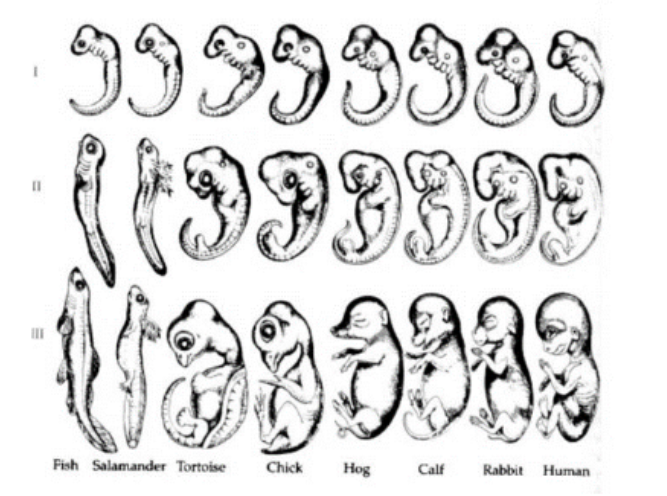
Embryonic homologies: Similar early development
↳ e.g. vertebrate embryos with a tail and pharyngeal pouches
Vestigial organs: Structures with little or no use
↳ e.g. flightless birds
Molecular homologies: similar DNA and amino acid Sequences
Anatomical Evidence
Homologous structures
Structures that are similar structures occurring in different species, but are derived from the same ancestor
Divergent evolution (common ancestor, different pressures)
Analogous structures
Structures that are similar structures in a different species
Convergent evolution (Different ancestor, similar pressures)
Like analogies, they may not be the same, but you can compare them
Convergent Evolution
↳ Results when distantly related/ unrelated species can resemble one another
↳ Similar problem, similar solution
↳ e.g. torpedo shape of sharks, penguins, and dolphins
Divergent Evolution
↳ Results when two species share a common ancestor
↳ Same ancestor, different problem + solution
↳ e.g. limbs of humans, cats, whales, and bats
Vestigial Structures
↳ Structures that has lost all or most of its original function
↳ e.g. the ability to move our ears
Embryological Evidence
↳ We compare the morphology (physical structures) embryos of different organisms at different stages
Genetic Evidence
↳ Comparing the genetic sequences and genes of different organisms
↳ Hox genes are a group of related genes that specify regions of the body plan of an embryo along the head-tail axis (spinal axis)
↳ This is both embryological and Genetic Evidence combined
Endosymbiotic Theory
↳ Explains how the mitochondria and chloroplast became organelles
The outer membrane is similar to that of the plasma membrane
Mitochondria look a lot like bacteria; chloroplasts look like blue-green algae
↳ Both these organelles are similar to prokaryotes in that:
a. Both have circular (naked) DNA
b. RNA is similar
c. Both have prokaryotic sized/type of ribosomes
d. Inner membrane lipids are similar to the prokaryote counterparts
e. Membrane proteins are HIGHLY similar
7.2: Natural Selection
Charles Darwin!
Best known for the Galapagos island observations (finches)
Wrote One the Origin of Species
Presented evidence that evolution has been happening for years
The struggle :(
Members of each species compete for resources
The faster, mor adept predators get lunch
The faster prey, or ones with good camouflage get away
Adaptations allow organisms so survive
Adaptations
↳ Any trait that improves the chances of survival and reproduction
!!!HOWEVER!!!
!!!INDIVDUALS DO NOT EVOLVE / ADAPT!!!
↳ There are two types of adaptations
Structural adaptations
↳ Changes the structure of the body parts
Mimicry: Provides protection by copying the appearance of another more threatening species
Big eye on butterfly wings
Camouflage: Enables an organism to blend in with its surroundings
A moth with a tree bark pattern on its wings
Physiological adaptations
↳ Changes the organisms metabolic process
Some bacteria evolve to be immune to antibodies
Possessing a gene of resistance for antibodies
Bacteria pop. is exposed to antibody
Resistant bacteria survive, less fit die
Resistant bacteria reproduce
Over time, all bacteria is immune
Natural Selection
↳ A mechanism for change in populations that occurs when organisms with traits allow them to survive, better reproduce and pass on those traits to their offspring
Stipulations
Overproduction: There is a tendency for more offspring than can possibly survive
↳ Type 3 survivorship curve
Variation: Individuals will have small differences in phenotypes
Different Reproductive Success: Individuals with traits that allow them to be fit in their environment, live long enough to pass on those traits, which later can make up most the population
Inheritance: Variations are inherited from parents
Survival of the fittest
Fitness: An organisms ability to survive and reproduce in a particular environment
Essentially the “fittest“ will have the best traits for the environment whilst the “not so fit“ will die off and will not pass on their “not so fit“ traits
Relative fitness: Contribution an individual makes to the gene pool of the next generation relative to contribution of others
*Tap and hold image to make larger when viewing on a phone*
Directional selection |
| 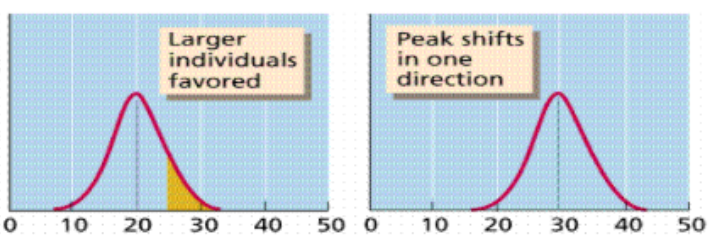 |
Stabilizing selection |
| 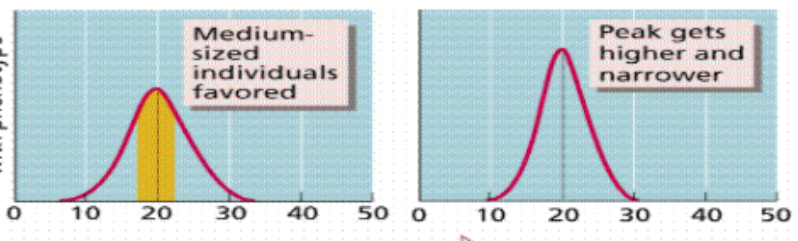 |
Disruptive selection |
| 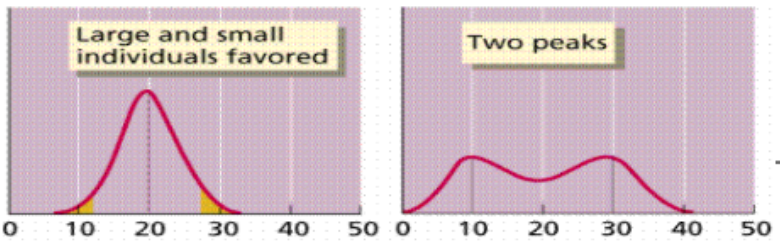 |
7.3: Specification & Mechanisms of Evolution
The major mechanisms of Microevolution
Natural selection
Genetic drift
Gene Flow
Natural Selection
Microevolution: Change in allele frequencies within a single gene pool
↳ Small changes
Macroevolution: Evolutionary change above the species level
↳ Cumulative effects of speciation over long periods of time
Sources of Genetic Variation
Mutations are the ONLY source of new genes and alleles
Fast reproduction in prokaryotes results in a higher frequency of mutations
S3xual reproduction: allows for shuffling of existing alleles
Crossing over, independent assortment, random fertilization
Biological Species Concept
Species: A population/group whose members can interbreed and produce fertile offspring
Speciation: The process of creating new species
Reproductive isolation: Barriers that prevent member of two species from producing viable, fertile hybrids
Other Definitions of species:
Morphological: By body, shape, size, structural features
Ecological: niche/role in community
Phylogenic: share a common ancestor
Modes of Speciation: | Allopatric Speciation “other homeland“ | Sympatric Speciation “together homeland“ |
What it is: | Geographically isolated population | Overlapping populations within the same geographic area |
About it: |
| Gene flow between subpopulation blocked by:
|
Examples: | Squirrels on the N/S rims of the Grand canyon | Polyploidy in 80% of plants (oats, cotton, potatoes, wheat) |
#9d07d3
Sympatric Speciation by Polyploidy
Autoploid: The presence of more than two copies of each genome wihtin an organism or species
↳ This results from a failure of a cell division (2n → 4n)
↳ Strawberries are 4n, 6n, 8n, 10n
Allopolyploid: Occurs when two species produce a hybrid
↳ Species A (2n=6) + Species B (2n=4) → Hybrid (2n=10)
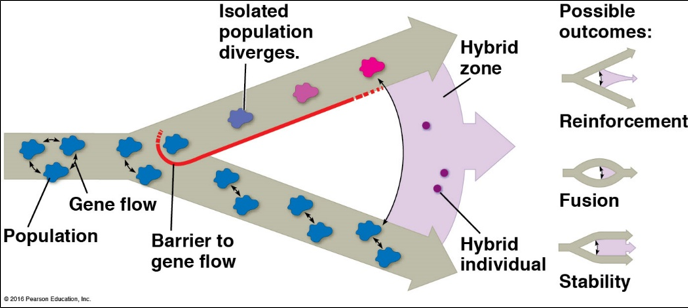
Hybrid Zones
↳ Occur when there are incomplete reproductive barriers
↳ Possible outcomes are
1. Reinforcement: The hybrid becomes more distant from what created it
2. Fusion: The hybrid becomes so common it becomes one species again
3. Stability: After the hybrid is made, there is minimal change between the populations
Genetic drift
↳ variation in the relative frequency of different genotypes in a small population
↳ unpredictable fluctuation of alleles from one generation to the next
↳ Significant GD in small populations
↳ Allele frequencies change at random
↳ Can lose genetic variation in populations
↳ Can cause harmful alleles to become fixed
↳ HAPPENS BY CHANCE
Two types:
Founder effect: GD due to migration of a small group of organisms to a new area
An island has a 5 Blue : 1 Red ladybug ratio
A group of red ladybugs end up on a new island with no ladybugs.
After many years it is inhabited by hundreds of red ladybugs
Bottleneck Effect: GD due to a catastrophic event
Natural disasters; disease, habitat destruction
Survivors are survivors of chance and thus the future generation may differ from the parental
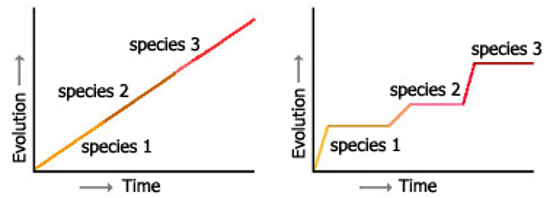
Time course speciation
There are two ways a species can evolve over time:
Gradualism: Slow constant change
Punctuated Equilibrium: Long periods of stasis punctuated by sudden change
Coevolution
Evolution of on species in response to a new adaption that appears in another, they may share a close relationship
An antelope pop. evolves to run faster because the lion got faster to chase the antelope
Gene Flow Migration
↳ Results in changes in a population’s genes pool due to movement from one place to another, where offspring is made
↳ Gene flow: population gains/loses alleles due to immigration or emigration
S3xual Selection
S3xual dimorphism: The difference between two s3xes
↳ Size, color, behavior
Intras3xual selection: Results from competition within the same s3x
↳ Buck/Moose fight = Winner picks their mate
Inters3xual selection: Results from mate choice
↳ Pufferfish female chooses the male with the prettiest sand sculpture
Non-Random Mating
Individuals with particular traits are chosen as mates
↳ Peacocks use their feathers to attract peahens
↳ The peacock with the prettier feathers are able to attract mates
Balancing selection
Diploidy: allows for an individual to inherit two alleles, the recessive alleles can be hidden
↳ Lead to Heterozygous Advantage: heterozygotes have better survival
↳ Hetero. for sickle cell anemia protects against malaria
Natural selection Limitations
Selection can only edit existing variations
Evolution is limited by historical constraints
Adaptations are often compromises
Chance, natural selection, and the environment interact
7.4: Hardy-Weinberg
Practice problems:
Kansas state university Population genetics and the Hardy Weinberg Law
Population Genetics
Population genetics: The study of how populations change genetically over time
Population: A group of individuals of the same species that live in the same area and interbreed
Gene pool: All the alleles at all loci (locations) in all the members of the population
Fixed allele: When all members of a population are homozygous for the same allele
↳ More Fixed alleles → less genetic diversity
Hardy-Weinberg Principle
In nature it IS NOT likely all the conditions for H-W Equilibrium will be met → Populations are evolving
We make the assumption that allele/genotype frequencies are minor
Conditions:
No mutations
Random mating (no s3xual selection)
No natural selection
Extremely large population size (no genetic drift)
No gene flow (No immigration of emigration)
If ANY of these conditions are NOT met → Microevolution occurs
Applying H-W principle:
Allele frequencies:
Gene with two alleles: p, q
p = frequency of A, dominant allele
q = frequency of a, recessive allele
p + q = 1
1 - p = q
1 - q = p
Genotype frequencies:
3 genotypes: AA, Aa, aa (Homo. Dom., Hetero, Homo Rec.)
p2 = AA, homozygous dominant
2pq = Aa, heterozygous
q2 = aa, homozygous recessive
p2 + 2pq + q2 = 1
Practice problem:
Suppose in a plant population, red flowers (R) is dominant to white flowers (r). In a population of 500 individuals, 25% show the recessive phenotype. How many individuals would you expect to by homozygous dominant and heterozygous for this trait?
Answer: 125 Homozygous dominant and 250 Heterozygous
7.5: Phylogenetics
Systematics
↳ the process of classifying organisms and determining their evolutionary relationships
Tools to describe Evolutionary relationships:
Fossils
Morphology (homologous structures)
Molecular evidence (DNA, Amino Acids)
Taxonomy
↳ the study of how organisms are ordered based on similar/different characteristics
Ordered in categories of Taxon’s:
Dear King Philip Came Over For Good Soup
Domain, kingdom, phylum, class, order, family, genus, species
Binomial Nomenclature
↳ The naming system to give organisms universal names
Parsimony
The principle of maximum parsimony states that the use of the simplest explanation to construct phylogenetic tree is the most likely explanation
“Keep it simple!“
The first tree is the most parsimonious → fewest changes in bases
Molecular clocks
↳ Used to measure evolutionary change based on regions of genome that appear to evolve at constant rates
Estimate date of past evolutionary events
E.g. Origin of HIV infections in humans = 1930’s
Common ancestry of all life forms
DNA and RNA are carriers of genetic info
Universal genetic code (codons → amino acids)
Conserved metabolic pathways
Conserved Elements in Eukaryotes
Cytoskeleton
Membrane-bound organelles
Linear chromosomes
Endomembrane systems (+ nuclear envelope)
Horizontal gene transfer
The movement of genetic information between different genomes, distinct from vertical transmission (parent-to-offspring)
Through viral infections, fusion of organisms, plasmids and more
Phylogenetic tree
↳ a branching diagram which shows evolutionary history of a group of organisms
↳ Branch length can represent genetic change
↳ Branch length can represent time
Constructing phylogenetic tress
You must be able to tell the difference between convergent and divergent evolution so you can sort homology and analogy
Cladogram
↳ Depicts patterns of shared characteristics among groups
It categorizes Clades: A group of species that includes an ancestral species and all its descendants
Kahoot/Additional notes
What is a requirement to maintain hardy-weinberg equilibrium
Random mating
An example of gene flow
Wind blows pollen from one population to another
What increases the chance of a harmful recessive allele to stay in the gene pool
Heterozygous advantage (Sickle cell anemia)
The sudden appearance of polyploid of polyploid individuals due to mistakes in meiosis is an examples of
Sympatric speciation (making new species)
Darwin’s finches are an example of
Adaptive radiation
Two different species make viable offspring but later generations are weak and sterile
Hybrid breakdown
The remnant of pelvic and leg bones in a snake
are vestigial structures
What is true about natural selection?
It results in new adaptations
What do nodes represent on phylogenetic trees?
Common ancestry
In order for speciation to occur what must happen?
Reproductive isolation
Adaptive radiation occurs most commonly in what case?
Islands after mass extinctions which can remove predators
Everyone gets a fresh start
Essential Questions
How does evolution by natural selection occur?
What other forced of change can act on a population? How do they work?
Which force of change consistently acts on populations?
How is Hardy-Weinberg equilibrium used to show changes in a population over time?
How does specification occur?
What factors are important in speciation happening?
What is reproductive isolation?
How does reproductive isolation lead to speciation?
Evidence for evolution is found in multiple scientific disciplines. Discuss different types of evidence that support the theory of evolution by natural selection.
How do homologous and anologous structures help us determine relatedness between organisms? Embryology? Genetic sequences?
How are phylogenetic trees constructed? What do they tell us? How are they different from cladograms?
Is evolution random?
Is natural selection random?
Are mutations random?
How does evolution promote continuity in population but also support change in populations?