Meiosis

Meiosis and Genetic Diversity
Overview of Genetics
Genetics: The study of heredity and hereditary variation.
Heredity: The transmission of traits from one generation to the next.
Traits: Characteristics that are passed from parent to offspring through genes:
Genes: Segments of DNA that code for basic units of heredity.
Inheritance: Offspring acquire genes from parents by inheriting chromosomes.
Types of Reproduction
Asexual Reproduction
Definition: Involves a single individual.
Mechanism: No fusion of gametes.
Cloning: Offspring are exact copies of the parent.
Source of Variation: Mutations are the only source of genetic variation.
Process: Can produce asexually through mitosis.
Sexual Reproduction
Definition: Involves two parents (male/female).
Genetic Diversity: Offspring are unique combinations of genes from both parents.
Genetic Variability: Offspring are genetically varied from parents and siblings.
Chromosome Concepts
Homologous Chromosomes
Definition: A pair of chromosomes (same size, length, centromere position) that carry the same genetic information.
One homologous chromosome is inherited from the mother and the other from the father.
Pair Examples: Paternal vs. Maternal chromosomes.
Karyotypes
Definition: A display of chromosome pairs ordered by size and length.
Components of Karyotype: Sister chromatids are paired homologous duplicated chromosomes.
Note: In actual karyotypes, sister chromatids may not be clearly visible.
Cells and Chromosomes
Cell Types:
Somatic (body) cells:
Chromosomal Content: Diploid (2n): two complete sets of each chromosome.
Human Example: 2n = 46.
Gametic (sex) cells:
Chromosomal Content: Haploid (n): one set of each chromosome.
Human Example: n = 23 (sperm and eggs).
Types of Chromosomes:
Autosomes: Chromosomes that do not determine sex (humans have 22 pairs).
Sex Chromosomes: X and Y chromosomes.
Eggs: X chromosome (human makeup: 22 + X).
Sperm: Can carry either X or Y chromosome (22 + X or 22 + Y).
Life Cycles
Definition: The sequence of stages in the reproductive history of an organism from conception to its own reproduction.
Fertilization and Meiosis: Alternate in sexual life cycles.
Fertilization Process: Fusion of a haploid sperm cell with a haploid egg to form a diploid zygote.
Meiosis Overview
Definition: A process that creates haploid gamete cells in sexually reproducing diploid organisms.
Outcome: Results in daughter cells with half the number of chromosomes compared to the parent cell.
Human Example:
Diploid: 2n = 46.
Meiosis produces: Sperm and eggs that are haploid (n = 23).
Division Rounds: Involves two rounds of division — Meiosis I and Meiosis II.
Comparisons: Mitosis vs Meiosis
Mitosis
Location: Occurs in somatic cells.
Divisions: 1 division.
Progeny: Results in 2 diploid daughter cells, genetically identical to parent.
Meiosis
Divisions: 2 divisions.
Progeny: Results in 4 haploid daughter cells, each cell has unique genetic makeup.
Differences: While meiosis is similar to mitosis, key differences exist.
Key Events in Meiosis
I: Unique events include synapsis and crossing over.
Metaphase I: Tetrads (homologous pairs) line up at the metaphase plate.
Anaphase I: Homologous pairs separate.
Stages of Meiosis
Meiosis I
Interphase
Cell goes through growth phases G1, S (DNA is copied), and G2.
Prophase I
Homologous chromosomes condense and pair through synapsis.
Tetrads held together by a protein framework called the synaptonemal complex.
Meiotic spindle formation begins.
Centrosomes move to opposite poles.
Nuclear envelope breakdown occurs.
Crossing Over: DNA exchanged between non-sister chromatids creating recombinant chromatids; sites of crossing over are called chiasmata.
Metaphase I
Independent Orientation: Meiotic spindle fibers align tetrads at the metaphase plate.
Anaphase I
Homologous chromosome pairs separate and are pulled towards the poles by meiotic spindle fibers; sister chromatids remain attached.
Telophase I and Cytokinesis
Meiotic spindle breaks down.
Nuclear envelope develops.
Cleavage furrow forms in animal cells or a cell plate in plant cells.
Cytokinesis results in haploid sets of chromosomes in each daughter cell.
Meiosis II
Prophase II
No crossing over occurs.
Meiotic spindle forms; sister chromatids attach to the meiotic spindle.
Metaphase II
Chromosomes align at the metaphase plate; resulting chromatids are unique due to crossing over in Meiosis I.
Anaphase II
Proteins at centromeres break down, allowing sister chromatids to separate and move toward opposite poles.
Telophase II and Cytokinesis
Meiotic spindle breaks down.
New nuclear envelope develops.
Cytokinesis occurs, resulting in 4 genetically unique haploid cells.
Review of Meiosis
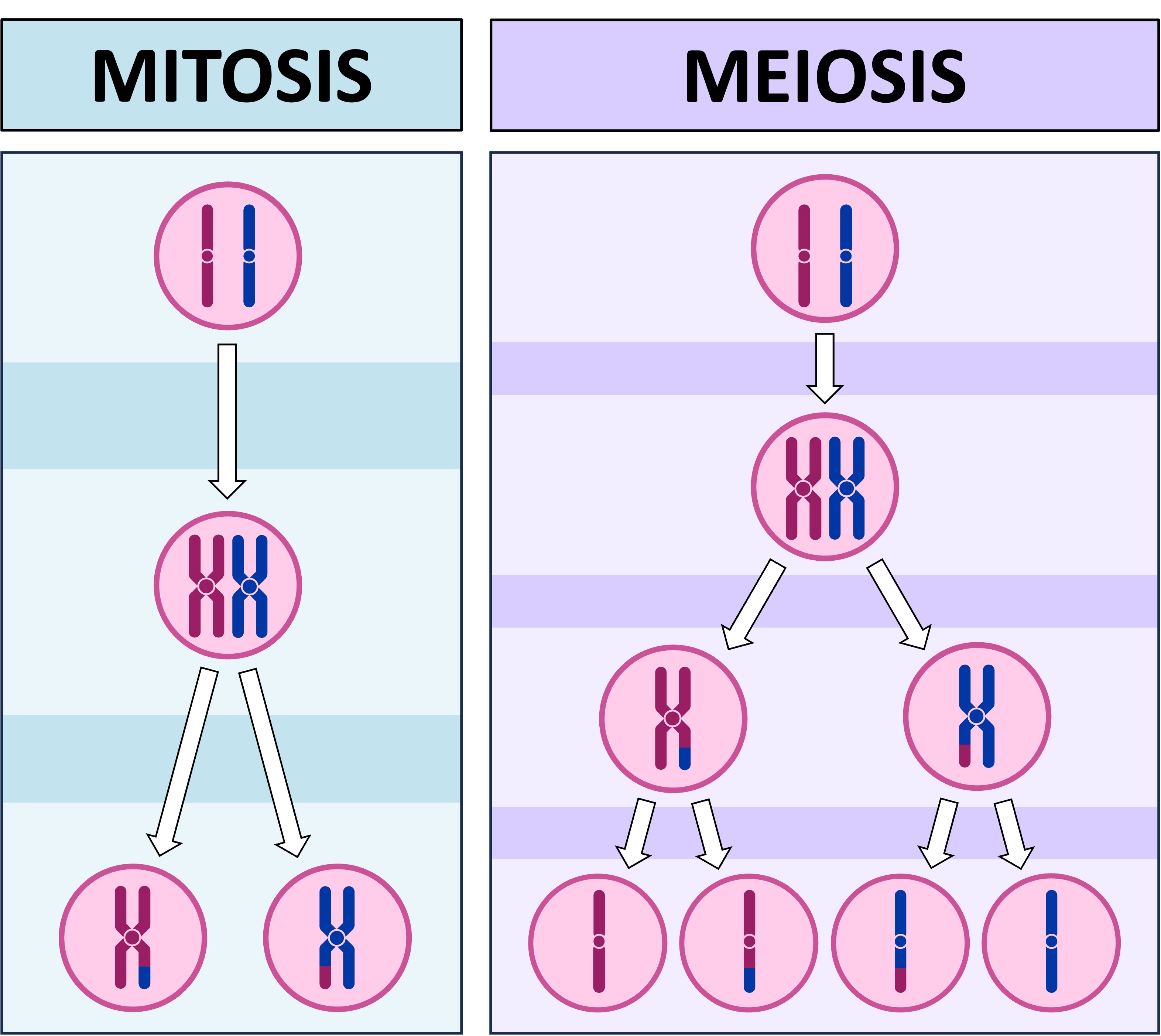
Early Meiosis I, starting with a parent cell: 2n = 4.
End of Telophase II and Cytokinesis: Each daughter cell results in n = 2.
Genetic Variation Through Meiosis
Crossing Over: Produces recombinant chromosomes through genetic material exchange.
Independent Assortment: Chromosomes randomly orient along the metaphase plate during Metaphase I. Each orientation can align with either maternal or paternal chromosomes at poles.
Random Fertilization: Any sperm can fertilize any egg, enhancing genetic diversity.
Conclusion: Meiosis and Genetic Diversity
Meiosis followed by fertilization guarantees genetic diversity within sexually reproducing organisms and provides genetic variation, a crucial factor in natural selection.
Cellular processes involved in meiosis operate through interactions of subcellular components and utilize free energy needed for growth and reproduction of living organisms.
Chromosomal Changes
Gamete Variability: Gametes may carry an extra chromosome (n + 1) or lack one altogether (n - 1).
Nondisjunction: An incorrect separation of homologous chromosomes in Meiosis I or of sister chromatids in Meiosis II, resulting in non-haploid gametes.
Example: Down Syndrome – characterized by three copies of chromosome 21.
Overview of Genetics
Genetics: The scientific study of heredity and hereditary variation. It examines how specific traits are transmitted from parents to offspring.
Heredity: The transmission of traits from one generation to the next, often called inheritance.
Genes: Specific sequences of DNA located on chromosomes that serve as the basic unit of heredity. Most genes program cells to synthesize specific enzymes and other proteins, whose cumulative action produces an organism’s inherited traits.
Locus: The specific physical location of a gene on a chromosome.
Alleles: Alternative versions of a gene that reside at the same locus on homologous chromosomes.
Genome: The complete complement of an organism’s genes and non-coding DNA sequences.
Types of Reproduction
Asexual Reproduction
Definition: A single individual (the sole parent) passes copies of all its genes to its offspring.
Mechanism: Occurs via mitosis in eukaryotic organisms or binary fission in prokaryotes. There is no fusion of gametes.
Cloning: An individual that is genetically identical to its parent.
Source of Variation: Genetic variation in strictly asexual populations arises only through spontaneous DNA mutations.
Advantages: Fast, energy-efficient, and does not require a mate.
Sexual Reproduction
Definition: Two parents give rise to offspring that have unique combinations of genes inherited from both parents.
Genetic Diversity: Results in high genetic variability, allowing for better adaptation to changing environments.
Cost: Requires more energy and time compared to asexual reproduction to find a mate and produce specialized gametes.
Chromosome Concepts
Homologous Chromosomes
Definition: A pair of chromosomes of the same length, centromere position, and staining pattern that possess genes for the same characters at corresponding loci.
One is the paternal chromosome (inherited from the father) and the other is the maternal chromosome (inherited from the mother).
Autosomes: The 22 pairs of chromosomes in humans that are not involved in sex determination.
Sex Chromosomes: The $X$ and $Y$ chromosomes. Females have a homologous pair ($XX$), while males have a non-homologous pair ($XY$).
Karyotypes
Definition: An ordered display of an individual's chromosomes, arranged in pairs starting from the longest.
Preparation: Cells are typically arrested in metaphase (when chromosomes are most condensed) and then stained and photographed.
Cells and Chromosomes
Somatic Cells: These are all body cells except for gametes.
Diploid Number ($2n$): In humans, . This represents two sets of 23 chromosomes.
Gametes: Reproductive cells (sperm and eggs).
Haploid Number ($n$): In humans, . This represents a single set of chromosomes.
Egg construction: 22 autosomes + $X$.
Sperm construction: 22 autosomes + either $X$ or $Y$.
Life Cycles
Definition: The generation-to-generation sequence of stages in the reproductive history of an organism.
Fertilization: The union of haploid gametes, culminating in the fusion of their nuclei to form a diploid zygote ().
Meiosis: A specialized type of cell division that reduces the chromosome number from diploid to haploid, ensuring that the chromosome number does not double every generation.
Meiosis Overview
Purpose: To produce haploid daughter cells that are genetically distinct from the parent cell and each other.
Rounds of Division:
Meiosis I: The reductional division. Homologous chromosomes separate, resulting in haploid cells with duplicated chromosomes.
Meiosis II: The equational division. Sister chromatids separate, resulting in haploid cells with unduplicated chromosomes.
Comparisons: Mitosis vs Meiosis
Mitosis
DNA Replication: Occurs during interphase (S phase) before mitosis begins.
Number of Divisions: One, including prophase, prometaphase, metaphase, anaphase, and telophase.
Synapsis: Does not occur.
Outcome: Two daughter cells, each genetically identical to the parent cell, with the same number of chromosomes.
Meiosis
DNA Replication: Occurs during interphase before Meiosis I begins but not before Meiosis II.
Number of Divisions: Two (Meiosis I and II).
Synapsis: Occurs during Prophase I; homologous chromosomes pair up and form tetrads.
Outcome: Four daughter cells, each genetically different from the parent and from each other, containing half as many chromosomes as the parent cell.
Key Events in Meiosis
Synapsis and Crossing Over: During Prophase I, duplicated homologs pair up and the physical exchange of genetic material between non-sister chromatids occurs.
Alignment of Homologous Pairs: In Metaphase I, chromosomes line up as pairs (tetrads) rather than individual chromosomes.
Separation of Homologs: In Anaphase I, homologous chromosomes move to opposite poles, while sister chromatids remain attached at the centromere.
Stages of Meiosis
Meiosis I (Reduction Division)
Interphase: Chromosomes duplicate in the S phase; each chromosome consists of two identical sister chromatids.
Prophase I:
Centrosome movement, spindle formation, and nuclear envelope breakdown.
Synapsis: Homologs loosely pair along their lengths, aligned gene by gene.
Crossing Over: Broken DNA ends are joined to the corresponding segment of the non-sister chromatid. The points where this occurs are called chiasmata.
Metaphase I: Pairs of homologous chromosomes are now arranged at the metaphase plate.
Both chromatids of one homolog are attached to kinetochore microtubules from one pole.
Anaphase I: Breakdown of proteins responsible for sister chromatid cohesion along chromatid arms allows homologs to separate.
Telophase I and Cytokinesis: Each half of the cell has a complete haploid set of duplicated chromosomes. Cytokinesis usually occurs simultaneously with Telophase I.
Meiosis II (Equational Division)
Prophase II: A spindle apparatus forms. In late Prophase II, chromosomes move toward the metaphase II plate.
Metaphase II: Chromosomes are positioned at the metaphase plate as in mitosis. Due to crossing over in Meiosis I, the two sister chromatids are not genetically identical.
Anaphase II: Cohesion at the centromeres breaks down, and the chromatids move toward opposite poles as individual chromosomes.
Telophase II and Cytokinesis: Nuclei form, chromosomes begin decondensing, and cytokinesis occurs.
Genetic Variation Through Meiosis
Independent Assortment of Chromosomes: Because each pair of homologous chromosomes is positioned independently of other pairs at Metaphase I, the first meiotic division results in each daughter cell sorting maternal and paternal homologs into daughter cells independently.
The number of possible combinations is (where is the haploid number). For humans (), this is million combinations.
Crossing Over: This process produces recombinant chromosomes, which combine DNA inherited from two parents into a single chromosome. In humans, an average of one to three crossover events occurs per chromosome pair.
Random Fertilization: The fusion of a single male gamete with a single female gamete during fertilization adds to the variation. The number of possible diploid combinations for a human zygote is trillion.
Chromosomal Changes and Abnormalities
Nondisjunction: An accident in meiosis or mitosis in which members of a pair of homologous chromosomes or a pair of sister chromatids fail to separate properly from each other.
Results: One gamete receives two of the same type of chromosome and another gamete receives no copy.
Aneuploidy: A condition in which the zygote has an abnormal number of a particular chromosome.
Monosomic (): An aneuploid cell that has only one copy of a particular chromosome.
Trisomic (): An aneuploid cell that has three copies of a particular chromosome (e.g., Trisomy 21 / Down Syndrome).
Polyploidy: A condition in which an organism has more than two complete sets of chromosomes (, , etc.). This is common in the plant kingdom.
The statement that best distinguishes sexual reproduction from asexual reproduction is: Sexual reproduction produces genetically diverse offspring through meiosis and fertilization.
Homologous chromosomes are best defined as chromosomes that carry the same genes at the same loci but may have different alleles.
According to the notes:
Definition: Homologous chromosomes are a pair of chromosomes of the same length, centromere position, and staining pattern that possess genes for the same characters at corresponding loci.
Alleles: These represent alternative versions of a gene that reside at the same locus on homologous chromosomes. One chromosome is inherited from the mother and one from the father, meaning they are not necessarily identical in their genetic sequence.
A karyotype is best described as: An organized display of chromosomes arranged by size, centromere position, and banding pattern.
According to the notes:
Definition: A karyotype is an ordered display of an individual's chromosomes, arranged in pairs starting from the longest.
Arrangement: Chromosomes in a karyotype are ordered by size, length, and centromere position.
Preparation: During preparation, cells are arrested in metaphase and stained, which reveals the specific banding patterns used to identify and pair homologous chromosomes.
Why the other options are incorrect:
A graph showing gene expression levels: This describes results from techniques like RNA sequencing or microarrays, not a visualization of physical chromosomes.
A diagram of crossing over events: While crossing over is an important genetic event, a karyotype shows whole chromosomes rather than the specific molecular sites of DNA exchange (chiasmata) in detail.
A map of alleles on homologous chromosomes: This is more closely related to a genetic map or linkage map. Karyotypes show the structure of the chromosomes rather than the specific alleles present at each locus.
In humans, the Somatic cell is diploid ().
According to the notes:
Somatic (body) cells: These are the cells that make up the body (excluding gametes) and contain two complete sets of chromosomes, which is defined as being diploid (). In humans, .
Gametes (sex cells): This category includes egg cells and sperm cells. These are haploid (), meaning they contain only one set of chromosomes. In humans, .
Because egg cells and sperm cells are types of gametes, all three of those options represent haploid cells. Only somatic cells are diploid.
Autosomes differ from sex chromosomes in that autosomes are chromosomes not involved in determining biological sex.
According to the notes:
Autosomes: These are the pairs of chromosomes in humans that are not involved in sex determination. They carry genes for the majority of an organism's traits and characteristics.
Sex Chromosomes: These are the and chromosomes. Females have a homologous pair (), while males have a non-homologous pair ().
Why the other options are incorrect:
Do not carry genes: Incorrect; autosomes carry the vast majority of an organism’s genetic information.
Exist only in pairs in females: Incorrect; autosomes exist in homologous pairs in both males and females. Only the sex chromosomes are non-homologous in males ().
Occur only in somatic cells: Incorrect; both somatic cells and gametes contain autosomes. In humans, a haploid gamete contains autosomes.
Synapsis refers to the process during meiosis in which homologous chromosomes pair closely along their lengths.
According to the notes:
Prophase I: This stage involves unique events including synapsis and crossing over.
Mechanism: During synapsis, homologs loosely pair along their lengths, aligned gene by gene. This results in the formation of tetrads, which are held together by a protein framework called the synaptonemal complex.
Why the other options are incorrect:
Chromosomes condense: While this happens during Prophase I, condensation is a general process and not the specific definition of synapsis.
Sister chromatids separate: This event occurs during Anaphase II of meiosis (or Anaphase of mitosis).
Spindle fibers attach to centromeres: This describes the attachment of kinetochore microtubules, which occurs during Prometaphase and leads into Metaphase.
When homologous chromosomes pair during synapsis, they form a structure known as a Tetrad.
According to the notes:
Prophase I / Synapsis: During this stage, homologous chromosomes condense and pair through synapsis. This process results in the formation of tetrads, which are groups of four chromatids (the homologous pair) held together by a protein framework called the synaptonemal complex.
Metaphase I: The notes also specify that these tetrads are what line up at the metaphase plate before the homologous pairs are separated during Anaphase I.
Why the other options are incorrect:
Chromatid: This refers to one half of a duplicated chromosome.
Centrosome: This is the organelle that serves as the main microtubule-organizing center for the meiotic spindle.
Kinetochore: This is a protein structure located at the centromere where spindle fibers attach during cell division.
Stages of Meiosis
Meiosis I (Reduction Division)
Prophase I:
Centrosome movement, spindle formation, and nuclear envelope breakdown.
Synapsis: Homologs loosely pair along their lengths, aligned gene by gene.
Crossing Over: Broken DNA ends are joined to the corresponding segment of the non-sister chromatid. The points where this occurs are called chiasmata.
Metaphase I: Pairs of homologous chromosomes are now arranged at the metaphase plate.
Both chromatids of one homolog are attached to kinetochore microtubules from one pole.
Anaphase I: Breakdown of proteins responsible for sister chromatid cohesion along chromatid arms allows homologs to separate.
The visible -shaped regions where crossing over has occurred are called Chiasmata.
According to the notes:
Prophase I: During crossing over, broken DNA ends are joined to the corresponding segment of a non-sister chromatid. The specific points where this physical exchange occurs and remains visible are called chiasmata.
Why the other options are incorrect:
Tetrads: These are the groups of four chromatids (a pair of homologous chromosomes) that form during synapsis.
Centromeres: This is the region of a chromosome to which the microtubules of the spindle attach, via the kinetochore, during cell division.
Alleles: These are alternative versions of a gene that reside at the same locus on homologous chromosomes.
Independent assortment results from the random orientation of homologous chromosome pairs during metaphase I.
According to the notes:
Genetic Variation Through Meiosis: Independent assortment occurs because each pair of homologous chromosomes is positioned independently of other pairs at the metaphase plate during Metaphase I.
Mechanism: Each orientation can align with either maternal or paternal chromosomes at the poles, resulting in daughter cells sorting these homologs independently. For humans (), this results in approximately million possible combinations.
Why the other options are incorrect:
DNA replication prior to meiosis: This occurs during the S phase of interphase to ensure chromosomes are duplicated, but it does not determine how those chromosomes are distributed into daughter cells.
Random fertilization only: While random fertilization adds to genetic diversity (the fusion of unique gametes), it is a separate process from independent assortment, which happens during the formation of the gametes themselves.
The separation of sister chromatids during anaphase II: This event occurs during the second meiotic division (equational division) and involves separating chromatids that were already sorted into cells during the independent assortment that took place in Meiosis I.
Genetic Variation Through Meiosis
Crossing Over: Produces recombinant chromosomes through genetic material exchange.
Independent Assortment: Chromosomes randomly orient along the metaphase plate during Metaphase I. Each orientation can align with either maternal or paternal chromosomes at poles.
Random Fertilization: Any sperm can fertilize any egg, enhancing genetic diversity. The fusion of a single male gamete with a single female gamete during fertilization adds to the variation. The number of possible diploid combinations for a human zygote is trillion.
Prophase I differs from Prophase II because Prophase I includes synapsis and crossing over.
According to the notes:
Synapsis and Crossing Over: These are unique events that occur only during Prophase I. In synapsis, homologous chromosomes pair up closely along their lengths to form tetrads. This allows for crossing over, where DNA is exchanged between non-sister chromatids at regions called chiasmata.
Meiosis II Comparisons: The notes specifically state that in Prophase II, "no crossing over occurs," and the processes are more similar to a mitotic division where chromosomes simply condense and attach to the spindle.
Why the other options are incorrect:
Separation of sister chromatids: This event occurs during Anaphase II of meiosis or Anaphase of mitosis, not during any prophase stage.
Chromosome condensation only: While chromosomes do condense in Prophase I, they also condense in Prophase II and Mitotic Prophase, so this does not distinguish the two stages.
Spindle formation only: The formation of the meiotic spindle occurs in both Prophase I and Prophase II, so it is not a distinguishing factor.
During Metaphase I of meiosis, homologous chromosome pairs align at the metaphase plate.
According to the notes provided:
Metaphase I: Pairs of homologous chromosomes (tetrads) are arranged at the metaphase plate.
Independent Orientation: Meiotic spindle fibers align tetrads at the metaphase plate. Each orientation is random, with maternal and paternal chromosomes potentially aligned toward either pole.
Why the other options are incorrect:
Sister chromatids separate: This occurs during Anaphase II or mitotic Anaphase. In Meiosis I, the breakdown of proteins allows homologs to separate, but sister chromatids remain attached at their centromeres.
Chromosomes decondense: This happens during Telophase, the final stage of cell division, when the nuclear envelope redevelops around the newly separated sets of chromosomes.
Sister chromatids align individually: This is the pattern seen in Metaphase II (equational division) and mitosis. In Metaphase I, specifically, the chromosomes must align as homologous pairs to ensure the reduction of chromosome number from diploid () to haploid (nn2n2nnn2nn + n = 2n2n = 46n = 232nXY232nn2n - 12n + 1(n + 1)(n - 1)(2n + 1)(n)(3n, 4n, etc.). While it is mentioned as being common in plants, nondisjunction typically results in aneuploidy (an extra or missing individual chromosome) rather than causing polyploidy in all offspring.
Increased genetic variation: While nondisjunction creates genetic differences, it is classified as a chromosomal abnormality or mutation. The standard mechanisms for healthy genetic variation listed in the notes are crossing over, independent assortment, and random fertilization
Trisomy 21 (Down syndrome) is the human condition that results from nondisjunction.
According to the notes:
Nondisjunction: This is an accident in meiosis or mitosis where members of a pair of homologous chromosomes or a pair of sister chromatids fail to separate properly. This leads to gametes and subsequent zygotes having an abnormal number of chromosomes, a condition known as aneuploidy.
Example: The notes explicitly identify Down Syndrome as an example of a condition resulting from nondisjunction, specifically characterized by having three copies of chromosome 21 (Trisomy 21).
Why the other options are incorrect:
Sickle cell anemia, Tay-Sachs disease, and Cystic fibrosis: These conditions are genetic disorders caused by specific mutations in individual genes rather than the incorrect distribution of whole chromosomes during cell division.
Anaphase I is the stage most likely to produce nondisjunction of homologous chromosomes.
According to the notes:
Nondisjunction is defined as the incorrect separation of homologous chromosomes in Meiosis I or of sister chromatids in Meiosis II.
Anaphase I is the specific phase where homologous pairs separate and are pulled towards the poles. Therefore, if these chromosomes fail to separate correctly during this phase, it results in nondisjunction of the homologous chromosomes.
Anaphase II, by contrast, involves
The overall biological significance of meiosis is that it produces genetically diverse haploid gametes for sexual reproduction.\n\nAccording to the notes, the importance of meiosis lies in several key areas:\n1. Chromosome Reduction: Meiosis is a reduction division that transforms a diploid (2nn2n) is restored rather than doubled.\n2. Genetic Variability: Mechanisms such as crossing over in Prophase I and independent assortment in Metaphase I ensure that each daughter cell has a unique genetic makeup. This variability allows for better adaptation to changing environments.\n3. Role in Natural Selection: The genetic diversity provided by meiosis is a crucial factor in natural selection, allowing for the evolution of populations over time.\n\n### Why the other options are incorrect:\n- Increases chromosome number: Meiosis specifically halves the number of chromosomes so that fertilization can maintain the constant number of chromosomes in a species.\n- Repairs damaged DNA: While cells have DNA repair mechanisms, the primary biological purpose of meiosis is gamete production and genetic mixing.\n- Produces identical daughter cells: This is the function of mitosis, which provides cells for growth and tissue maintenance.
The correct answer is Random orientation of homologous chromosome pairs during metaphase I.
According to the notes, independent assortment occurs because each pair of homologous chromosomes is positioned independently of other pairs at the metaphase plate during Metaphase I. This random orientation allows for the sorting of maternal and paternal homologs into daughter cells independently of one another. For humans, where the haploid number is n = 232^n2^{23} \approx 8.4C^R C^RC^W C^WC^R C^WABABI^AI^BpHABI^AI^BI^AI^BiABI^AI^BiIXY2nn4623$$.
Genetic Diversity: Meiosis introduces variation through mechanisms like crossing over during Prophase I and independent assortment during Metaphase I. This diversity is essential for natural selection and adaptation.
Why the other options are incorrect:
Replicate chromosomes: Chromosome replication occurs during the S phase of Interphase before meiosis begins; it is a prerequisite for division, not the purpose of the meiotic process itself.
Produce identical daughter cells: This is the role of mitosis, which creates genetically identical somatic cells for growth and tissue repair.
Repair damaged DNA: While cells possess DNA repair mechanisms, the high-level purpose of the meiotic cycle is sexual reproduction and the generation of genetic variety.