Respiration
Page 383-390 + class work
ATP Cycle
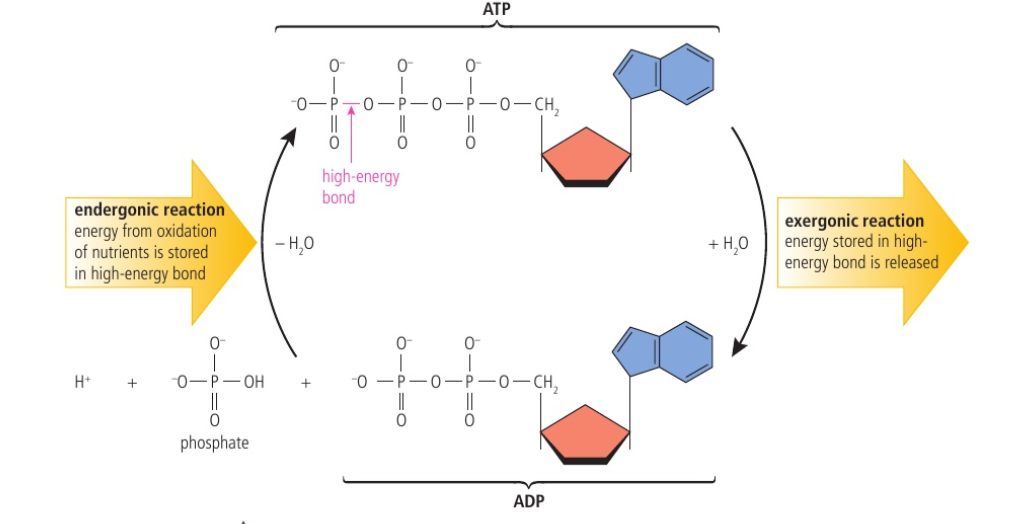
High-energy bonds in ATP: the two final phosphates are negatively charged, causing them to repel each other - this causes an unstable covalent bond between them called a high-energy bond.
The bonds have low activation energy, which makes them easy to break down through exergonic (energy-releasing) hydrolisis, which means that energy is free to perform other cellular activities.
Cellular work carried out using energy from ATP:
Active transport
Synthesis of macromolecules
Whole cell movement via cilia or flagella
Movement within the cell such as chromosome movement during meiosis and mitosis
ATP cycle: the synthesis of ATP from ADP and an inorganic phosphate requires energy, which comes from the oxidation of nutrients. This energy is then stored in the high-energy bond between the second and third phosphate groups. Because ATP has higher potential energy than ADP, this is an endergonic reaction. When ATP hydrolises, it releases energy and also forms an ADP molecule (adenosine diphosphate). This is an exergonic reaction.
Cellular Respiration
Glucose is a high-energy molecule compared to carbon dioxide and water. This means that respiration, which involves the oxidation and reduction of glucose, is exergonic.
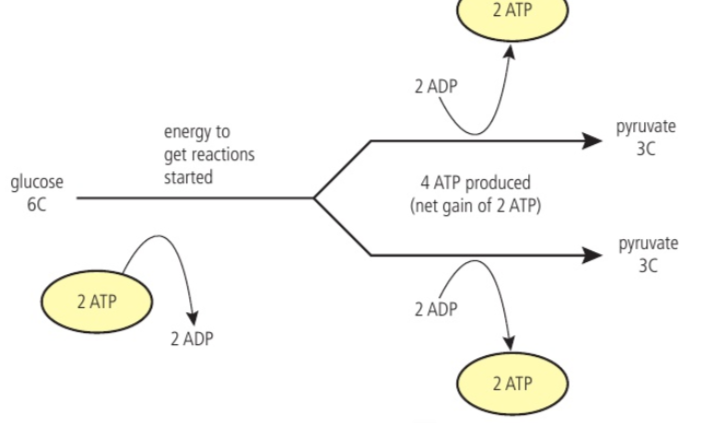
Glycolisis: glucose enters the cytoplasm of a cell, and enzymes are released to break down the 6-carbon glucose molecule into two pyruvates, which are 3-carbon molecules. This breaks down some of the covalent bonds in the molecule. The energy that is released from these reactions is used to form ATP molecules.
Note: there is a net gain of 2 ATP molecules, since 2 are needed to start the reaction
Anaerobic cell respiration: some organisms can derive all their ATP without the use of oxygen
In anaerobic respiration, organic molecules are broken down by fermentation, either lactic acid fermentation or alcoholic fermentation
If there is not enough oxygen available for aerobic respiration, the pyruvates are converted into lactic acid. This allows glycolisis to continue, since it prevents a build-up of pyruvates. Lactic acid fermentation only produces 2 ATP molecules
Lactic acid fermentation can be felt in the muscle burn that occurs during intense exercise
Aerobic cell respiration:
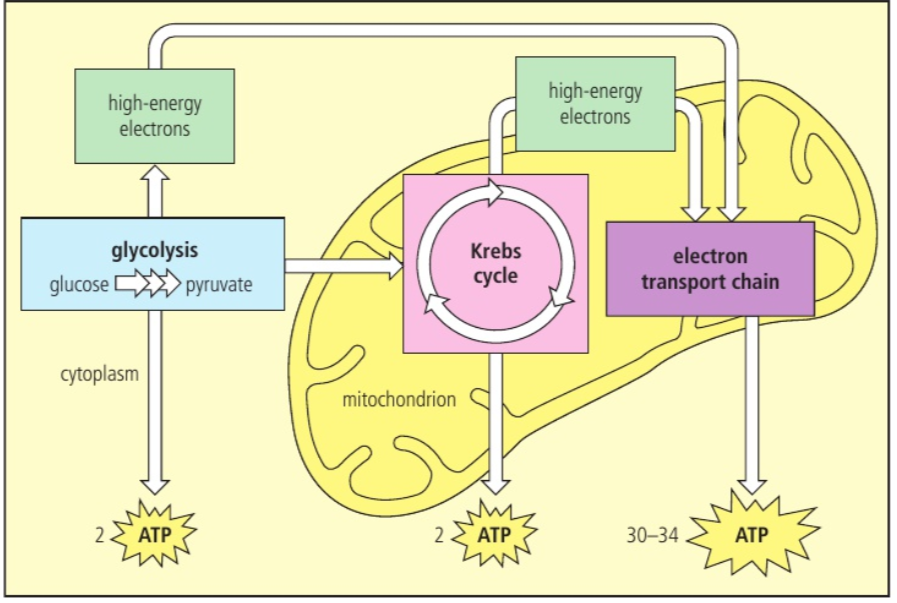
Pyruvates enter the mitochondrion and are turned into a 2-carbon compound, which then enters the Krebs cycle.
The preparatory stage for the Krebs cycle is known as the link reaction, and takes place in the matrix of the mitochondria
The Krebs cycle has a net ATP gain of 2 molecules
Final stage of aerobic respiration is called the electron transport chain. This stage produces 30-34 ATP molecules
Key Points on Anaerobic and Aerobic Respiration
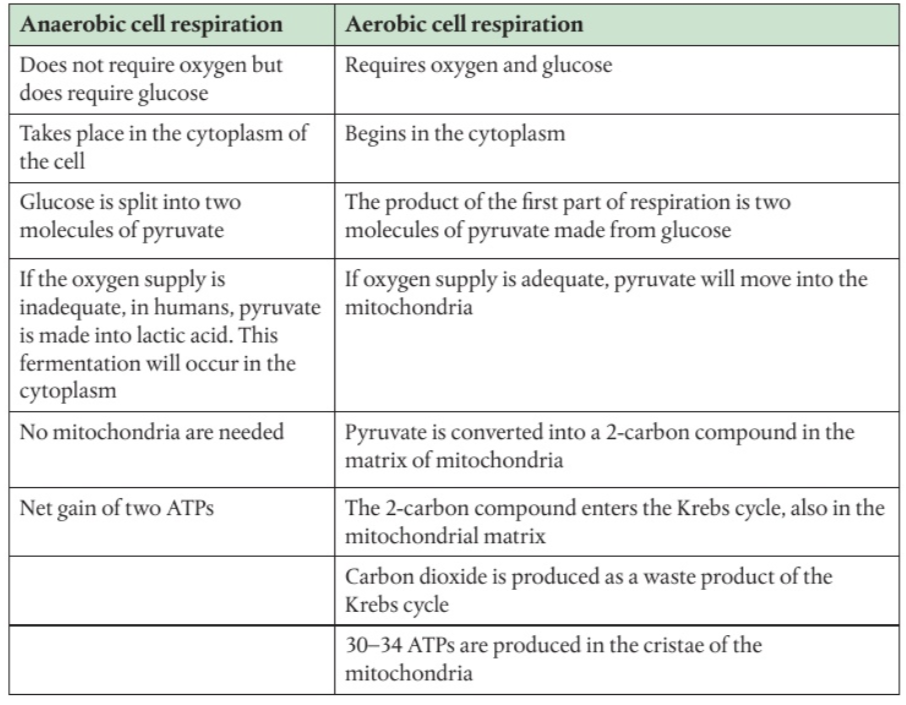
Both types of respiration initially occur in the cytoplasm
In both cases, glucose is broken down into two molecules of pyruvate
The production of ATP is significantly lower in anaerobic respiration than in aerobic respiration
Anaerobic respiration takes place in the cytoplasm and does not require oxygen, while aerobic respiration partially takes place in the mitochondria and does require oxygen.
The final products of anaerobic respiration are lactic acid and ATP, whereas the final products of aerobic respiration are water, carbon dioxide, and ATP.
Factors affecting the rate of respiration:
Temperature - the optimum temperature for respiration is 20-30°C
CO2 concentration - the more CO2, the lower the rate of respiration
Oxygen concentration - the more oxygen, the higher the rate of respiration
Glucose concentration - the more glucose, the higher the rate of respiration
Type of cell - some cells require more oxygen than others
Cellular Respiration - Class work
ATP is the “energy currency” of the cell
Muscle contraction requires a lot of ATP, which is why we expend the most energy when sprinting
ATP is soluble in water
All molecules have energy in the bonds between the atoms