Effects of lifestyle and environment on gas exchange
External factors have the ability to affect the efficiency of the respiratory surfaces.
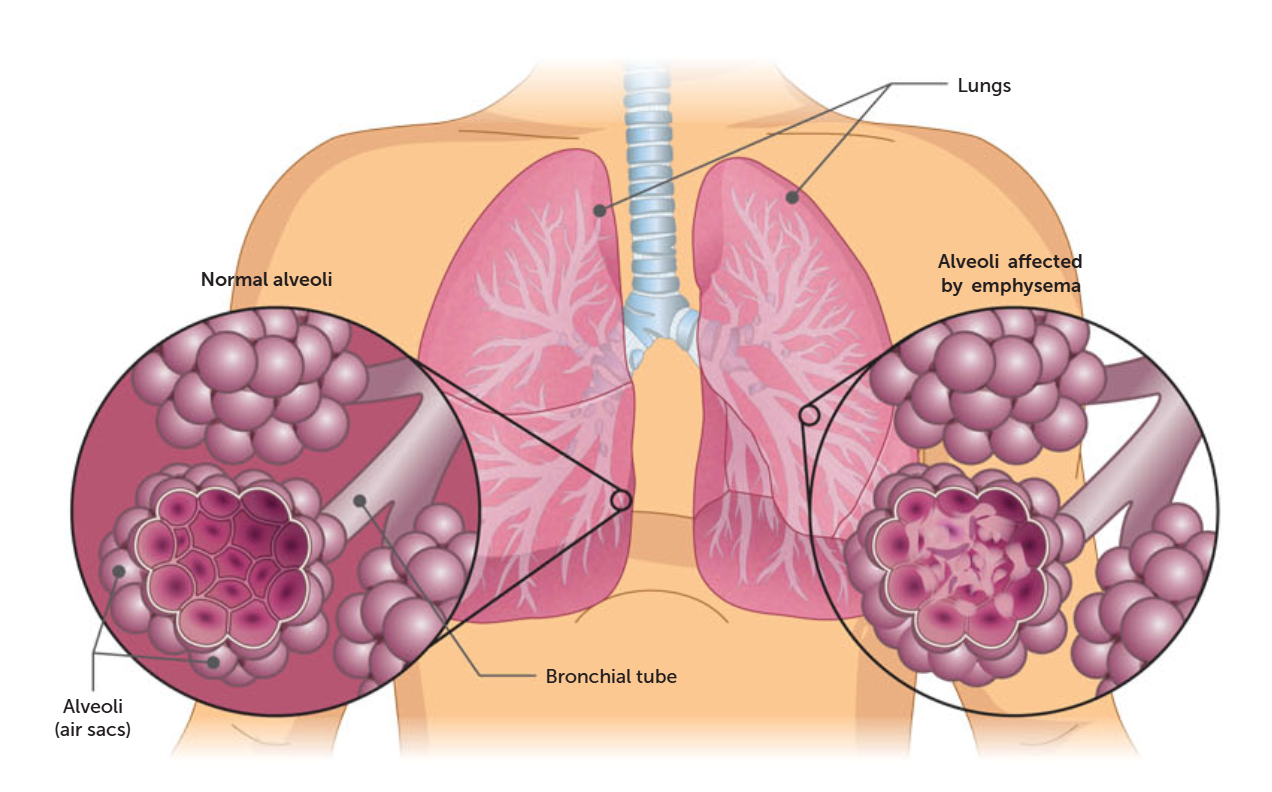
Emphysema
A disease caused by the irritation of the inhalation of particles long term.
Exposure to excessively high levels of particles in the atmosphere increases one’s risk of emphysema. An example of excessive exposure/inhalation of particles occurs in smokers. ➡The constant inhalation of irritants, such as tobacco smoke. OR people who work in a situation where there is a lot of dust also have an increased risk.
The irritating particles cause damage to the alveoli. The alveoli lose their elasticity and are often replaced with fibrous tissue, and may break down, reducing the SA of the lungs.
Because of the loss of elasticity in the lungs, they are constantly inflated, meaning breathing in and out no longer happens passively and requires voluntary effort. This causes difficulty in ventilating the lungs for patients.
It cannot be cured and is progressive.

Lung Cancer
The development of mass cells that divide in an uncontrolled way. (tumour)
There is evidence that exposure to asbestos and other pollutants causes lung cancer, for example, tobacco smoke.
Lung cancer is caused by some chemical substances that irritate the cancerous growth; others seem to promote the growth of the tumour. ➡(Tobacco smoke contains both irritants and promoters of lung cancer)
The most common Lung cancer begins in the bronchi. The inhaled smoke particles that irritate this area cause the excess production of mucus from the lining of the bronchi; this mucus cannot be removed. ➡ resulting in ‘smokers cough’.
The trapped mucus can cause the alveoli to rupture.
⬆ Emphasema is developed.
cancerous growths developed in the airways can break off
and spread further.
Lung infections
Pneumonia is an infection of the lungs caused by bacteria, viruses, fungi or other organisms. The inflammation as a result of the infection causes secretion of fluid and mucus into the alveoli, which reduces the amount of air that it can contain.
⬆ reduces the SA available, making gas exchange more difficult and causing breathing difficulty.
Tuberculosis, or TB, is an infection of the lungs caused by the bacterium Mycobacterium tuberculosis.
top 3 infectious diseases casuing death globally.
Both Pneumonia and TB are spread by droplets through sneeze, cough, and other droplets of moisture containing the virus, fungi or bacteria.
Asthma
A medical condition that causes difficulty breathing because of the narrowing of the airways.
Asthma occurs due to:
The contraction and narrowing of the smooth muscle airway.
The inflammation of the airway lining thickening ➡ narrowing the diameter.
Mucus fills the airway ➡ narrowing the tube.
Asthma can be an allergic or non-allergic response. The cause of Asthma could be a range of things, from cold weather to pollens, mould, smoke, foods and everything else.
An Asthma attack occurs when the muscles that surround bronchioles go into involuntary spasm. This causes the airway passages to narrow, causing difficulty in breathing. The irritation of the particles can also cause the membrane lining to secrete excessive mucus, restricting air movement. ⬆ reducing the amount of oxygen going into and out of the lungs and all of the repercussions that come with that.