THE LIMBIC LOBE
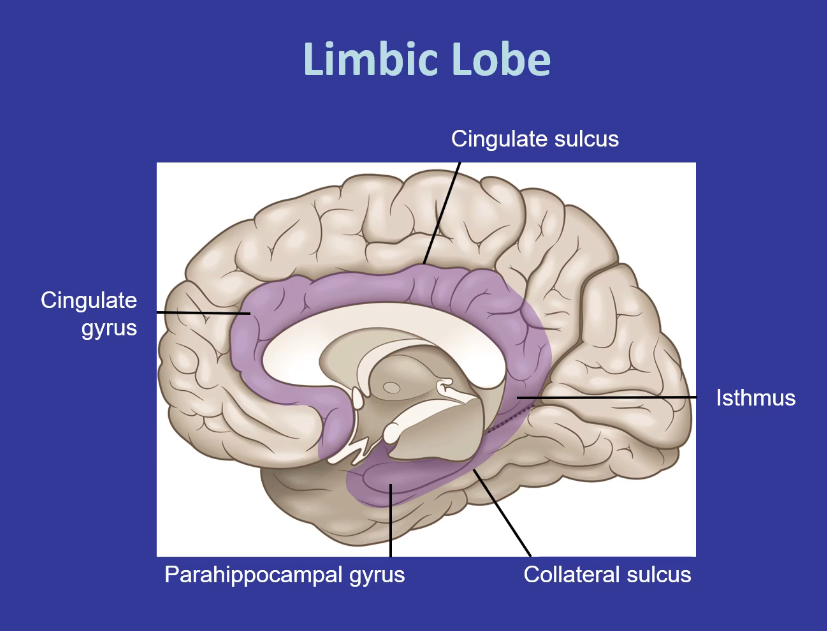
The limbic lobe is a part of the cerebral cortex that lies on the medial surface of the brain, forming a ring around the corpus callosum and upper brainstem.
It is concerned with:
Mood and emotion
Motivation and drive
Learning and memory
Linking internal states (emotion, need) to behaviour
The term “limbic system” is outdated and imprecise — it has no agreed anatomical boundary or single function and is best avoided.
Anatomical Components of the Limbic Lobe
The limbic lobe is made up primarily of cortical gyri, not deep nuclei.
1. Cingulate Gyrus
Runs above the corpus callosum
Bounded superiorly by the cingulate sulcus
Acts as a bridge between emotion, cognition, and action
Strongly connected with frontal cortex, thalamus, and limbic structures
2. Isthmus of the Cingulate Gyrus
Posterior narrowing of the cingulate gyrus
Connects cingulate gyrus to parahippocampal gyrus
Anatomical hinge between emotion, memory, and spatial processing
3. Parahippocampal Gyrus
Located on the medial temporal lobe
Bounded by the collateral (rhinal) sulcus
Involved in memory encoding, contextual processing, and spatial layout
4. Hippocampus
Lies deep to the parahippocampal gyrus
Is cortical tissue, not a subcortical structure
Essential for episodic memory formation and spatial memory
Included within the limbic lobe
Functional Organisation of the Cingulate Cortex
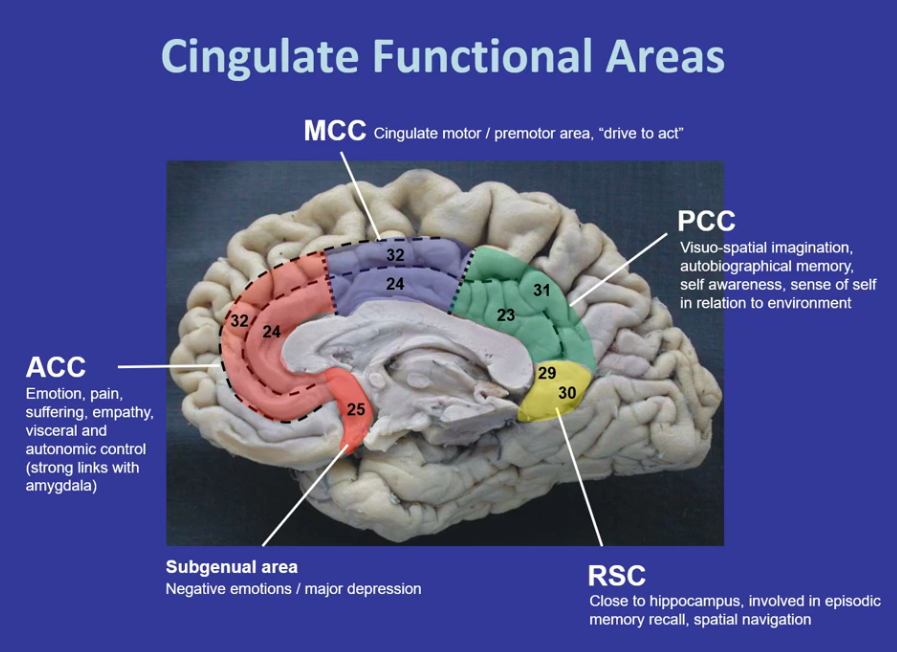
The cingulate gyrus is not functionally uniform — it has distinct regions:
Anterior Cingulate Cortex (ACC)
Emotion, pain, suffering, empathy
Visceral and autonomic control
Strong connections with the amygdala
Integrates emotional state with decision-making
Subgenual Area
Involved in negative mood states
Strongly linked to major depression
Target for deep brain stimulation in treatment-resistant depression
Mid-Cingulate Cortex (MCC)
Cingulate motor / premotor region
“Drive to act”
Translates motivation into action
Important for effort-based behaviour
Posterior Cingulate Cortex (PCC)
Self-awareness and internal monitoring
Autobiographical memory
Visuospatial imagination
Sense of self in relation to the environment
central to the Default Mode Network (DMN)
(The Default Mode Network (DMN) involves interconnected brain regions active during rest and internal thought, primarily the medial prefrontal cortex, posterior cingulate cortex (PCC), precuneus, and inferior parietal lobule, facilitating daydreaming, memory recall, future planning, and self-reflection.)
Retrosplenial Cortex (RSC)
Close to hippocampus
Episodic memory recall
Spatial navigation and orientation
Interface between memory and spatial maps
Cingulate Motor Area
Located within the mid-cingulate cortex
Functionally linked to:
Supplementary motor area (SMA)
Primary motor cortex (M1)
Projects to the motor striatum (putamen)
Modulated by the voluntary motor loop of the basal ganglia
Key idea:
This region allows motivation and internal drive to bias motor output — not just how you move, but whether you move.