Mini Notes Of The Civil War (4 Years of Fighting) Study Guide
Civil War Vocabulary & Historical Figures
Blockade- Actions used to keep areas or a country from communicating or trading with other areas or nations.
Material Law- Military government, involving suspension of ordinary law.
Civilians- A person not in the arm services or the police force.
Defer- Postpone or put back the conscription of someone.
Copperheads- Known as the Peace Democrats, opposed the Civil War.
Seige- An attempt to force surrender by blocking the movement of people or goods into or out of a place; military blockade.
Total War- A war that is unrestricted in terms of the weapons used, the territory or combatants involved, or the objectives pursued.
Casualty- A solider who is killed, captured, or wounded in battle.
Amputate- A surgical procedure to remove a piece of the body because of trauma or infection.
Draft- A system of selecting people for required military service.
Emancipation Proclamation- A degree issued by Abraham Lincoln that declared that all slaves held in Rebel states, like the confederate states, shall be free.
Habeas Corpus- Court order that requires police to bring a prisoner to explain why they are holding the person.
Inflation- When it takes more and more money to buy the same amounts of goods; increase in price of goods or services.
Ironclad- A worship equipped with iron protection.
rebel- A person who is against or oppose something.
Yankee- A native of the Northern U.S. A term used by Southerners to describe their rivals (opponent) from the Union.
What is the difference between the Union and the Confederate?
(known as the North): they have an industrialized economy, anti-slavery, and believe in a larger federal government. The Union is also referred to as the remaining US after the secession of the eleven Southern states.
(known as the South): They have an agricultural economy, were pro-slavery, and believe in state rights.
Election of 1860.
In November He won the popular and the Electoral College votes.
Lincoln´s Republican platform opposed the expansion of slavery in new territories but committed
Secession
Lincoln´s election led Southern states to secede from the Union.
%%South Carolina was the first%% state to secede in December 1860. Ten other states eventually followed (Mississippi, Florida, Alabama, Georgia, Louisiana, Texas, Virginia, Arkansas, North Carolina, and Tennessee.)
Three states formed a new nation, the Confederate States of America, and
Fort Sumter
In the aftermath of the War of 1812, the @@United States built Fort Sumter at the entrance to Charleston Harbor to protect Charleston, South Carolina from attack.@@
It stood more than 50 ft high and featured 5-foot thick walls. After decades of work, construction was nearing completion in 1860.
Major Anderson
U.S. Army Major Robert Anderson was in command of federal troops stationed in Charleston when South Carolina seceded.
On December 26, 1860: Anderson secretly moved his troops to the unfinished Fort Sumter.
Secessionists seized Union property in Charleston and began to construct new batteries pointed at Fort Sumter.
The Union attempted to provide Anderson and his troops with supplies so they could keep Fort Sumter but the secessionists blocked their efforts.
By the Spring of 1861, the soldiers at Fort Sumter were in need of supplies. In April, Abraham Lincoln decided to send ships with supplies and reinforcements to Fort Sumter
Lead Up To The Attack on Fort Sumter
On April 11, after the first of the Union ships had arrived in Charleston, three Confederate officers traveled by boat to Fort Sumter to demand the Union forces surrender. Anderson refused.
On the morning of April 12, the secessionists returned and ask Anderson to reconsider. He again refused.
The Confederate representatives then handed Anderson a letter indicating that a bombardment of Sumter would begin in one hour.
Advantages of the North and South
Advantages of The North: The @@North has more population@@ than the South. The North @@has a 22 million population while the South only has 5.5 million.@@ The North also has 22,000 miles of railroad tracks. It also has canals and roads while the South only has 9,000 miles of railroad tracks.
However, the South also have advantages like having strong military traditions where they only defend their territories until the Northerners grew exhausted from fighting. The Southerner’s armies also fought in their home soils so they have more advantages during the battle of geographic locations on where to hide and run during the battle. Moreover, the Southerner’s farmers provide food for the troops so they won’t be famished.
Scott’s Snake Plan
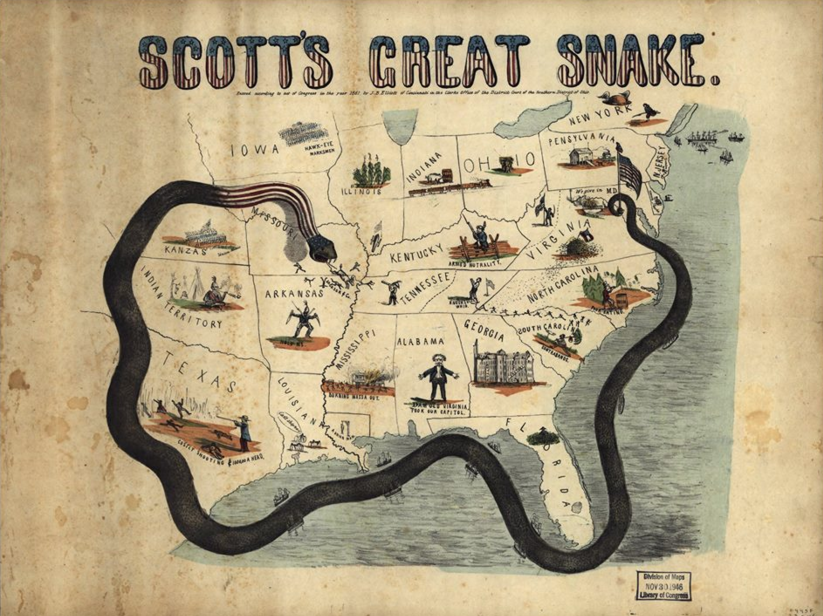
I think a snake was chosen to describe the Union’s plan of attack because since the snake’s body is very long that it can block its prey by going around its prey, the snake might represent the Union blockading Southern ports and controlling the Mississippi River. They cut off and isolate the South from the outside world so the snake is represented.
Abraham Lincoln (President of the Union)
He was an American Lawyer, politician, and statesman who %%served as the 16th president of the United States from 1861 to 1865.%% He leads the nation during the Civil War and issued the Emancipation Proclamation where slaves shall be free. He was a as well as the %%commander of the Union Army.%%
Jefferson Davis (President of the Confederate)
Jefferson Davis was the first president of the Confederate States of America from 1861 to 1865. @@He was a Democratic politician as well as a hero of the Mexican-American War.@@ He defended the interests of the South in the growing battle of slavery that would put the nation into a Civil War.
The Goals of the War of North and South
^^The Confederacy (South) wanted to be an independent nation.^^ It does not need to invade the Union’s armies. It just needed to fight long and hard enough to convince northerners that war was not worth its cause.
@@The North wanted to restore the Union.@@ It forced to have to invade the South and force the breakaway states to give up their quest for independence.
The Confederate and the Union strategies.
The Confederate They also tried to win the support of Great Britain and the French because their economy %%depended on the export of Southern cotton.%% They @@hoped that the British and the French help pressure the North to end the war.@@
The Union strategies are the %%Anaconda Plan proposed by Winfield Scott%%.
First: The Union would blockade Southern ports. This would keep supplies from reaching the Confederacy and prevent the South from exporting its cotton crop.
Second: They seek to gain control of the Mississippi River to split the Confederacy into two.
Third: They also seek to capture Richmond, Virginia- The Confederate capital.
Other Important Notes:
One Northern State Example: Massachusetts
One Southern State Example: Virginia
One Border State Example: Missouri
One example of a Battlefield: Fort Sumter
One example of a Union Territory: the Indian Territory.
Capital of the Confederate: Richmond, Virginia.
Capital of the Union: Washington, D.C.
What is the Gettysburg Address?
- The Gettysburg Address is a speech delivered by Abraham Lincoln reminding the citizens on why the Civil War was fought and honoring the soldiers who had died fighting in the Gettysburg War of 1863 located in Pennsylvania.
\n