Plant exchange and transport
Definitions:
Xylem
Tissue responsible for water and mineral transport in plants.
Phloem
Transports sugars and nutrients produced in the leaves throughout the plant.
Transpiration
Process by which water evaporates from the plant, mainly through stomata.
Stomata
Tiny pores on plant leaves that control gas exchange and water loss.
Intensity
Amount of light or energy present in a given area.
Sucrose
Type of sugar plants use to store energy.
Starch
Complex carbohydrate stored in plants for later energy use.
Glucose
Simple sugar that provides energy to cells during photosynthesis.
Vascular bundle
Group of xylem and phloem tissues that transport water, nutrients, and sugars.
Balanced equation for photosynthesis:
6CO₂ (carbon dioxide)+ 6H₂O (water) →(photosynthesis) C₆H₁₂O₆ (glucose) + 6O₂ (oxygen)
Transport in Plants
Plants need to transport water and minerals from the roots to the leaves.
They also carry the products of photosynthesis, like sucrose and amino acids, from the leaves to the rest of the plant.
Plants have two separate transport systems:
Xylem: Carries water from roots to leaves.
Phloem: Carries sugars (sucrose) from leaves to be stored as starch.
The Transport of Water and Minerals
Water is used for transport, as a medium for chemical reactions, and as a reactant in photosynthesis.
Evaporation of water (transpiration) from the leaves helps keep the plant cool, similar to sweating in animals.
Water is needed for support; plant cells are mainly supported by the water in their vacuoles, keeping cells turgid.
The movement of water through a plant is called transpiration stream.
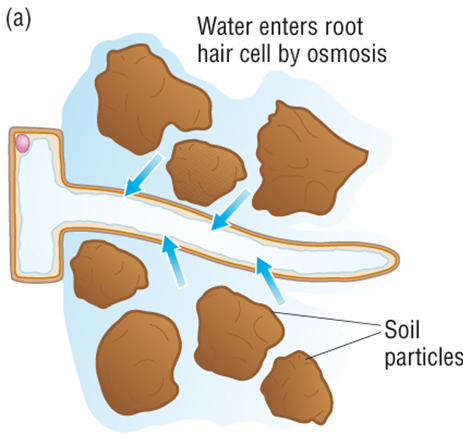
Water enters the root through root hair cells.
Their hair-like structure increases the surface area for absorption.
The water moves across the root to the xylem vessels.
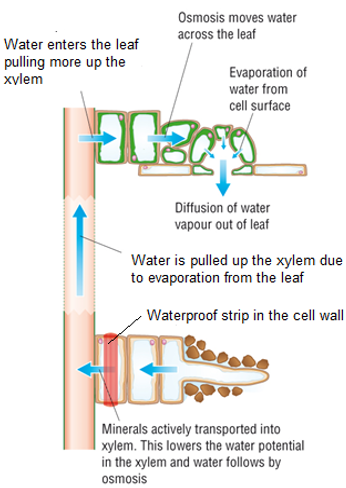
Transport of Water – Xylem
As water moves up the plant, it carries dissolved minerals.
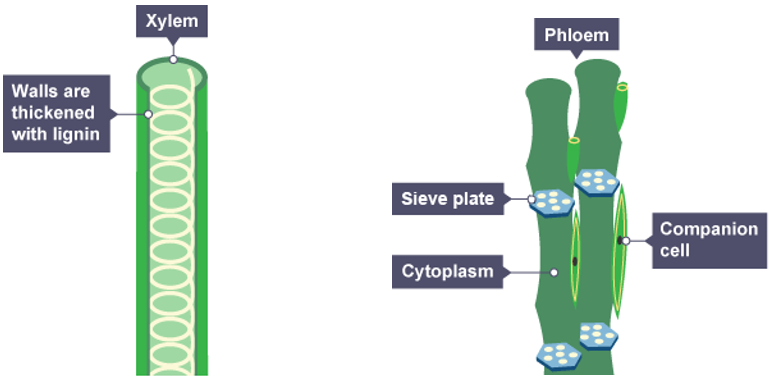
The xylem vessels are made from dead cells that have lost their cytoplasm.
They are joined together to form a long continuous tube.
Transport of Food – Phloem
Food, in the form of sucrose and amino acids, is transported around the plant by the phloem.
Unlike xylem, phloem is made up of living cells joined end to end to form a tube.
The cell walls between the cells have large pores, called plasmodesmata.
Phloem can move substances up and down the plant.
Xylem and phloem vessels are found in groups next to each other in the stem, called a vascular bundle.
Extension
Xylem cells strengthen their walls with lignin, making them waterproof.
Phloem cells have cytoplasm but no nucleus or organelles.
They are always found with a companion cell that helps keep them alive.
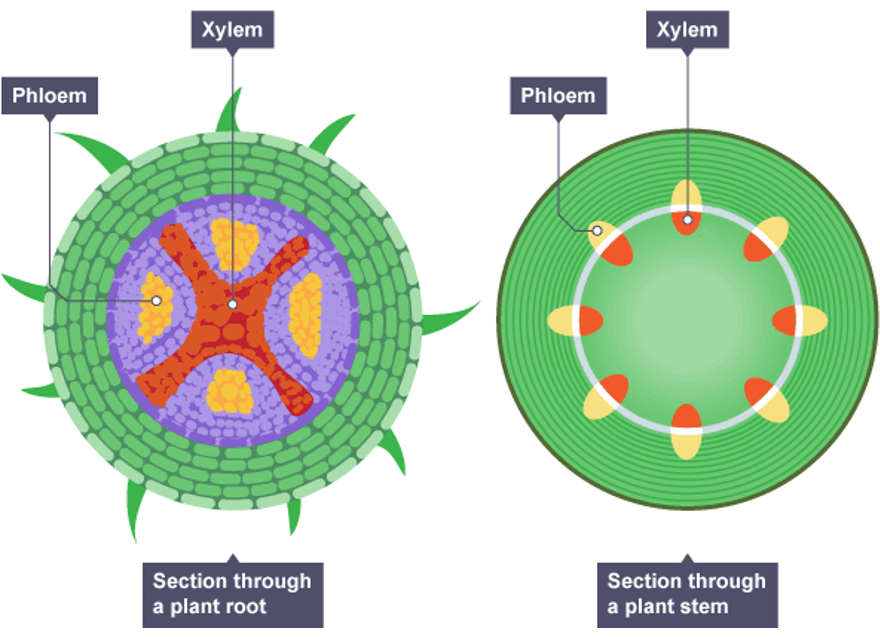
How and Why the Location of Xylem and Phloem Changes Through the Plant
In young plants:
Xylem and phloem are arranged in vascular bundles around the edge of the stem, supporting early growth and efficient transport.In mature plants:
They move to the centre of the stem in a cylinder for added stability and efficient transport over greater distances.In roots:
Xylem and phloem are in the centre in a star-shaped pattern, aiding water and nutrient transport.Reason for changes:
The location adapts to the plant's growth:Early growth: Near the edge for initial support.
Mature plants: Central for structural support and better transport efficiency.
Structure of a leaf:
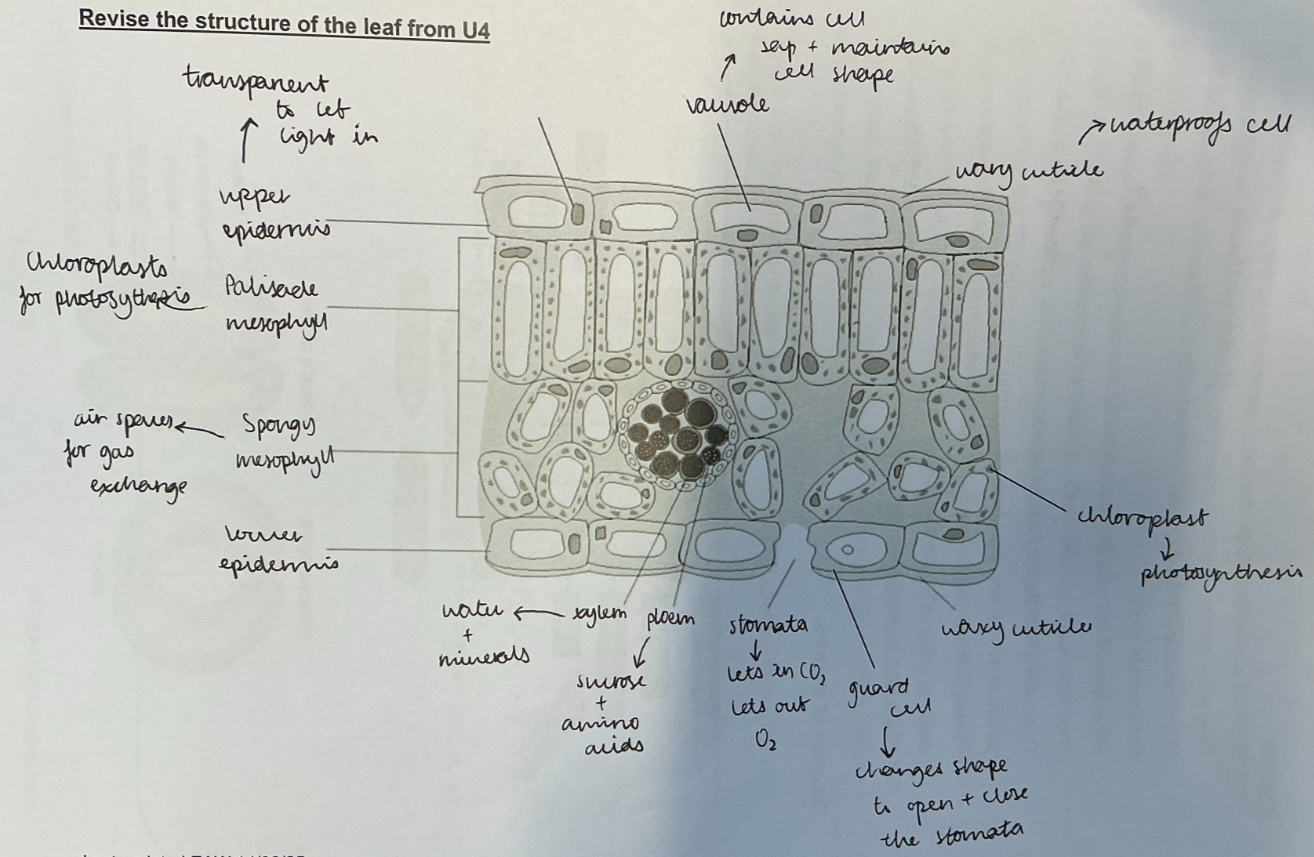
Stomata
Stomata are tiny pores found in the epidermis of leaves.
They allow carbon dioxide to enter (for photosynthesis) and oxygen (from respiration) and water to leave (evaporation at the end of the transpiration stream).
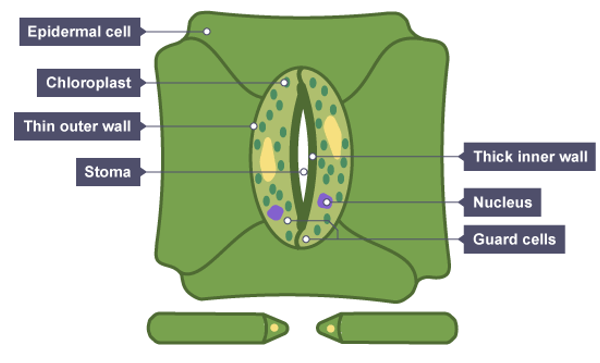
On either side of the stoma are two cells called guard cells.
These cells have extra thickness on their inner cell walls.
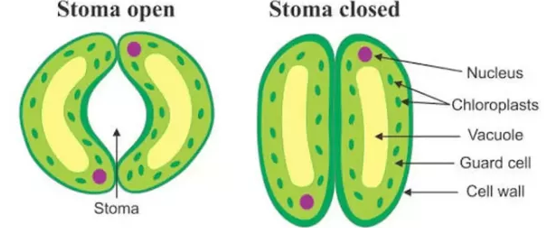
As they take in water and become turgid, the cells swell unevenly, forming an opening – the stoma.
Photosynthesis increases sugar concentration in the leaf, drawing water in by osmosis.
Therefore, stomata are open during the day and closed at night.
Diagram of stomata:
Extra questions:
Define Photosynthesis
Photosynthesis is the process by which plants use sunlight, water, and carbon dioxide to produce glucose and oxygen.
Word Equation for Photosynthesis
Carbon dioxide + water → glucose + oxygen
Balanced Chemical Equation for Photosynthesis
6CO₂ + 6H₂O → C₆H₁₂O₆ + 6O₂
How and Why Does CO₂ Concentration Affect Rate?
More CO₂ increases the rate of photosynthesis as it’s needed for glucose production.
However, it plateaus once the plant reaches a limit in carbon dioxide uptake.
How and Why Does Temperature Affect Rate?
Higher temperatures can speed up photosynthesis to a point.
If too high, enzymes involved in photosynthesis can become denatured, slowing the process.
How and Why Does Light Intensity Affect Rate?
Higher light intensity increases the rate of photosynthesis as more energy is available for the process.
At very high light intensities, the rate levels off because other factors (like CO₂) become limiting.
What Are the 4 Layers of the Leaf?
Upper epidermis
Palisade mesophyll
Spongy mesophyll
Lower epidermis (with stomata)
Why Do Plants Need Magnesium?
Magnesium is essential for producing chlorophyll, which is needed for photosynthesis.
Why Do Plants Need Nitrates?
Nitrates are vital for producing amino acids, proteins, and chlorophyll.
How Can We Measure the Rate of Photosynthesis Using a Water Plant?
By measuring the amount of oxygen produced or the volume of carbon dioxide consumed over time, often using a water plant like Elodea.
The Transpiration Stream
The transpiration stream is the route that water takes through a plant and is important because:
It transports water to the leaves.
It provides water for support (turgidity).
It helps cool the leaves through evaporation.
It provides water for photosynthesis.
Measuring Transpiration
Transpiration is the loss of water from a plant by evaporation and can be measured with a potometer.
There are two main types of measurements: mass and volume.
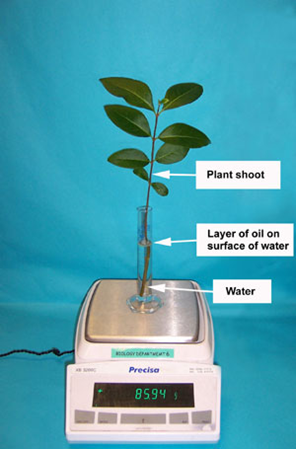
Mass Potometers
A simple method of measuring water loss is by taking the mass of the plant over time.
Wrapping the pot in a plastic bag prevents water loss from the soil.
Any loss in mass is due to transpiration from the leaves.
Volume potometers:
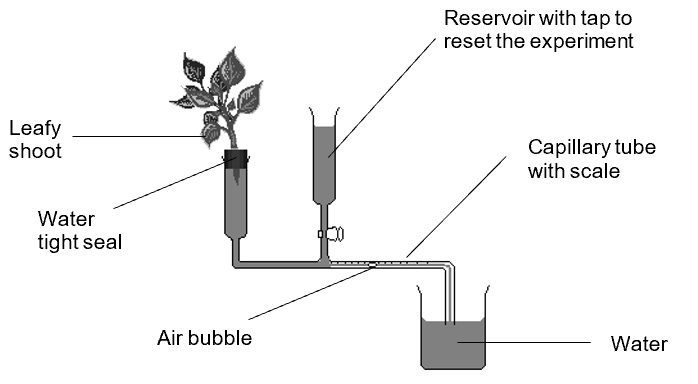
As water evaporates from the leaves, more is drawn up from the apparatus.
This pulls an air bubble along the capillary tube.
It gives a very quick and sensitive reading over a short time.
You can calculate the volume of water lost using πr²h (r = radius of tube, h = distance moved).
A key advantage is that the same plant can be used for multiple readings, making the experiment more reliable.
Method steps:
Cut stem under water - avoids air bubbles
Attach stem to potometer under water and seal with Vaseline - makes it air and watertight
Dry the leaves - ensures a steep water potential gradient
Lift the potometer out of the water then return - introduces an air bubble
Use a scale to measure the distance bubble moves over a period of time - calculates rate of water uptake
Repeat - for reliability
Mass potometer readings:
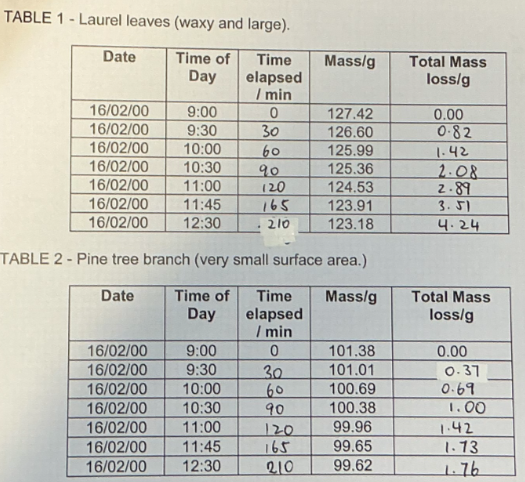
Note:
1 cm³ of water = 1 g
1 cm³ = 1000 mm³
Graph Task:
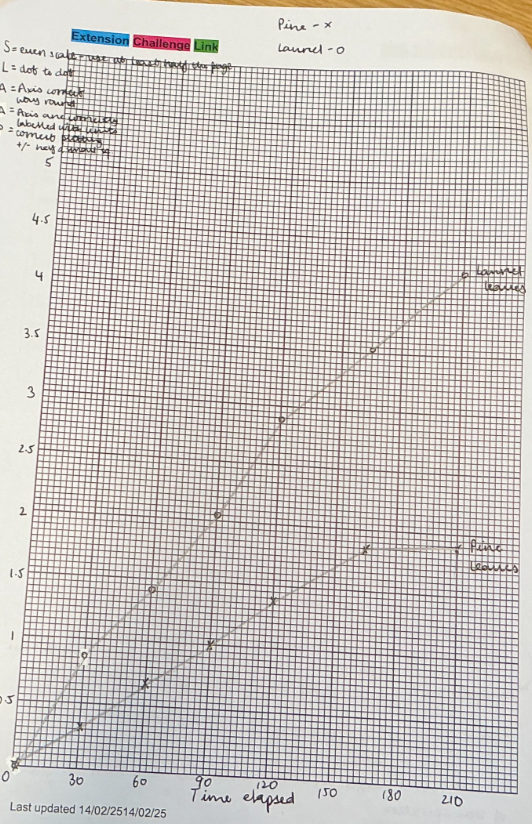
Draw one graph showing mass loss (y-axis) against time elapsed (x-axis) for both types of plant.
Use different lines or colours for each plant to compare transpiration rates.
Calculate Average Rate of Transpiration:
Use the formula:
Rate = total volume (or mass) of water lost ÷ time takenConvert g to cm³ (1 g = 1 cm³), then to mm³ if needed for clearer values.
Final units: cm³/min or mm³/min depending on scale.
Why Are the Rates of Transpiration Different?
Differences may be due to:
Leaf size or number – more stomata = higher rate
Surface area – larger area = more evaporation
Waxy cuticle – thicker layer = slower transpiration
Environmental conditions – like humidity, temperature, or light intensity
Graph:
Factors Affecting Transpiration
Humidity
High humidity reduces the rate of transpiration because the air around the leaf already contains a high concentration of water vapour.
This decreases the water potential gradient between the inside of the leaf and the surrounding air, so less water evaporates from the leaf surface.
Wind Speed
Higher wind speed increases transpiration.
Moving air removes the humid layer of water vapour near the stomata, maintaining a steep water potential gradient and allowing more water to evaporate quickly.
Temperature
Higher temperatures increase the kinetic energy of water molecules, making them evaporate faster from the surface of mesophyll cells inside the leaf.
Warmer air can also hold more water vapour, further increasing the rate of diffusion from the leaf to the air.
Light Intensity
Greater light intensity increases the rate of photosynthesis, causing the stomata to open to allow in more CO₂.
This also allows more water vapour to escape, increasing transpiration.
Experiment:
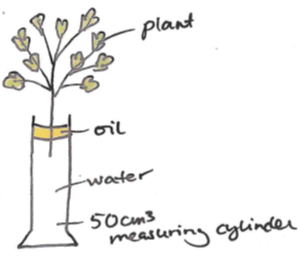
Results
Experiment Conditions | Water Remaining (cm³) | Explanation |
|---|---|---|
Starting point | 50 | Baseline reading before the experiment began. No water has been lost yet, so this is the full starting volume of water. |
Light, 20°C | 40 | Light causes stomata to open to allow CO₂ in for photosynthesis. As a result, more water vapour escapes through the stomata via transpiration. |
Dark, 20°C | 45 | In darkness, stomata close because photosynthesis stops. With fewer stomata open, less water evaporates, so transpiration is reduced. |
Light, 30°C | 30 | At higher temperatures, water molecules have more kinetic energy, increasing evaporation from leaf surfaces and speeding up transpiration. |
Light, 20°C, windy | 35 | Wind removes the humid air around the leaf, maintaining a steep water potential gradient, so water vapour diffuses out faster. |
Light, 20°C, humid | 45 | High humidity reduces the water potential gradient between the inside of the leaf and the surrounding air, slowing down transpiration. |
What is the purpose of the oil?
The oil forms a barrier on the surface of the water to prevent evaporation directly from the container, ensuring that any water loss is due only to transpiration through the plant.
In this experiment multiple variables have been changed. What is the problem with this?
Changing multiple variables means you can’t be sure which factor caused the observed effect, making it difficult to draw accurate conclusions about individual variables.
Despite this the experiment can produce interesting information. Which variables should you control to make the results valid?
To ensure valid results, you should control:
Type and size of plant – different species transpire at different rates.
Leaf surface area – more surface area can increase transpiration.
Volume of water at the start – ensures a fair comparison.
Container size and material – affects heat retention and evaporation.
Time allowed for transpiration – all conditions should be tested for the same length of time.
How would you check the results are reliable?
Repeat the experiment under each condition at least 3 times.
Calculate averages to reduce the impact of anomalies.
Ensure consistent methods and equipment are used in each trial.
Experiment 2:
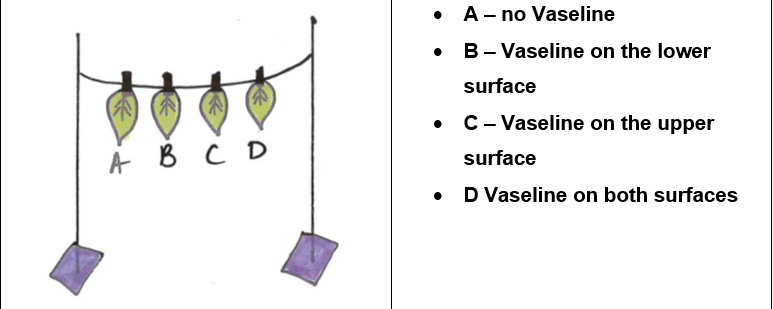
Final Table:
Leaf | Loss in Mass (g) | Justification |
|---|---|---|
A | 1.6g | No Vaseline – water evaporates freely from both surfaces, maximum transpiration. |
B | 0.7g | Vaseline on lower surface – stomata mostly blocked (most are on the lower side), so transpiration is reduced. |
C | 1.3g | Vaseline on upper surface – stomata on lower surface are still exposed, so transpiration remains high. |
D | 0.5g | Vaseline on both surfaces – stomata on both sides sealed, minimal water loss. |
Experiment 3:
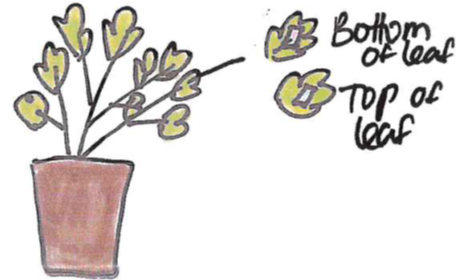
What does this test for?
Cobalt chloride paper is used to test for the presence of water. It is blue when dry and turns pink when it comes into contact with water, so this test detects water loss through transpiration.
Prediction: Which piece of paper would go pink first?
The paper on the underside (bottom) of the leaf will go pink first.
Justification:
Most stomata (tiny pores responsible for gas exchange and water loss) are found on the lower surface of a leaf.
Therefore, more water vapour escapes from the underside, making the cobalt chloride paper turn pink sooner than the one on the upper surface.
Experiment 4:
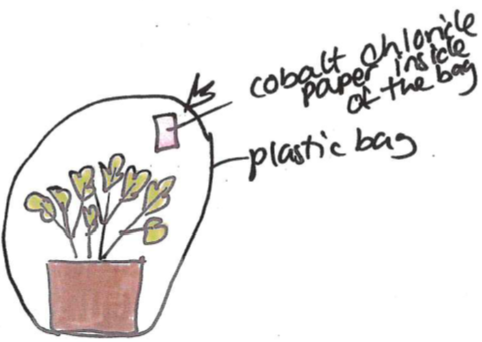
What is this experiment designed to show?
Designed to show water loss through transpiration.
Cobalt chloride paper inside the plastic bag turns from blue to pink when it comes into contact with water vapour.
The plastic bag traps water vapour and prevents it from escaping, allowing the paper to indicate the rate of transpiration.
What is the major limitation of this experiment?
Lack of a control group
Failure to account for other variables
The plastic bag increases humidity, which could slow down transpiration and affect the results.
Results may not reflect natural environmental conditions accurately.
Gas Exchange in Plants
The leaf is adapted to efficiently exchange gases (such as oxygen and carbon dioxide) due to its specific features.
Feature | Advantage |
|---|---|
They are thin | Short diffusion path – Gases can diffuse more easily and quickly across the leaf's thin surface. |
Cells are covered in a moist layer | Facilitates gas diffusion – The moisture allows gases (CO₂ and O₂) to dissolve, aiding easier movement across cell membranes. |
There are air gaps | Increases surface area for gas exchange – Air gaps between cells allow gases to move more freely and access the stomata. |
There are stomata | Regulate gas exchange – Stomata control the entry of CO₂ for photosynthesis and the exit of O₂ and water vapour. |
Cells have lots of chloroplasts | Photosynthesis – Chloroplasts absorb light for photosynthesis, where CO₂ is used to produce glucose, and O₂ is released. |
Plants carry out two processes that require atmospheric gases:
Respiration requires oxygen
Photosynthesis needs carbon dioxide
Respiration is the process of releasing energy from food. Plants, like animals, carry this out at all times. However,
Photosynthesis is how plants use light energy to make food from carbon dioxide and water. This can only occur during the day.
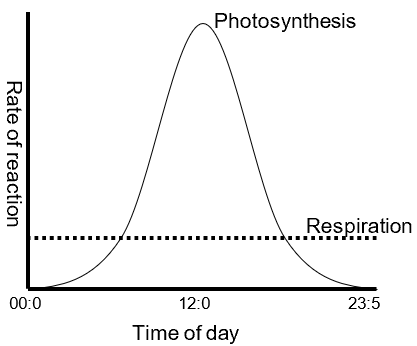
At midnight, plants take in oxygen and release carbon dioxide due to respiration.
At midday, plants still respire but photosynthesize much quicker. Therefore, they take in carbon dioxide and give out oxygen.
At dawn and dusk, the rate of respiration equals the rate of photosynthesis, meaning there is no net movement of gases in or out of the leaf.
Graph Explanation:
The compensation point is where the rate of photosynthesis and respiration are equal.
Estimate time: Based on the graph, the compensation point occurs around early morning or late evening (time may vary depending on the specific graph shown).
Gas exchange practical:
Hydrogen carbonate indicator is used to measure the amount of carbon dioxide.
It shows the following colour changes:
Concentration of CO2 | Colour |
High concentration | Yellow |
Normal air | Orange |
Low concentration | Purple |
Leaves were put in boiling tubes with hydrogen carbonate solution and tightly sealed. They were then left for 5 hours in the following conditions.
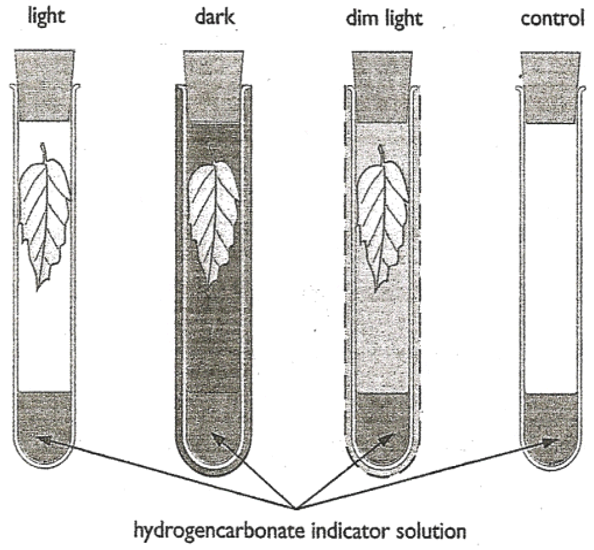
1. Prediction for Each Tube:
Boiling tube in light:
Prediction: The solution will turn red/orange as CO₂ is absorbed during photosynthesis.Boiling tube in dark:
Prediction: The solution will turn yellow as the plant will only respire and release CO₂.Boiling tube in dim light:
Prediction: The solution will be yellow/orange, as photosynthesis occurs but at a slower rate than in bright light.Control tube:
Prediction: The solution will stay red/orange with no plant activity.
2. Table to Record the Results:
Condition | Color of Hydrogen Carbonate Solution | Scientific Reason |
|---|---|---|
Light | Red/Orange | Photosynthesis occurs, CO₂ is absorbed, pH becomes more alkaline. |
Dark | Yellow | Respiration occurs, CO₂ is released, pH becomes more acidic. |
Dim Light | Yellow/Orange | Photosynthesis occurs at a slower rate, CO₂ is still released due to respiration. |
Control | Red/Orange | No plant, so no change in CO₂ levels or pH. |
3. Evaluation of the Method:
Limitations of the Method:
Boiling tube seal: If not airtight, CO₂ could escape, affecting the results.
Light intensity: Inconsistent light could affect photosynthesis rates.
Plant species and size: Varying plant sizes or types may give inconsistent results.
Experiment duration: 5 hours might be too short for significant changes.
Data is suggestive and people may see different colour shades
Quality of data - no numerical value
Improvements to the Practical Design:
Tight seals: Ensure airtight containers to prevent CO₂ leakage.
Control light source: Use a consistent light source at equal distances.
Monitor over longer periods: Check results at multiple time intervals.
Same plant type and size: Use identical plants for consistency.
Summary:
1. Respiration is a continuous process which occurs in every cell of plants and animals.
2. Respiration is when glucose (or other sugars) react with oxygen to release energy.
3. The reaction produces carbon dioxide and water as by-products.
4. Respiration is NOT photosynthesis.
5. The equation for respiration is:
Glucose + Oxygen → Carbon Dioxide + Water + Energy
6. Photosynthesis only occurs in plants (and some bacteria).
7. In photosynthesis, light is used as an energy source to make glucose from carbon dioxide and water.
8. The four things needed for photosynthesis to occur are light, chlorophyll, carbon dioxide, and water.
9. The equation for photosynthesis is:
Carbon Dioxide + Water → Glucose + Oxygen
10. Complete the following table:
Which process can take place in the dark? | Respiration |
|---|---|
Which process becomes faster in the light? | Photosynthesis |
Which process stops in darkness? | Photosynthesis |
Which process gives out carbon dioxide? | Respiration |
Which process takes in oxygen? | Respiration |
Which process gives out oxygen? | Photosynthesis |
Which process occurs in both plants and animals? | Respiration |