Coursework 1
i)
Process Overview:
Non-parametric tests rank the data and analyze ranks.
Assign ranks starting from the lowest score.
For tied scores, assign the mean of ranks.
Specific Test:
Wilcoxon Rank-Sum Test: Also known as Mann-Whitney U test equivalent to unpaired t-test for ordinal data and continuous data.
Wilcoxon Signed-Rank Test
Non-parametric version of the paired t-test.
Not to be confused with the Wilcoxon rank-Sum test.
Suitable for ordinal or continuous data.
Useful when the normality of the differences fails.
Assumes that the distribution of the differences is symmetric.
Check using histograms or the Stewart (lab) method.
Hypotheses
Null Hypothesis (Ho): Median difference is M (usually 0).
Wilcoxon Signed-Rank Test Method
State the null hypothesis (Ho).
Calculate differences: ( d_i = x_i - y_i ) where ( (x_i, y_i) ) are the paired observations.
Rank the absolute values of the differences.
Treat tied ranks as in the Mann-Whitney U test.
Exclude differences equal to M (usually 0) and adjust n accordingly.
Record the sign of the ranks.
Calculate the Sum of positive ranks: ( T_+ ).
Calculate the Sum of negative ranks: ( T_- ).
Assumptions and Focus on Mann-Whitney U Test
Assumptions for Unpaired t-test:
Normality of groups
Homogeneity of variances
If assumptions fail, use Mann-Whitney U Test.
Hypotheses:
Null (H0): Distribution is equal
Alternative (H1): Distribution is not equal.
Mann-Whitney U Test Steps:
Rank data ignoring group membership.
Attach group labels.
Assign tied ranks for repeated data values.
Effect Size Formula:
( r = Z / \sqrt{n} )
Effect Size Interpretation:
0.1 = Small effect
0.3 = Medium effect
0.5 = Large effect.
Best Practices: Reporting and using box plots for visualization.
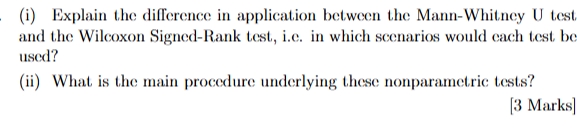
i)
in application the Mann-Whitney U test involves ranking data ignoring group membership then attaching group labels and assigning tied ranks for repeated data values it is best suitable when there is two independent groups and we want to compare their distributions eg comparing test scores of two different groups
on the other hand the Wilcoxon signed-rank test in application involves Calculating the differences between paired observations, ranking absolute values of the differences, and considering the sign of these ranks. it is best suitable when dealing with two related samples or matched pairs eg before-and-after measurements.
ii)
For the Mann-Whitney U Test, rank the data while ignoring group membership, attach group labels and assign tied ranks if necessary.
For the Wilcoxon Signed-Rank Test, calculate differences between paired observations, rank the absolute values of the differences and consider the sign of these ranks.
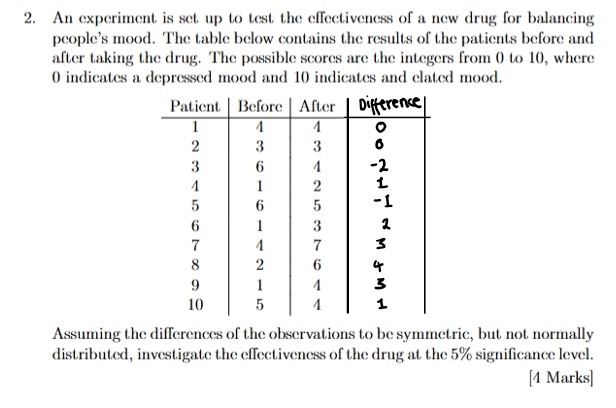
in this case the hypotheses are:
H0: the median difference is 0
H1: the median difference is not 0