The Citric Acid Cycle
Also called the Krebs cycle
Also called the tricarboxylic acid (TCA) cycle
Closely intertwined with cellular respiration
ATP (adenosine triphosphate) = a nucleotide that serves as the primary energy source for all living cells
ADP (adenosine diphosphate) = a molecule that serves as the lower-energy, de-energized form of ATP
GTP (guanosine triphosphate) = a high-energy nucleotide that serves as an essential energy source and signaling molecule in a wide range of cellular processes
GDP (guanosine diphosphate) = a molecule that acts as the inactive form of guanosine triphosphate
Found in all aerobic cells
Takes place in the matrix of the mitochondria in eukaryotes
Takes place in the cytoplasm in prokaryotes
“Engine of life”
Very universal, reenforcing the idea that all creatures evolved from others
Per cycle of the citric acid cycle:
2 carbons enter and are released
3 molecules of NADH are generated
1 molecule of FADH2 is generated
1 molecule of either ATP or GTP is produced
More ATP is produced via the NADH and FADH2 it generates
These molecules will connect with the last portion of cellular respiration and deposit their electrons into the electron transport chain so that more ATP can be made with the deposited electrons
Steps
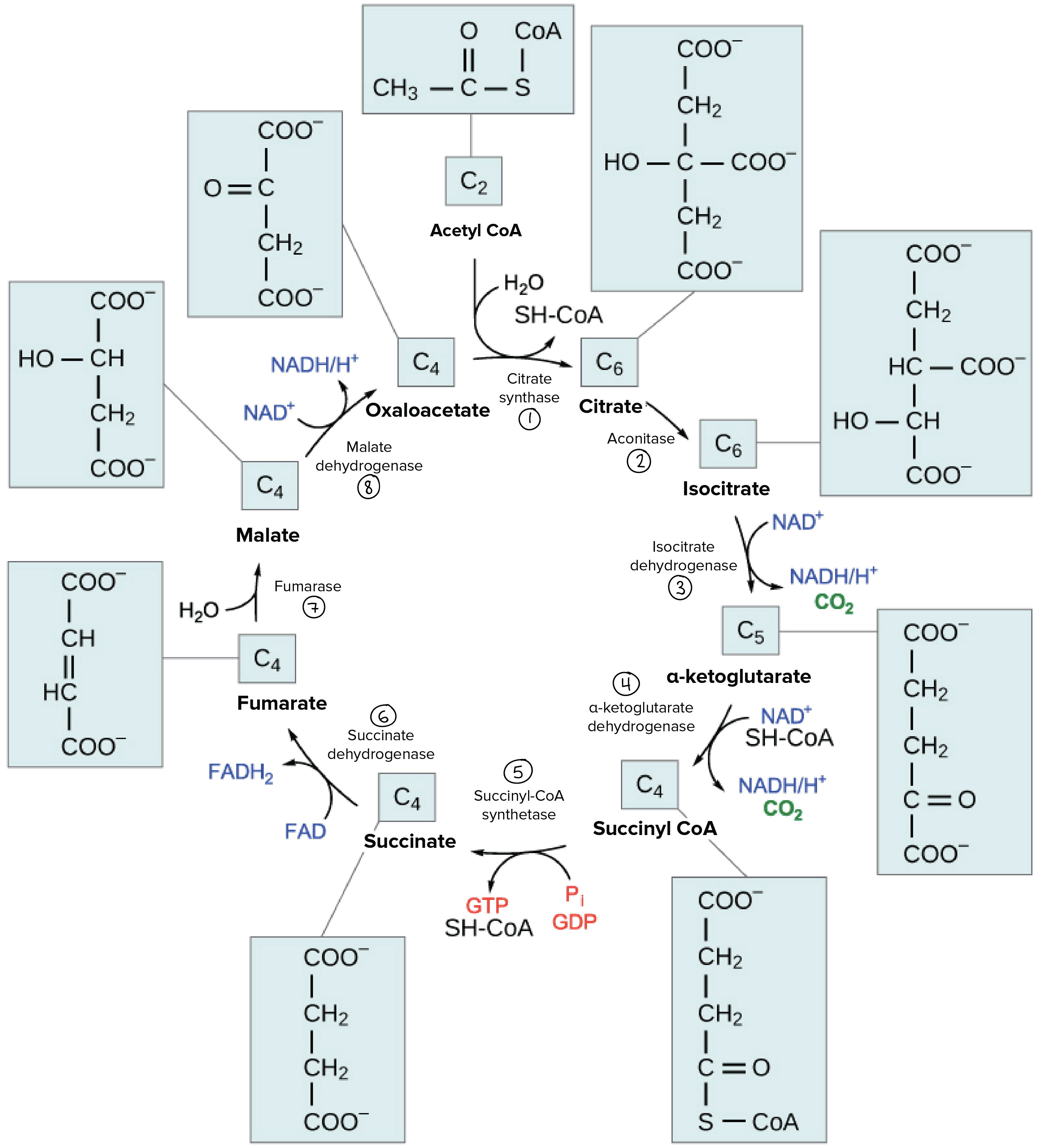
Acetyl COA joins with oxaloacetate to release the COA group & form citrate
Oxaloacetate is a 4 carbon molecule
Citrate is a 6 carbon molecule
An H2O molecule is added to citrate
An H2O molecule is removed from citrate, converting it to its isomer, isocitrate
Isocitrate is oxidized & releases a molecule of carbon dioxide, turning it into α-ketoglutarate
During this step, NAD+ is reduced into NADH
Isocitrate dehydrogenase is the enzyme which catalyzes this step
α-ketoglutarate is oxidized, releasing a molecule of carbon dioxide & picking up Coenzyme A, making it succinyl CoA
During this step, NAD+ is reduced into NADH
α-ketoglutarate dehydrogenase is the enzyme which catalyzes this step
Succinyl CoA is unstable
The CoA of succinyl CoA is replaced with a phosphate group, which is then transferred to ADP to make ATP
In some cells GDP is used rather than ADP
This is to form GTP
This step produces succinate
Succinate is a 4-carbon molecule
Succinate is oxidized, forming fumarate while 2 hydrogen atoms & their electrons are transferred to FAD, forming FADH2
The enzyme which catalyzes this reaction is embedded into the inner membranes of the mitochondrion, so that FADH2 can immediately transfer its electrons into the electron transport chain
Fumarate is a 4-carbon molecule
H2O is added to fumarate, converting it to malate
Malate is a 4-carbon molecule
Malate is oxidized to form oxaloacetate—the starting molecule
A molecule of NAD+ is reduced to NADH in the process
Colors
#134c31
#345635
#6B8f71
#9aa89a
#aebc9b for other stuff