Drone Pilot Training_ Drone rules and Regulations.
Drone Pilot Training Overview
Presentation by Droneacharya Aerial Innovations.
Emphasis on avoiding photographs or videos during classes.
Drone Rules (2021)
Various areas of operation include:
Airport
Corporate Campus
Smart City
Emergency Response
Port & Harbor
Critical Infrastructure
Public Venues
International Rules and Regulations
Four basic elements of regulation:
Pilot’s Certification
Aircraft Registration
Restricted Zones
Insurance
Indian Drone Regulation Timeline
CAR for RPAS was issued under the provisions of Rule 15A and Rule 133A of the Aircraft Rules, 1937
UAS Rules 2021 – March 2021
Amendment Rules, 2022 (February 11)
Drone Rules, 2021 (August 25)
Amendment Rules, 2023 (September 27)
Approaches to Drone Regulation by Different Countries
Outright Ban
Effective Ban
Constant Visual Line of Sight (VLOS) requirements
Experimental use of Beyond Visual Line of Sight (BVLOS)
Permissive regulations
Wait and See approach
Civil Aviation Requirements (CAR)
govern the operation of unmanned aerial vehicles (UAV) and provide a framework for testing and implementing BVLOS flight conditions.
Issued by Directorate General of Civil Aviation (DGCA) , these regulations aim to ensure safety and compliance while fostering innovation in the drone industry.
This approach encourages gradual integration of new technologies, allowing stakeholders to adapt to evolving standards and promote responsible usage.
Important terms:
AGL: Above Ground Level
RPTO: Remote Pilot Training Organization
ATC: Air Traffic Control
UAV: Unmanned Aerial Vehicle
VLOS: Visual Line of Sight
BVLOS: Beyond Visual Line of Sight
RPA: Remotely Piloted Aircraft
RPC: Remote Pilot Certificate
NPNT: No Permission No Take Off
RPAS: Remotely Piloted Aircraft System
UTM: Unmanned Traffic Management
GCS: Ground Control Station
UAV: Unmanned Aerial Vehicle
UIN: Unique Identification Number
DGCA's Role
Responsible for safety issues of aircraft and operations.
DigitalSky Platform : A regulatory framework for drone operations in India, providing services such as registration, pilot licensing, and airspace management.
Mobile application for drone pilots with features like:
provides a centralized system for managing drone operations and ensuring compliance with regulations.
Issuing UINs
Applying for Type Certificates
Accessing Interactive Airspace Maps
UIN Application for Model Subcategory or Nano Class does not require a Type Certificate.
Categorization of UAS
Types include:
Rotorcraft: Designed for vertical flight, utilizing rotors to achieve lift and maneuverability.
Hybrid: Combines characteristics of both fixed-wing and rotorcraft, allowing for versatile performance in various flight conditions.
Aeroplane: A fixed-wing aircraft that requires forward motion to generate lift, typically used for longer distances and higher speeds.
Sub-Categorization:
Remotely Piloted Aircraft System (RPAS): A type of unmanned aerial vehicle (UAV) that is operated from a distance through a ground control station.
Autonomous Unmanned Aircraft System (AUAS): A category of UAV that can navigate and operate independently without direct human control, utilizing onboard systems for decision-making and flight management.
Model Unmanned Aircraft System (MUAS):M A class of UAV that is designed for specific research, training, or experimental purposes, often serving as a platform for the development and testing of new technologies.
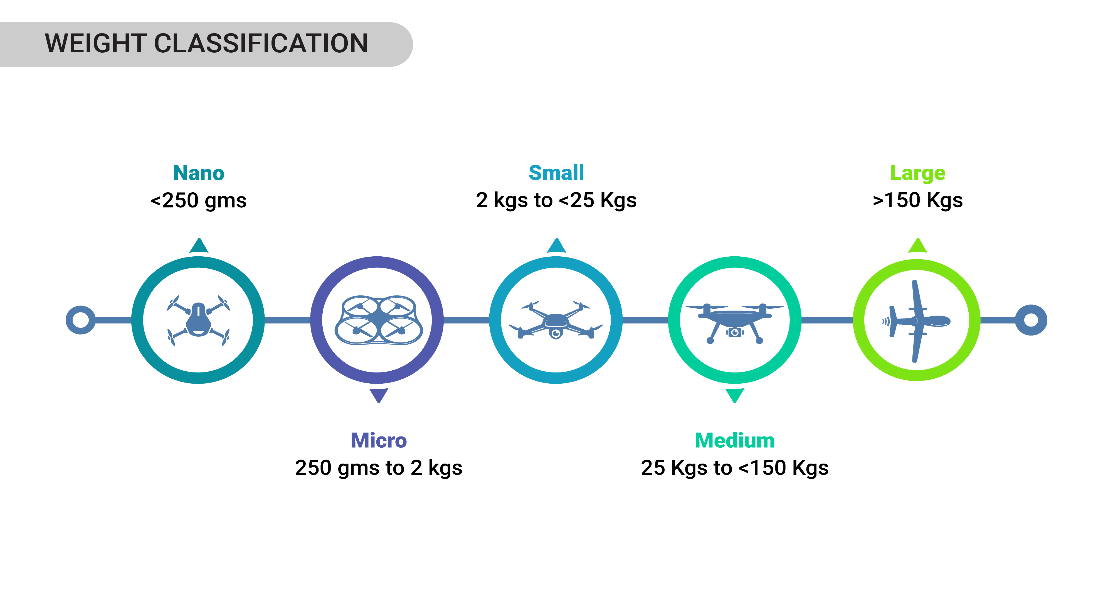
Classification of UAVs by Weight
Nano: ≤ 250 gms
Micro: > 250 gms and ≤ 2 kg
Small: > 2 kg and ≤ 25 kg
Medium: > 25 kg and ≤ 150 kg
Large: > 150 kg
Rules of Air (Issued by Ministry of Civil Aviation)
Responsibilities of Drone Pilots:
Keep drone within sight
Avoid airports and airfields
Maintain distance from people and property
Do not fly above 120m (400 ft)
Drone Laws
Registration as a drone pilot is compulsory
Knowledge of drone operation is essential
Completion of DGCA training and tests is required
Respect people's privacy while flying drones
Prepare drone for every flight
Weather Check Consideration
Must check weather conditions before flying drones to ensure safety and optimal performance, including wind speed, precipitation, and visibility.
Authorization of Drone Operations
Includes authorization of individuals, eligibility conditions, and validity periods for drone pilots, along with ensuring compliance with aviation regulations and obtaining necessary permits.
Third Party Liability and Insurance
Mandatory insurance includes:
Comprehensive
Payload
Beyond Visual Line of Sight
Night Flying (based on project)
Transit (good to have)