Biochemistry
Atoms, Molecules and water
Atoms
Atoms are basic units of matter
Made of:
Protons (+) positive charge 🡪
Nucleus Neutrons ( 0) no charge – neutral
🡪 Nucleus Electrons (-) negative charge
Atoms have a neutral charge protons (+) = electrons (-) Atomic number: Number of protons (periodic table arranged by this number) Atomic mass: Number of protons and neutrons
- Element: a pure substance made of only one type of atom
- Compounds: elements (atoms) combine with each other Expressed by formulas: like H2O
Isotopes: atoms of an element with the same number of protons (+) and electrons (-), but a different number of neutrons
Radioactive Isotopes: unstable nucleus, releases energy (radiation) over time as it breaks down
Uses of radioactive isotopes:
- Carbon Dating: measures amount of isotopes remaining to find out the age of an object
- Sterilization: used to kill bacteria in food and medical tools
- Radiation Therapy: used to kill cancer cells
Tracers: used to follow the movement of substances inside living organisms
\n
Chemical Bonds
Chemical Bonds: forces holding two or more atoms together Electrons make the bonds
Covalent Bonds - atoms SHARE electrons
Ionic Bonds -
electrons are transferred for one atom to another, results in attraction \n
WATER
Hydrogen Bonds -
In between water molecules– hydrogen bonds The positive end (H) of one water molecule attracts the negative end (O) of another water molecule, until all the water molecules are connected.
Weak attraction between water molecules
slightly negative oxygen of one water connects to the slightly positive hydrogen of another water
H-Bonds lead to many unique properties of water:
Cohesion: holds water together
Adhesion: water sticks to other substances
Density: Solid water (ice) is less dense than liquid water
Universal Solvent : Water dissolves most substances (best solvent), breaks up ionic bonds
Water is neutral
pH: Measures how acidic or basic a solution is Measures the concentration of H+ ions in the solution .
Acids release more H+. Bases release more OH- 0=Very Acid 7=neutral 14=Very Basic
Cohesion and Adhesion give water High Surface Tension 2. Water can move up through small tubes against gravity = Capillarity 3. Water dissolves most substances (Universal Solvent). 4. Water is able to absorb large amounts of heat and Stabilize temperatures 5. Water absorbs heat when it evaporates. Organisms can cool off. 6. Solid water (ice) is less dense than liquid water. Water expands when it freezes and floats.
Macromolecules
6 elements make up all living things Only about 6 make up most organisms:
- Hydrogen H
- Oxygen O
- Nitrogen N
- Carbon C
- Phosphorus P
- Sulfur S
- Calcium (Ca), Sodium (Na), Potassium (K),
Why should we study carbon?
- All life (on Earth) depends on carbon. Carbon atoms have 4 electrons on the outer shell – they need 4 more electrons to be stable (happy) (8 electrons is the magic number) Carbon atoms bond easily with H, O, or other C atoms.
- Organic compounds: Compounds that have a backbone of CARBON (and H)
Example:
- Inorganic Compounds: No C-C bonds
Example:
- Do not confuse with Organic Food: Food grown without pesticides, hormones, or fertilizers.
Macromolecules
- Macromolecules: Large molecules in living cells.
- Macromolecules are made by joining together thousands of smaller molecules (think Legos)
- The small molecules
are called monomers.
- Monomers join together
to make polymers
(= macromolecules)
\n The 4 organic molecules that make living organisms are
1. Carbohydrates
2. Lipids
3. Proteins
4. Nucleic Acids
These 4 organic molecules are called macromolecules because of their large size
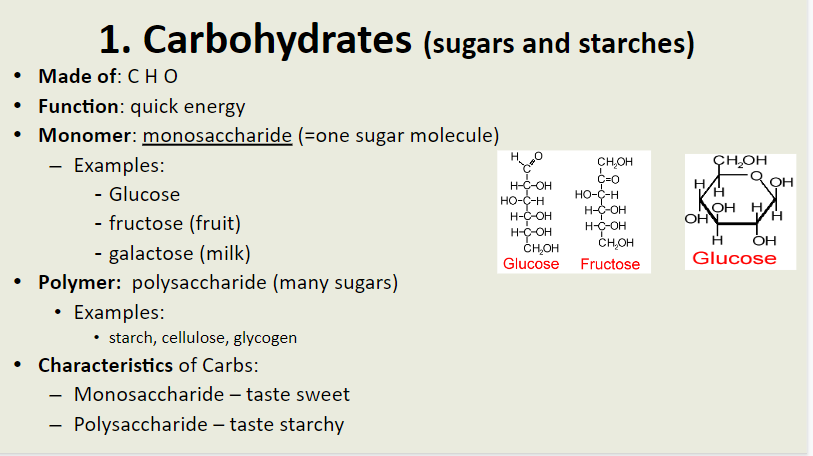
\n
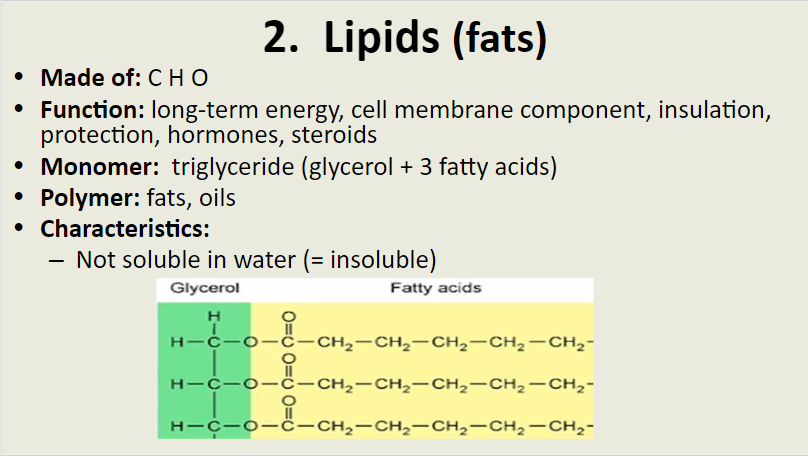
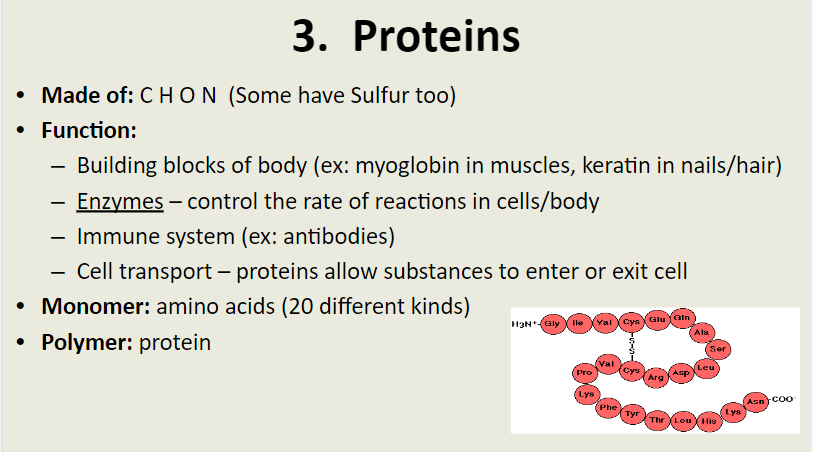
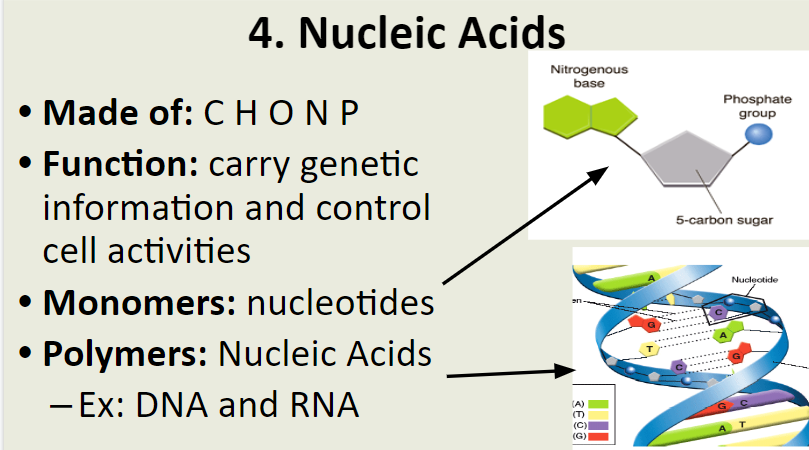
Dehydration Synthesis
Synthesis - to make a carb, lipid, or protein by combining certain elements Water must be removed Called Dehydration Synthesis (DS) or Condensation Energy is used
Small + Small ------------- ----→> Large + Water
Molecule Molecule Molecule
HYRDOLOSIS
Carbs, lipids, and proteins also need to be broken down into smaller pieces so that our cells can utilize them
- Water must be added (exact opposite process of DS!)
- Called hydrolysis (to lyse= to cut) using water
- Energy is released
Large + Water ----- ----------→> Small + Small
Molecule Molecule Molecule
Isomer-- Same molecular formula, but atoms are arranged differently (different structural formula)
\n \n
Enzymes
Chemical Reactions: Processes that change one set of chemicals into another set of chemicals METABOLISM: Set of chemical reactions inside cells that build and break down materials
- Reactants or Substrate: Start the reaction
- Products: End the reaction
\n
2H2 + O2 🡺 2H2O
\n
(reactants) 🡺 (product)
\n
- Activation energy: amount of
energy needed to start rxn
\n Enzymes speed up chemical reactions by lowering the activation energy
- Responsible for metabolism (digestion and synthesis)
- Enzymes are organic catalysts.
Catalyst - chemical that changes the rate (speed) of reaction
Enzymes are highly specific.
Specificity – enzyme’s have a 3D shape that allows them to bond with a specific substrate (the reactant)
Lock and Key Mechanism:
Enzymes “fit” a specific substrate like a key fits a lock
\n Enzymes have an active site.
Active Site – enzyme’s specific pocket, bonds to substrate
\n Enzyme are recycled.
Recycled – enzymes are used over and over again
\n Enzymes are sensitive to environmental conditions.
- pH
- Temperature
- Each enzyme has optimum conditions
- Outside of these conditions, the enzyme can denature
- Denature – destroy from damage
\n
\n
\n