Bacterial Genetics
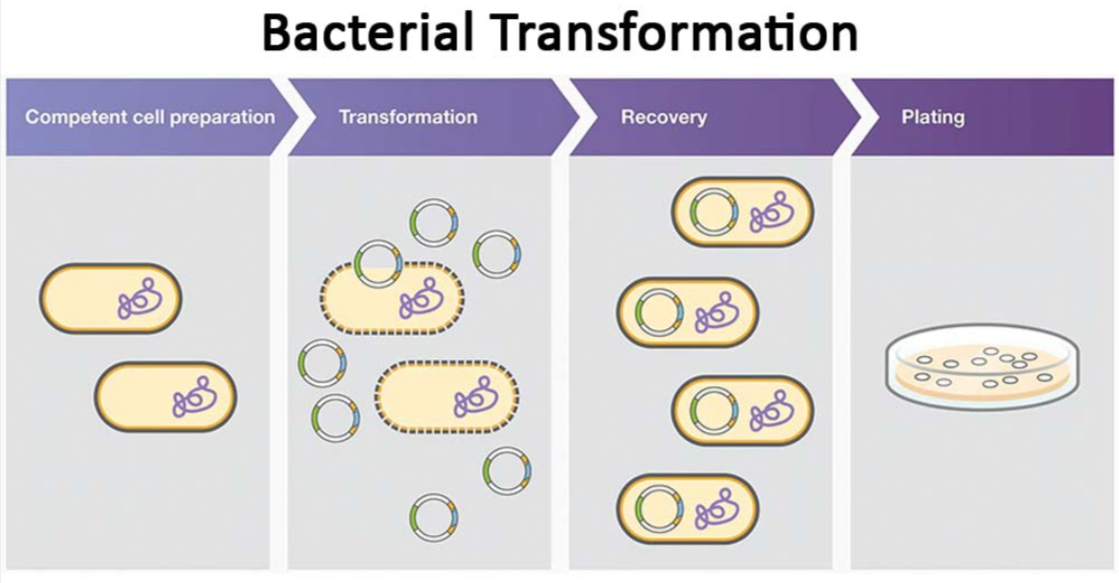
Transformation is the uptake of DNA from the environment
DNA must cross the cell membrane to enter the cell
Negative charge on DNA has to be shielded from the negative charge of the phospholipid. This is done by making bacterial cells competent through calcium chloride treatment that the positive charged calcium ion will shield the negative charged phosphate on the plasmid DNA
A heat shock is then applied to open up the cell membrane so the plasmid DNA can enter the bacterial cell
Bacterial cells are then placed on ice to close the cell membrane, so the plasmid DNA does not leak out
Transformation usually does not occur in nature but is a way scientists can introduce plasmids into bacteria for genetic engineering such as the production of insulin
Transposons
Transposons are genes that can move to different chromosomes.
Plasmids can contain transposons that result in a gene on the plasmid leaving the plasmid and integrating into the bacterial chromosome DNA
This will result in variation of the bacterial DNA that depending on the environment can provide advantage or be hazardous
The enzyme transposase will cut the transposon gene out of the plasmid and then integrate this transposase gene into the bacterial chromosome DNA
Conjugation
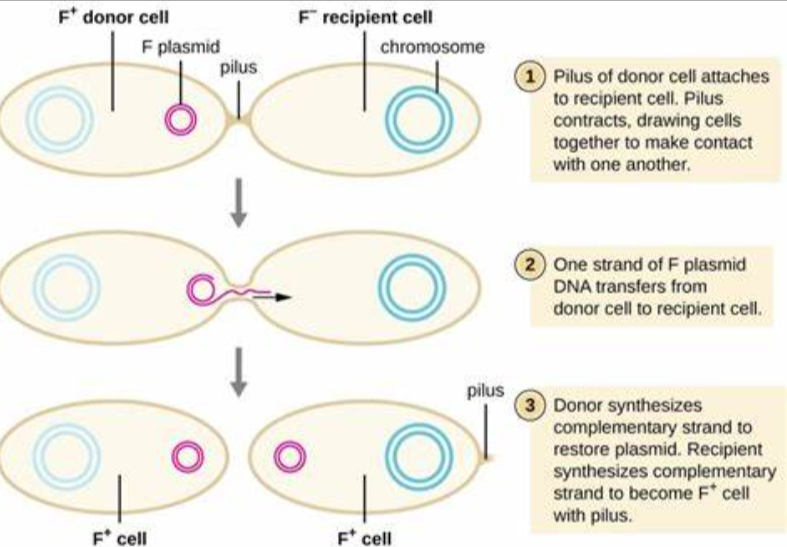
Conjugation- The exchange of genetic material between bacteria
A bacterial cell that has a plasmid is F+, while the bacterial cell that does not have the plasmid is F-
A donor cell, F+, and a recipient cell, F-, replicates and then the plasmid is transferred to the F- cell making it into a F+ cell
Lytic Cycle:
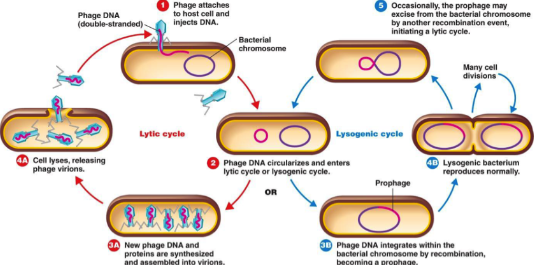
Bacteriophage attaches to host cell and injects its DNA inside the cell
Bacteriophage using host cell machinery (host cell ribosomes, amino acids, tRNA, DNA and RNA polymerase, etc.) through transcription and translation makes bacteriophage proteins and replicates its DNA.
As new Bacteriophages are being assembled inside the host cell, the bacteriophages will degrade the host cell DNA and randomly incorporate this degraded host cell DNA into the newly assembled bacteriophages
The newly assembled bacteriophages will now “lyse” the cell membrane of the host cell and infect different cells.
Lysogenic Cycle:
Bacteriophage attaches to host cell and injects its DNA inside the cell
Bacteriophage DNA integrates into host cell DNA
Bacteriophage is “dormant” meaning not causing harm and juts remaining integrated in the host DNA and the bacteriophage DNA is replicated with the DNA to leave the bacterial host DNA
The bacteriophage using host cell machinery (host cell ribosomes, amino acids, tRNA, DNA and RNA polymerase, etc.) through transcription and translation makes bacteriophage proteins and replicates its DNA
As new bacteriophages are being assembled inside the host cell, the bacteriophages will degrade the host cell DNA and randomly incorporate this degraded host cell DNA into the newly assembled bacteriophages
The newly assembled bacteriophages will now “lyse” the cell membrane of the host cell and infect different cells
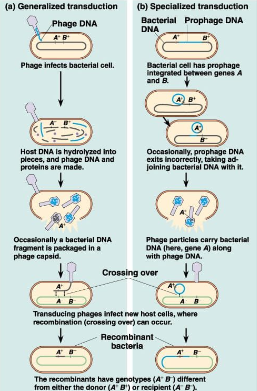
Transduction:
Transduction: is the transfer of bacterial DNA from a host bacterial cell through a recipient bacterial cell in which a virus transports the DNA from the host cell to the recipient cell
Generalized Transduction occurs during the lytic cycle which a random piece of host cell bacterial DNA is incorporated into the newly assembled bacteriophage that then when the bacteriophage infects a new cell (recipient cell) that piece of bacterial DNA from the host cell through homologous recombination will exchange with the bacterial DNA in the recipient cell
Specialized Transduction occurs during the lysogenic cycle in which a piece of bacterial DNA attached to bacteriophage DNA that had integrated into the host cell DNA is now linked to the bacteriophage DNA leaving the host cell bacterial DNA. When the bacteriophage infects a new cell (recipient cell) that piece of bacterial DNA from the host cell through homologous recombination will exchange with the bacterial DNA in the recipient cell