W5: Motion Perception
Motion Perception
Basic Aspect of Perception
Information about motion is fundamental to perception.
Detecting motion is crucial for navigation and survival in the environment.
Recommended textbooks on motion perception:
Sensation and Perception, Goldstein, EB, 2007; 2010.
Sensation and Perception, Wolfe, JM et al, 2009.
Significance of Motion
Provides essential information for:
Attracting attention (movement in periphery draws focus)
Identifying three-dimensional form (how objects relate to an observer) - if something moves in the environment or if we walk around an object.
Supporting figure-ground segregation (movement helps distinguish an object from its background)
Interaction with the environment (e.g., walking aids in avoiding collisions and maintaining course)
Types of Motion
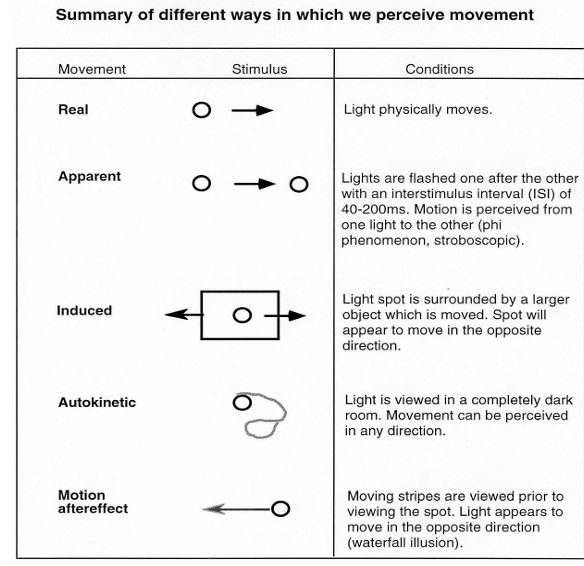
Real Motion
Involves physical movement of an object.
Must also account for eye and head motion.
Apparent Motion
Motion perceived when objects are sequentially presented and separated in space.
Inter-stimulus interval (ISI) is crucial in determining perceived motion.
Induced Motion
Perceived motion of a stationary object due to the motion of surrounding objects.
Example: Moon appearing to move against clouds.
Autokinetic Motion
Perceived movement of a small stationary object in a dark room, often misinterpreted due to involuntary eye movements.
Motion After-effects
Illusory motion experienced after adaptation to actual motion.
Physiology of Motion
Retinal Image Motion: Reichardt’s Model
Differentiates between the motion of small and large objects using a simple neural circuit that reflects motion direction and velocity.
E.g., need to differentiate between input from motion of a small ladybug moving from L to R (1) and that from one large stationary ladybug (2)
can be achieved by a simple circuit that includes 2 additional components.
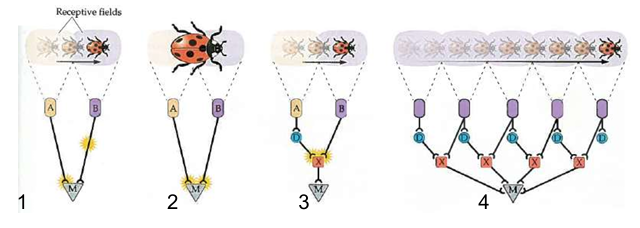
Two components in circuit (3):
D delays transmission from A to M
Fires when A is initially stimulated but stops if light continues to shine on A.
This behavior accounts for cases such as the large stationary ladybug (2).
X, a multiplication cell
Only fires when both B and D are active, making it sensitive to motion.
Direction-Selective Circuit
The circuit responds well to motion from left to right (L to R) but not from right to left (R to L).
It is tuned to velocity, firing when a delayed response at A and a direct response from B occur at the same time.
additional receptors would enable detection of longer duration / extend of motion.
This forms the basis of Reichardt’s Model of how flies detect motion and also the basis of the most theoretical human models of motion detection.
Visual Cortex Involvement
Involves complex cells in area V1 and
Extrastriate areas involved in motion
Medial temporal area (MT)
Medial superior temporal area, dorsal part (MSTd)
magnocellular system mediates input to area MT -good temporal and contrast sensitivity
Dorsal and Magnocellular Systems
The dorsal system is responsible for 'where' processing, while the magnocellular system contributes to high temporal and contrast sensitivity.
magnocellular lesions - can’t detect movement. Can’t relate movement and time.
Real Motion and Corollary Discharge Theory
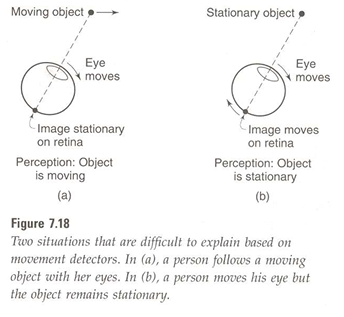
retinal motion detectors cannot fully explain our perception of motion.
need to know if eyes and head are moving.
Motion thresholds are the smallest amount of motion that can be detected
approximately 10-20 min arc per second
displacement thresholds are the smallest change in position that can be detected.
Corollary Discharge Theory
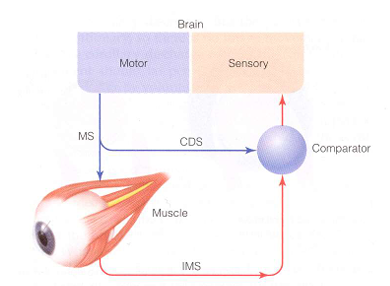
Compares input from retinal and eye-head movement systems.
outside visual cortex
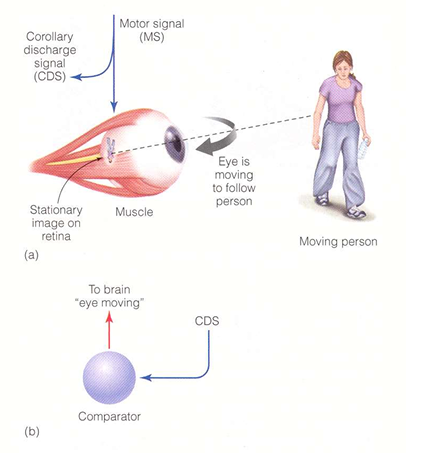
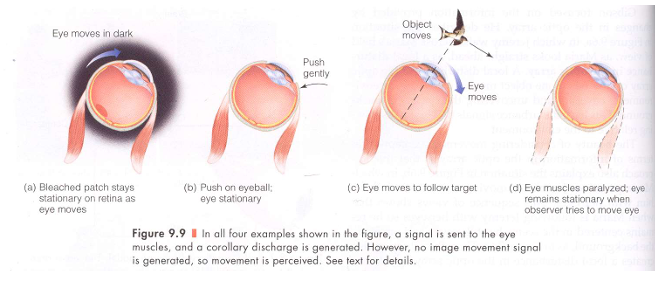
Efferent copy (corollary discharge signal) sent to the comparator for distinguishing whether movement is perceived based on eye/head motion.
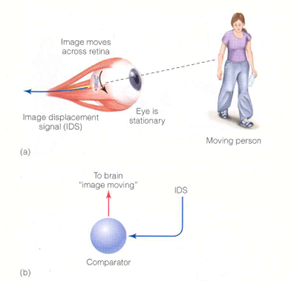
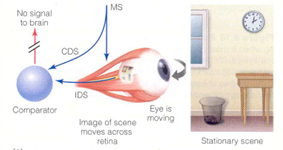
Retinal image motion is combined with this corollary discharge. If both reach the comparator they cancel each other out
Perception of Movement
Just the sensory motion signal is sent to the comparator
Just the corollary discharge is sent to the comparator
No movement is perceived if both reach the comparator
Examples:
Eyes tracking a moving object: stationary retinal image, eyes moving so CDS sent to comparator.
Moving Object but eyes remain stationary: Moving retinal image (IDS) sent to comparator but as eyes are stationary, no CDS is sent to comparator.
Person scanning a stationary seen: moving retinal image (IDS), eyes moving (CDS) - both signals reach the comparator, and no motion is perceived.
pushing on eyeball: stimulates eye muscles but retinal image doesn’t change. Therefore will see motion
Factors Affecting Motion Perception
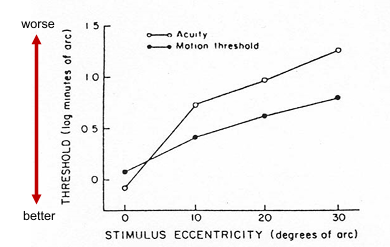
Retinal eccentricity: poorer sensitivity in peripheral vision, peak sensitivity at fovea.
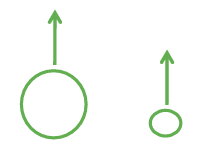
Stimulus Size: motion perception is better (higher sensitivity) for smaller objects.
the larger circle must move faster than the smaller circle for them to be perceived to be moving at the same speed. This is known as Velocity transposition
Reference Stimuli: Motion perception better if other stationary objects are located near to the target
Increase motion sensitivity (10x), eg, 10-20 min arc per second down to 1 min arc per second
Optical Blur: Correction of refractive error / aberrations improve peripheral motion sensitivity.
Luminance: Increasing luminance improves motion sensitivity
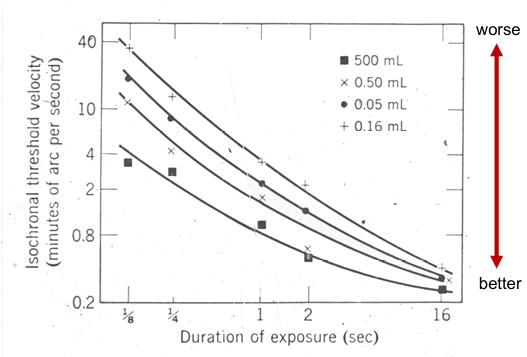
Duration: longer duration of moving target improves motion sensitivity
Eye movements: Aubert-Fleishel Paradox - objects appear to move more slowly when tracked.
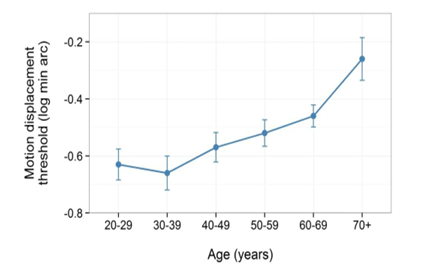
Age: Reduction in motion sensitivity (poorer performance) with increased age
Extent depends on target configuration, duration, speed and central or peripheral
Unlikely to be due to age-related changes in pupil size or ocular media
Involves neural factors including decreases in spatial summation, visual attention, reduced sampling efficiency, cortical inhibition and increased neural noise
implications for moving in environment such as driving.
Types of Motion
Apparent Motion
Motion Perception
Motion is perceived when objects are presented sequentially and separated in space.
As the speed of the two images are appearing/ replaced at different locations, the images appear to be moving.
Media Applications
Apparent motion underlies our perception of motion in television, movies, and cartoons.
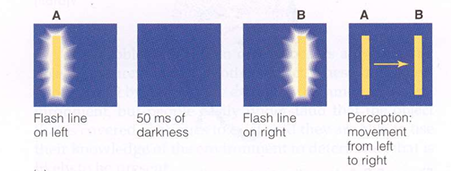
Inter-Stimulus Interval (ISI)
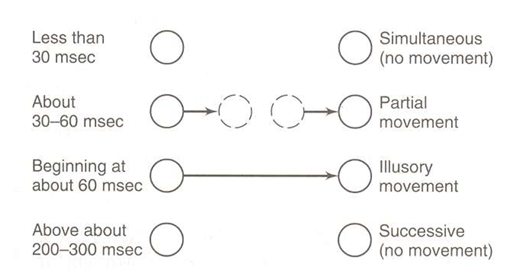
Simultaneous Flickering
ISI < 30 ms:
No motion perceived
Disembodied motion: Phi Motion
30 ms < ISI < 60ms
Motion is perceived to ‘jump’ from one light to the other;
No perception of intermediate positions.
Smooth Optimal Motion (Beta Motion)
60 ms < ISI < 200–300 ms:
Continuous motion perceived across positions between lights
Sequential Alteration:
200–300 ms < ISI:
Alternate flashing of two distinct lights
Apparent Motion & Induced Motion
Induced Motion
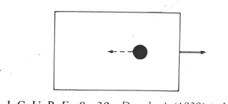
perceived motion of a stationary object due to motion of surrounding objects.
moon racing against clouds
building falling over
walking pigeon
movement tends to be assigned to the smaller object
possible site for this illusion is the posterior parietal association cortex.
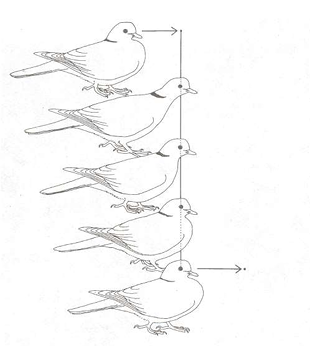
pigeon walk moves it head forward, then moves body forwards whilst head is stationary but gives the illusion that the head is moving backwards.
Autokinetic effect
perceived movement of a small stationary object in a dark room.
Cause is not well understood - probably due to misinterpretation of involuntary eye movement.
Motion After-Effects
Illusory motion following adaptation to motion
the adapting motion might be transverse, looming or spiralling.
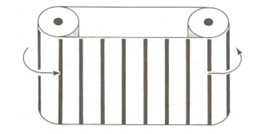
Physiological Mechanism
when viewing a stationary object the responses of neurons are tuned into different directions.
neurons are sensitive to upwards and downwards motion fire at the same rate so signals cancel out and no motion is perceived.
Neurons’ sensitivity to downwards motion becomes fatigued when viewing waterfalls.
Neurons sensitive to upward motion fire faster than the fatigued downwards sensitive neurons and so perceive upwards motion of adjacent rocks.
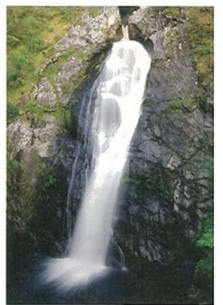
Movement and Perception
motion aids distance and shape perception
3D information - Structure From Motion (SFM)
Motion parallax
deletion and accretion
Also important for balance control and moving around safely in your environment
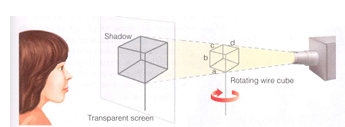
Kinetic Depth Effect
Construction of 3D effect from a 2D projection (SFM)
E.g., rotating wire cube projected onto a screen.
Biological Motion
biological motion is a class of Structure From Motion (SFM) event
pattern of motion of living creatures is very different to that of inanimate objects.
Evident in babies and does not deteriorate with age.
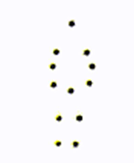
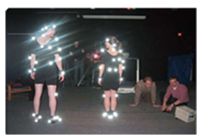
Biological motion experiment
small lights are placed at strategic locations on the limbs
the moving lights are quickly perceived as a moving human
The effect allows judgement of gender, size.
Physiological part of biological motion
Networks of areas - superior temporal Sulcus (STS) and fusiform face area (FFA) - specialised for perception of biological motion.
Locomotion
motion perception is important for:
maintaining balance
moving around in the environment
avoiding obstacles
Balance
Visual cues provide strong input to balance
Force plate experiments: Sway (as measured using force plate) is increased when the eyes are closed (right trace) compared to open (left trace)
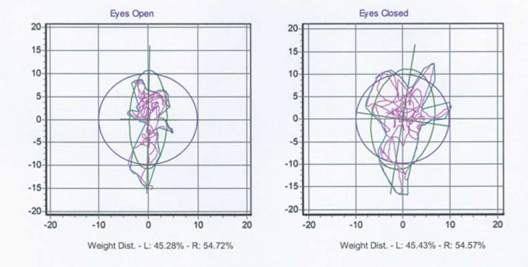
vision becomes more important for balance with age.
compensated for age-related deterioration in somatosensory and vestibular systems.
Factors of balance:
Vision: reduced vision leads to reduced balance
Vestibular Neurons: kinaesthetic cues
Somatosensory: muscle function and reflexes
Swinging room experiment:
indicates that visual cues provide a powerful input to balance.
false ceiling and walls, mounted on a pulley system - makes room move backwards or forwards
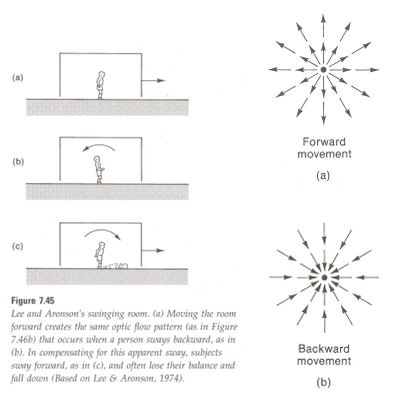
optic flow patterns provide cues regarding forward (a) or backwards (b) movement.
When room swings forwards, produce optic flow patterns of a backwards movement (b)
results in infant swaying forwards to compensate the feeling of going backwards.
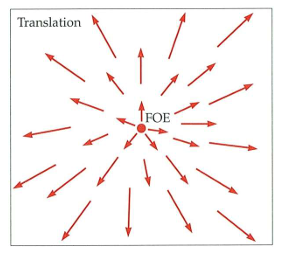
Optic Flow Fields
pattern of movement of the environment.
As we move forwards, it expands
As we move backwards, it constricts.
imaginary patterns that the visual system is receiving and using to interpret patterns of movement.
Movement and Perception
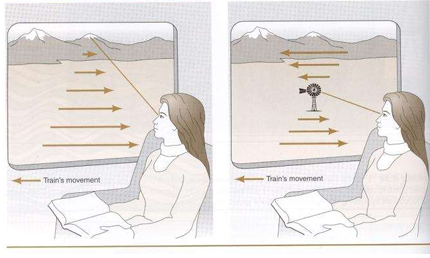
Motion Parallax
characteristic motion gradients provide accurate cues to distance
Near objects appear to move faster and to a greater extent than distant objects.
objects nearer than fixation point moves against (opposite direction) to observer’s movement.
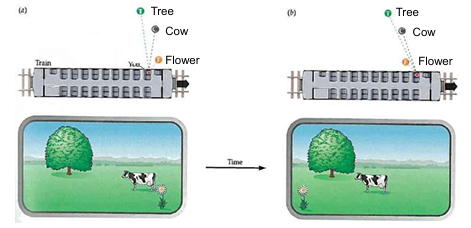
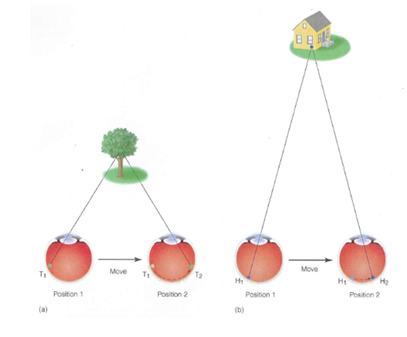
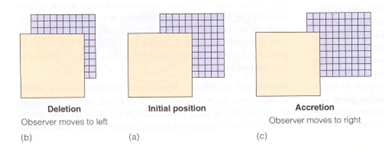
Deletion and Accretion
Occurs when an observer moves in a direction not perpendicular to two surfaces that are at different depths
Gives relative position in space.
Deletion: object at the back is covered up
Accretion: Object at the back is uncovered
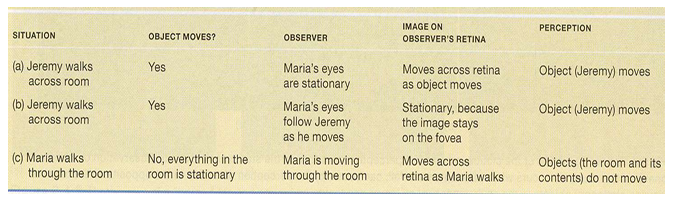
Ecological approach to perception
information from environment including surfaces, contours and textures creates an “optical array”
Collection of light rays that interact with objects in the world in front of the viewer
Disturbances in the optical array provide information
As you walk through a room, there are flow patterns on the retina, but you properly judge that the objects are not moving.
Navigation
patterns of optic flow provide cues for navigation
radial expansion: move fowards in space, optic array expands outwards in a pattern known as “radial expansion”
focus of expansion (FOE): point we are heading towards which is always at the centre. Always Stationary
Focus of constriction: move backwards in space, the optic ray constricts.
optic flow patterns inform us regarding direction as well as assist in maintaining balance.
Obstacle Avoidance:
angular expansion (looming) provides information on time to collision.
Motion cues (e.g., motion parallax) provide information on how far away an obstacle is from the observer.
Assists the observer in avoiding obstacles in the pathway.