Earth and Space
Day and Night (earths rotation)
there is an imaginary line through the centre of the earth called the axis
the axis extends from north to south
the axis is at a tilt of 23.5 degrees
Day and Night
only half of the planet earth faces the sun at any one time, the side facing the sun is in daytime
the side facing away from the sun is in darkness and so is nighttime
so it takes 24 hours for the earth to rotate once on its axis
New Zealand is on the opposite side of the world
The Seasons
Have you ever wondered why we have different seasons?
This is because Earth's axis is tilted.
This tilt gives Earth its seasons - spring, summer, autumn and winter.
When the northern hemisphere of the Earth is tilted away from the Sun, people in the these regions are experiencing winter.
Seasons in the Northern Hemisphere
the seasons are created through the combination of the earths revolution and the tilt of the axis
when the northern hemisphere of the earth is tilted away from the sun people in these regions are experiencing winter
when the northern hemisphere of the earth is tilted towards the sun people in these regions are experiencing summer
In Ireland we are in the northern hemisphere in winter were tilted away from the sun, it is colder the mights are longer and the days are shorter. the earth continues to move in a path around the sun, the days in the northern hemisphere get longer and warmer until it becomes spring. the northern hemisphere continues on its orbit tilted more towards the sun, until the longest summer days in june.
after summer earths orbit means it begins tilting away from the sun again. the days get shorter and colder as we move into autumn.the days keep getting shorter and colder until the northern hemisphere is tilted the furthest from the sun then it becomes winter once again, this is a complete orbit of the sun and as a new year starts the seasons start all over again.
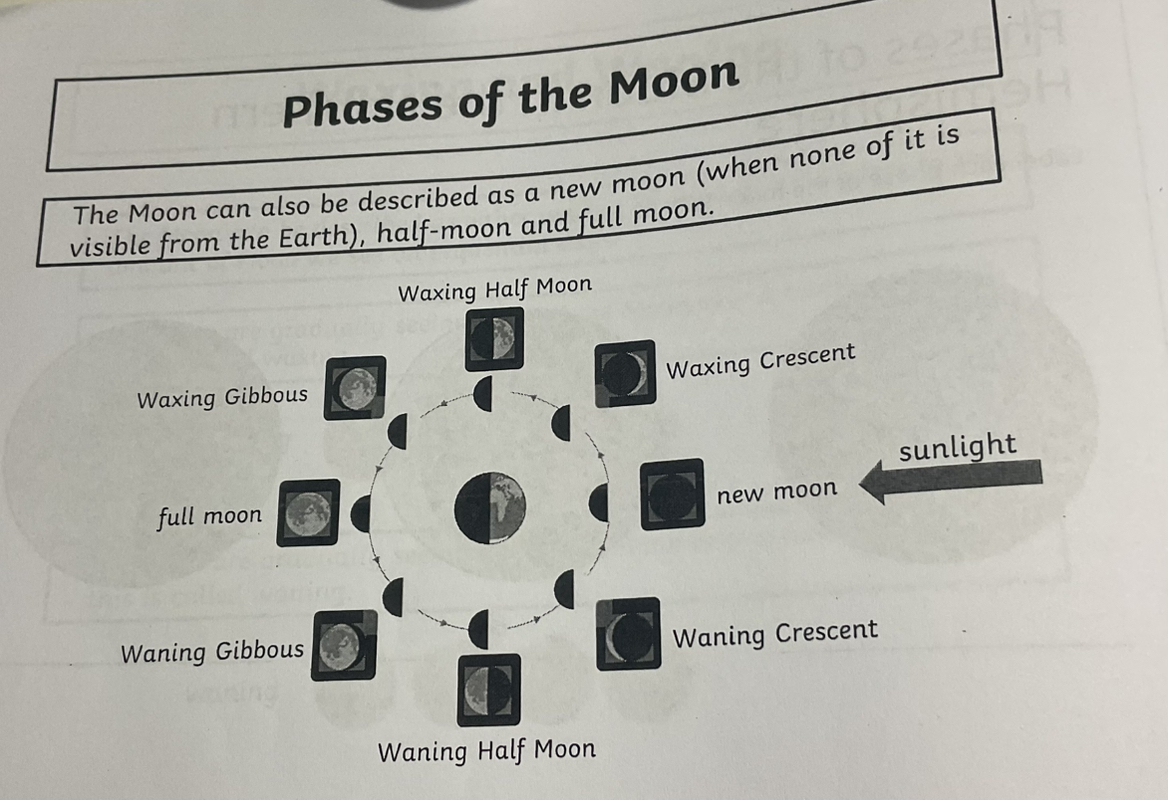
Phases of the Moon
The Solar System (order of planets)
mercury
venus
earth
mars
jupiter
saturn
uranus
neptune
My
Very
Enthusiastic
Mother
Just
Served
Us
Nachos
Rocky and Gas Planets
Rocky Planets
they are the four planets closest to the sun
mercury is the smallest planet its dry and rocky
earth is our planet it has one moon
venus is covered in hot poisonous gases, it has volcanoes and is the hottest
mars is known as the red planet it has 2 moons and can be covered by dust storms
Gas Planets
there are four larger gas planets
jupiter is the largest planet it is a giant ball of gas with 50 moons
saturn is a large planet made of mainly gas it has over 60 moons and 7 rings made of rocks and ice
Gas Giants
uranus is an icy planet which spins
neptune is the furthest away from the sun it is a very cold planet with 13 moons
Space Rocks
Comets
gas tails
dirty snowballs
frozen gas
dust
rocks
orbits the sun
Asteroid
left from when the solar system formed
rocks or metal
it can be the size of a rock to a car
between mars and jupiter
asteroid belt
Meteoroids
can become a meteorite
asteroids comets and moons collide
Meteor
called shooting stars
rock or metal
falls through the earths atmosphere
Meteorites
pieces of a meteoroid
rock or metal
lands on earth