BIOCHEM LIPIDS
Structure and Classification of Lipids
Definition of Lipids
Organic compounds in living organisms
Insoluble in water but soluble in non-polar organic solvents
Lack common structural features for classification
Classification of Lipids
Based on solubility, not functional groups
Insoluble or sparingly soluble in water
Soluble in non-polar organic solvents
Five Categories of Lipids
Categories
Energy-storage lipids (triacylglycerols)
Membrane lipids (phospholipids, sphingoglycolipids, cholesterol)
Emulsification lipids (bile acids)
Chemical messenger lipids (steroid hormones, eicosanoids)
Protective-coating lipids (biological waxes)
Structural Formulas of Lipids
Diversity
Lipids exhibit structural diversity
Include esters, amides, alcohols (acyclic and cyclic), and polycyclic compounds
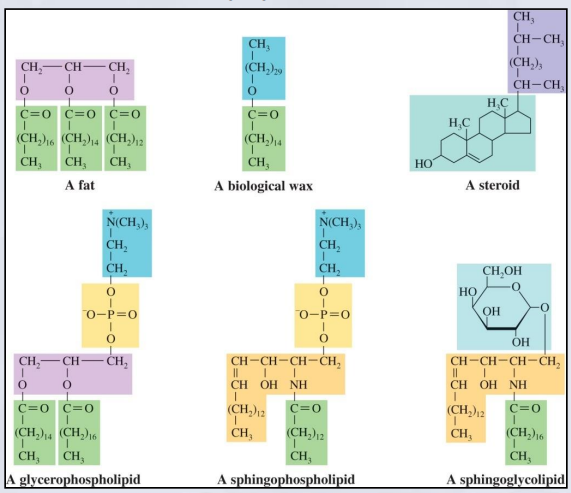
Types of Fatty Acids
Saturated and Unsaturated Fatty Acids
Fatty acids are monocarboxylic acids with linear carbon chains
Classified into saturated (single C-C bonds) and unsaturated (mono- and polyunsaturated) types
Different chain lengths and numbering systems for fatty acids
Unsaturated Fatty Acids
Monounsaturated fatty acids have one carbon-carbon double bond
Polyunsaturated fatty acids have two or more double bonds
Omega-3 and Omega-6 fatty acids are biochemically important
Omega Acids and Essential Fatty Acids
Nutritional Importance
Essential fatty acids like Omega-3 and Omega-6 must be part of the diet
Imbalance in Omega-3 and Omega-6 linked to health issues
Ideal ratio of Omega 6 : Omega 3 is 4 - 10 g : 1g
Physical Properties of Fatty Acids
Melting Point
Depends on carbon chain length and degree of unsaturation
More double bonds lead to lower melting points
Short chain fatty acids have some solubility, while long chain fatty acids are insoluble
Energy-Storage Lipids: Triacylglycerols
Storage Materials
Triacylglycerols are primary energy storage materials in cells
Stored in adipocytes and nearly filled with the material
Simple and mixed triacylglycerols with different fatty acid compositions
Dietary Considerations and Triacylglycerols
"Good Fats" Versus "Bad Fats"
Importance of type and amount of dietary fats for a balanced diet
Saturated fats considered "bad fats," while monounsaturated fats are "good fats"
Trans-monounsaturated fats are considered "bad fats"
Polyunsaturated fats can be both "good fats" and "bad fats"
Omega-3 and Omega-6 fatty acids are essential "good fats" in the diet
Essential Fatty Acids
Fatty acids must be obtained from dietary sources as they are not synthesized in the body.
Linoleic acid (omega 6) and Linolenic acid (omega 3) are the two most important essential fatty acids.
Needed for proper membrane structure and production of other important fatty acids.
Deficiencies in these acids can lead to skin issues, infections, dehydration, and liver abnormalities.
Fat and Fatty Acid Composition of Nuts
Eating nuts can protect against coronary heart disease.
Nuts have low saturated fatty acids and contain antioxidants, vitamins, minerals, and plant fiber protein.
Chemical Reactions of Triacylglycerols
Partial Hydrolysis
Triacylglycerols undergo partial hydrolysis by breaking ester bonds.
Enzymes from the pancreas carry out this process.
Saponification
Saponification in basic solution produces salt of fatty acid and glycerol.
It involves the hydrolysis of ester bonds.
Hydrogenation
Hydrogenation increases saturation by adding hydrogen across double bonds.
Common in producing food products like peanut butter and margarine.
Oxidation
Oxidation of double bonds in triacylglycerols can lead to rancidity.
Antioxidants like Vitamin C and E are added to prevent oxidation.
Membrane Lipids: Phospholipids
Cell membranes are mainly composed of lipids, with up to 80% being phospholipids.
Phospholipids contain fatty acids, phosphate group, glycerol/sphingosine, and an alcohol.
Glycerophospholipids have two fatty acids and a phosphate group esterified to glycerol.
Membrane Lipids: Sphingoglycolipids
Sphingoglycolipids contain both fatty acids and carbohydrates.
Cerebrosides are simple sphingoglycolipids found in the brain.
Gangliosides are complex sphingoglycolipids with a branched chain of monosaccharide residues.
Membrane Lipids: Cholesterol
Cholesterol is a C27 steroid molecule important in cell membranes, nerve tissue, and brain tissue.
It plays a role in chemical synthesis of hormones and essential vitamins.
Page 34: Cholesterol in Food
Liver synthesizes cholesterol at about 1g daily
Not necessary to consume through diet
Ingested cholesterol decreases synthesis but not enough
Leads to cardiovascular disease
Animal food contains a lot of cholesterol
Plant food does not contain cholesterol
Page 35: Cell Membranes
Plasma membranes surround cells
Separates cell interior from surroundings
Up to 80% of membrane is lipid material
Membranes are lipid bilayers of phospholipids
Nonpolar tails in the middle, polar heads on the surface
Membrane is liquid-like due to unsaturation in lipid tails
Page 36: Cholesterol in Cell Membranes
Cholesterol regulates membrane fluidity
Makes membrane rigid by fitting between fatty acid chains
Cholesterol acts as a membrane plasticizer
Page 37: Proteins in Cell Membranes
Membranes contain proteins
Responsible for moving substances across the membrane
Act as receptors for hormones and neurotransmitters
Proteins and lipids react with carbohydrate molecules
Act as markers for cell recognition
Page 38: Passive Transport
Transport across cell membranes
Three types: passive, facilitated, active
Passive transport: molecules move by diffusion
Includes O2, N2, H2O, urea, and ethanol
Page 39: Facilitated Transport
Facilitated transport: substances move with membrane protein aid
Specific protein carriers are involved
Page 40: Active Transport
Active transport: substances move against concentration gradient
Requires cellular energy, ATP supplies energy
Proteins involved in active transport are called "pumps"
Page 41: Emulsification Lipids: Bile Acids
Emulsifiers disperse water-insoluble substances in aqueous solution
Bile acids function as emulsifying agents
Convert cholesterol to bile acids for lipid solubility
Page 42: Bile Acids
Bile acids are cholesterol derivatives
Side chain oxidized to carboxylic acid
Bonded to amino acid through amide linkage
Bile is a fluid containing emulsifying agents secreted by the liver
Page 43: Messenger Lipids: Steroid Hormones
Hormones are biochemical substances produced by glands
Steroid hormones and eicosanoids are lipid messengers
Steroid hormones are derivatives of cholesterol
Page 44: Sex Hormones
Steroid hormones classified into estrogens, androgens, progestins
Page 45: Adrenocorticoid Hormones
Produced by adrenal glands
Two types: mineralocorticoids and glucocorticoids
Page 46: Eicosanoids
Derivatives of arachidonic acid with physiological effects
Act as hormone-like molecules in tissues
Page 47: Types of Eicosanoids
Prostaglandins: involved in various physiological functions
Thromboxanes: promote platelet aggregation
Leukotrienes: promote inflammatory and hypersensitivity responses
Page 49: Biological Waxes
Biological wax is a monoester of long-chain fatty acid and alcohol
Fatty acids in waxes are saturated and contain 14-36 carbon atoms
Alcohols in waxes may be saturated or unsaturated, with 16-30 carbon atoms
Page 50: Section 19.14 Protective-Coating Lipids: Biological Waxes
Properties of Biological Waxes:
Water-insoluble and water-repellent due to long nonpolar hydrocarbon chains.
Humans and animals secrete biological waxes from skin glands.
Function of Biological Waxes:
Protect hair and skin, keeping it pliable and lubricated.
Impart water repellency to animal fur.
Birds use waxes to keep feathers water repellent and minimize heat loss.
Plants use waxes on leaves to prevent excessive water evaporation