Differential
Differentials
The ring and pinion provide gear reduction to increase torque.
The differential transmits power from the driveshaft to the wheels.
It allows one wheel to turn at a different speed than the other during turns.
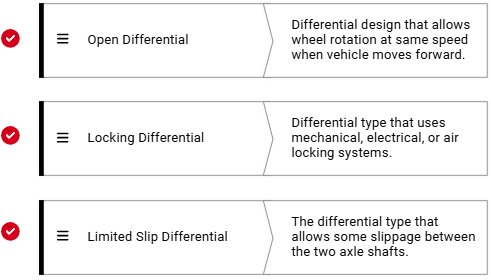
There are three main types of differentials: open, limited slip, and locking.
Open Differential
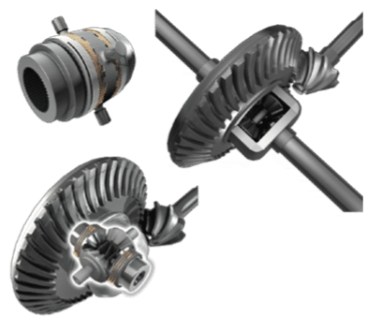
The standard differential, also called the open differential, is the most common type.
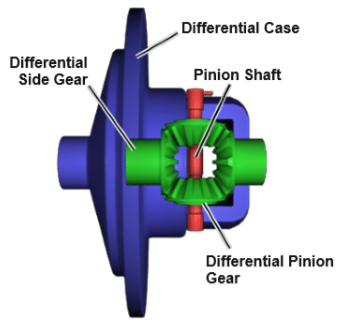
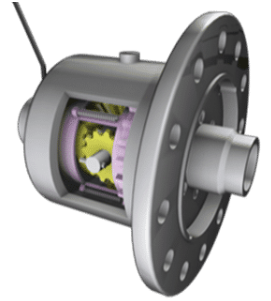
The open differential consists of a case that houses:
Two side gears
Two differential pinion gears
A differential pinion gear shaft secures the pinion gears to the case and allows them to rotate freely.
The pinion gears mesh with the side gears inside the differential case.
The open differential allows the driving wheels to rotate at the same speed when moving straight and at different speeds when turning.
Limited Slip Differential
Hydraulic
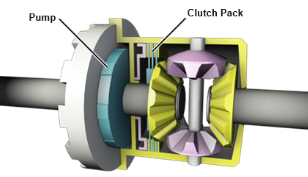
The hydraulic limited slip differential uses a clutch pack and a hydraulic pump.
The pump feeds fluid to the clutch pack.
When one axle spins faster than the other, hydraulic pressure increases, causing the clutch pack to engage.
This locks the drive axles to the differential case, transferring torque to the wheel with traction.
When the axles rotate at the same speed, the pump does not deliver pressure to the clutch pack.
Helical Gear
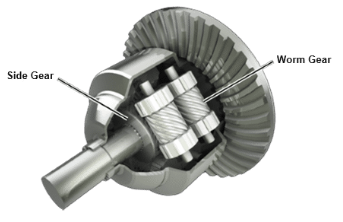
The helical gear differential transmits torque to both wheels even when they rotate at different speeds.
When one wheel begins to slip, the helical gears multiply torque to the slower-rotating wheel.
A common example of this design is the Torsen differential.
Clutch Pack
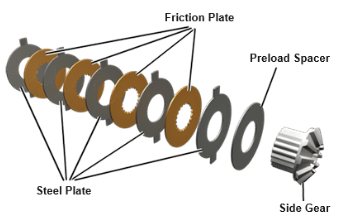
The clutch pack is the most common type of limited slip differential.
It consists of two sets of multiple disc clutches, containing steel and friction plates.
The differential case houses the friction and steel plates.
Friction plates are splined to the side gear hub.
The discs rotate with the side gear, which in turn rotates with the differential case.
The clutch attempts to lock both axles to the case when the wheels have unequal traction.
The clutch slips when the vehicle is turning to allow smooth cornering.
Viscous Clutch
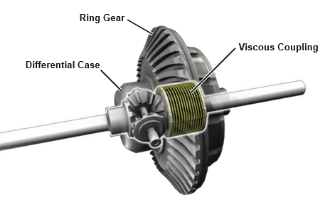
A viscous clutch limited slip differential contains a viscous coupling with two sets of plates.
Half of the plates are connected to one drive axle, and the other half to the other axle.
The plates are separated by high-viscosity silicone fluid.
When both wheels have equal traction, the differential transmits power evenly to both axles.
If one wheel has less traction, the silicone fluid shears and generates heat, causing the viscous clutch to engage by pressing the plates together.
This action reduces spinning of the wheel with less torque and transfers power to the wheel with more traction.
Cone Clutch
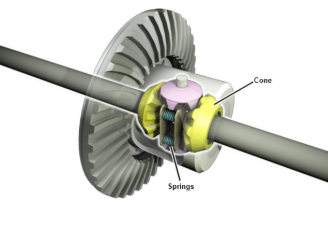
Some vehicles use a limited slip differential with a cone clutch, which is a cone covered with friction material.
When moving forward, spring pressure combined with force from the pinion gears pushes the clutch cone against the internal cone in the differential case.
Friction allows the cones to rotate together when pressed against each other.
The cones have spiral grooves to allow lubricant flow between the surfaces.
When differential action overcomes spring pressure, the clutch releases, allowing the inner axle to slip.
Locking Differential
Automatic Locking
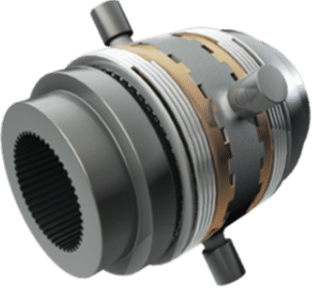
In the automatic locking differential, torque is transmitted to the wheel with the most traction, even if the other wheel is off the ground.
The automatic locker permits the gears to overrun when the vehicle is turning.
It locks the axles when the vehicle is traveling forward, providing maximum traction.
Electronic Locking
Another type of locking differential is the electronic locking differential.
It uses an electromagnet and a switch to lock and unlock the differential.
When the switch is activated, the electromagnet moves a collar, which locks the side gears to the differential case.
Cable Locking
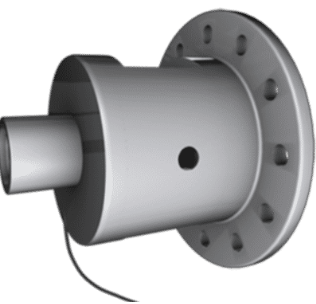
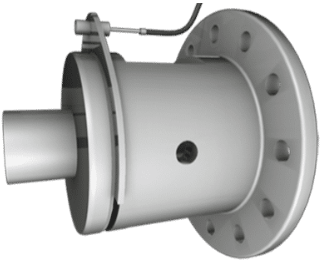
The cable locking differential uses a knob or lever inside the vehicle to control locking.
A cable operates a shift fork attached to the differential cover.
Moving the lever pulls the cable, which moves the shift fork.
The shift fork operates a collar on the differential case, locking the side gears to the case.
When unlocked, the differential functions like a standard open differential.
Air Locking
The air locking differential uses compressed air to engage a locking gear.
The driver uses a switch to lock and unlock the differential.
A separate air compressor, controlled by a relay, generates the compressed air.
The switch operates a solenoid that directs compressed air to the differential(s), depending on the application.
This system is typically used in off-road and 4x4 vehicles.
Differential Cases
One-piece Differential
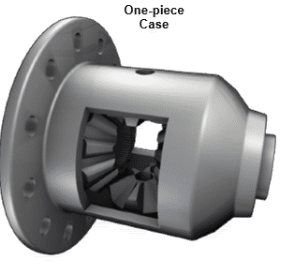
Most differential cases are one-piece units.
The one-piece differential houses the differential pinion gears, side gears, and any limited slip or locking differential components in a single assembly.
Two-piece Differential
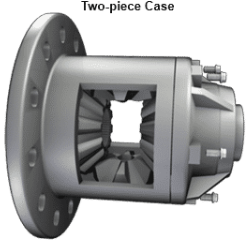
The two-piece differential case houses the side gears, pinion gears, and any limited slip or locking differential components, depending on the application.
Typically, a two-piece case is bolted together, with the differential gears contained between the two pieces rather than in a single unit.
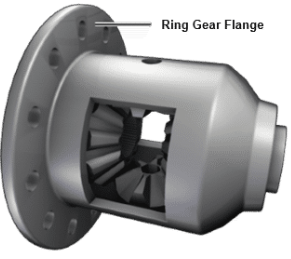
Ring Gear Offset
Ring Gear Offset
The ring gear offset refers to the position where the ring gear bolts to the differential case.
Proper offset ensures the differential drive pinion meshes correctly with the ring gear.
When replacing a differential case, it is important to verify that the replacement has the correct ring gear offset to maintain proper gear alignment.
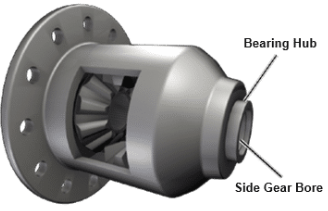
Side Bearing Hub
The side bearing hub is the surface on which the differential case bearings press.
The inner bore of the side bearing hub is the surface that the side gear rides on.
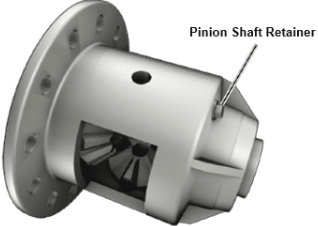
Pinion Shaft Retainer
The pinion shaft retainer holds the pinion shaft in the differential case.
It is typically threaded into the differential case, with a pin extending through the pinion shaft.
Some applications use a roll pin to secure the pinion shaft in the differential case.
Axle Retention
Axle retention can be achieved with a C-clip or a bearing.
A bearing is pressed onto the axle shaft and uses a bearing retainer plate and retaining ring to keep the axle in the housing.
The C-clip or bearing retainer plate keeps the axle shaft inside the housing and splined to the side gear.
To remove a C-clip:
Remove the pinion shaft.
Push the axle inward.
Remove the C-clip and pull the axle out of the housing.
The bearing retainer plate is typically bolted to the axle housing.
On a full-floating axle assembly, the axle shaft is bolted directly to the wheel hub.
Full Spool
The full spool is used in place of a differential in racing or off-road applications.
It does not allow differential action and distributes torque evenly to both wheels at all times.
With a full spool, it is normal for the tires to scuff during turns.