Need to know : Recaps + Extra
Lec 2 :
What is PGF?
What is Geostrophic flow? + Diagram
What is vorticity? and how to calculate it
What is the right hand rule?
What is viscocity, and the two types? + Diagrams
Extra:
What is hydrostatic balance?
What is geostrophic balance?
Rate of change is also known as what?
What is vertical and horizontal pressure gradients?
What is Coriolis effect in Southern and Northern hemisphere?
Lec 3: Modelling
What are the five types of modelling? Define them
What are the four types of physical flumes/models?
Extra:
What is an annular flume, and what is secondary flow (why does lid need to be in another direction)?
What are the two most important coastal emperical models?
What is longshore transport?
Lec 4: Wave measurement
What are the four ways to measure wave height?
What is signifciant wave height?
What are threeb ways to describe waves? + diagrams
Wave analysis, what is (Raleigh distribution) ? + Diagram and equation = Hrms = Hs/SQRT2
If they provide Tz (With no upcrossings) and N
N = T/Tz
Hmax = Hrms SQRT 2lnN
Extra:
What are acoustic transducers?
What is remote sensing, give me some exampkes?
Where would you putr a sensor and why?
What are the two ways wave data is processed?
Lec 5: Wave prediction
What is Miles-Phillips theory (1957)? Explain both
What is the 3% rule?
Draw an Wave spectra: (Power spectra), and what happens to wave with increase of wind and fetch?
What are the three types of wave spectra’s? (Pierson-Moskowits, JONSWAP and TMA.
Extra:
What are three ways wave generation is limited?
How to calcluate peak wave period, given fetch?
What is the equation for frequency/time?
What goes on the x axis of a frequency model?
Lec 6: Wave theories
What are the four theories?
The difference between Irrotational and rotational wave orbitals, and which waves will you find which?
What is stokes drift?
What are the two speeds? and what happens in deep water
With linear gravity waves, shallow water has what size wave lengths compared to Deep water. + Diagram what this looks like.
What is the application of theory - Draw
Difference between linear and non-linear waves? (e.g orbitals )
Extra:
What is radiation stress/Wave momentum flux
Diagram of linear/Stokes/Cnpidal waves?
Lec 7 - Shoaling
What happens to wavelength as it gets closer to shore/shallower water? + Diagram - ADD TO CHEAT SHEET (2 graphs)
How to read these graphs?
How to calculate Kr (reflection coefficient) ?
What is wave refraction? + Diagram
What is divergence of energy over a deep canyon. + Diagram
What is diffraction?
What are the two types of breaker ratios?
Three types types of breaking waves?
What are the four types of breakers?
What waves do iribarren numbers represent if small or large?
Extra:
What is shoaling coefficients?
What happens when wave hwight exceeds wave length?
What are the 3 main regions nearshore?
What is 1/7 rule, where does wave break? - Diagram
What ratio is determined by Mcgowan theory?
Lec 8: Surf zone dynamics
Lec 9: Sediment tranport
Draw Hjulstrom diagram?
Shields curve diagram. Showing whats happening to sediment.
Shields parameter
Parabatheic transport and Diabathic
Two types of longshore drift
Stokes law and Gibbs law account for?
What are the two types of ripples?
Two types of suspended and bed load?
Littoral cells?
Lec 10: Nearshore currents
U average = 0 if linear
Non - linear waves in deep water follow what theory?
Non-linear waves in shallow water can be calculated how?
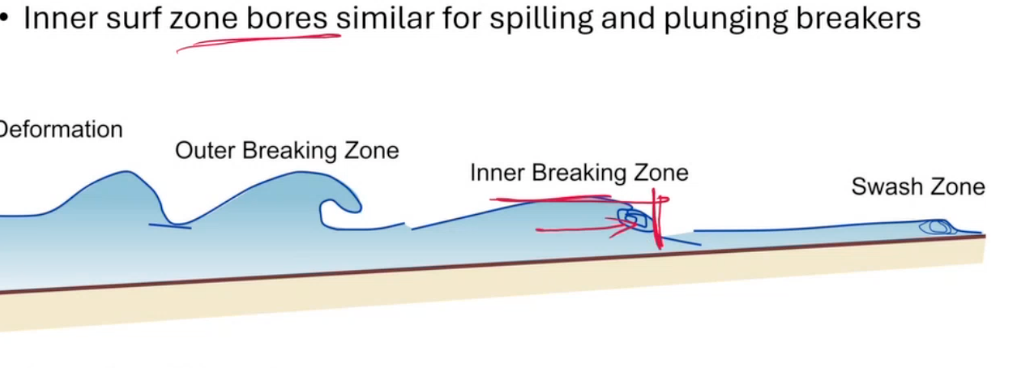
Inner surf zone bores + Diagram
Linear theory + Roller + Diagram
Middle region (Undertow)
Calculate max undertow 10% of shallow-water wave speed. + Diagram
2 types of longs shore currents
Rip current formation
Extra:
Theory of stive and wind (1986), assumes what?