Chemistry Revision(atomic structure, electronic structure, history of the atom, history of the periodic table and group 1)
Atomic Structure:
Atoms are made up of 3 subatomic particles:
Protons(mass of 1 atomic unit, positively charged)
Neutrons(mass of 1 atomic unit, no charge)
Electrons(mass of 1/2000 atomic units, negatively charged)
The centre of the atom is called the nucleus. The protons and neutrons are located inside the nucleus whereas the electrons orbit the nucleus in energy shells. The atomic number of an atom is how many protons it has. The mass number is how many protons and neutrons it has. So to calculate the number of neutrons in an atom, you take the atomic number and subtract it from the mass number. If an atom of lithium(Li) has a mass number of 7 and an atomic number of 3, then it has 3 protons and 4 neutrons. Also, in atoms, the number of electrons is equal to the number of protons.
Isotopes are atoms of the same element, with the same atomic number, but a different mass number. For example, there are 3 isotopes of carbon. All carbon atoms have atomic number 6 but some have mass number 12, some 13 and some 14. This means that some carbon atoms have 6 neutrons, some have 7 and some have 8. Isotopes can change the property of an element, such as radioactivity. You can’t change protons since Ipit would be a different element altogether
How to calculate relative atomic mass:
Abundance multiplied by mass number of each isotope, add them all together, divide by 100
Electronic Structure
As I said, electrons orbit the nucleus in energy shells. For the first 20 elements(atomic numbers 1-20), there is a way to calculate how many electrons are in each shell
The first shell(innermost) can hold maximum of 2 electron
The next shell can hold maximum of 8
The next shell can hold maximum of 8
The final shell can hold maximum of 2
For example, Magnesium has the atomic number of 12 so it has 12 electrons. This means that its electronic structure is 2,8,2. On the periodic table, vertical lines are called groups and horizontal lines are called periods. For the first 20 elements, the group that the element is in is how many electrons are there in its outermost shell. The period means how many shells there are in the atom. Noble gases(group 8 elements) have a very stable electronic structure, with a full outer shell. This is what makes them so unreactive.
History of the atom:
In 1803, a scientist called John Dalton thought that the world was made out of tiny spheres called atoms. He said that they are indivisible, contain no charged particles and mass is spread out. He thought that different types of spheres can resemble different elements. 94 years later, JJ Thomson proposed something called the plum pudding model. He said that the atom is a ball of positive charge with negatively charged particles( now known as electrons) embedded inside it. Essentially, the atom was a cake and the electrons were little plums inside the cake. Later on, Ernest Rutherford did an experiment. He fired some alpha particles at some very thin gold foil. Most of the particles passed through, showing that the atom is mainly empty space but some got deflected, showing that the nucleus is positively charged and that the electrons orbit the nucleus. Niels Bohr adapted the Rutherford model, saying that electrons orbit the nucleus in energy shells and are specific distances away. The whole point of electrons orbiting the nucleus is that the atom doesn’t collapse. In 1932, James Chadwick discovered the neutron which also lied in the nucleus with the proton.
History of the periodic table:
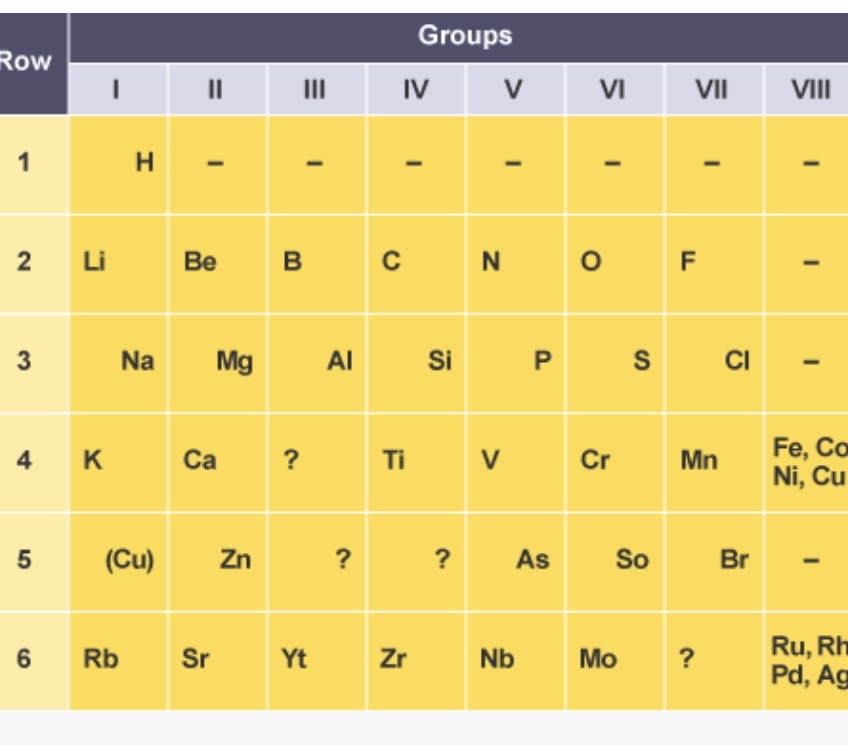
In the 1800s, Dmitri Mendeleev created the first ever periodic table. He predicted properties of the elements and put them in the same group. But he swapped a few of the elements to order them in increasing atomic weight. He also left gaps for elements that are yet-to-be discovered. For example, he said that eka-silicon would fit right next to silicon when it has been discovered.
Ions:
Sometimes, atoms can lose or gain electrons to become more stable and form compounds. If an atom loses electrons, it will have a positive charge but if it gains electrons, it will have a negative charge. Group 1 has elements with 1 electron in their outermost shell, so they lose their electron to form an ion with a noble gas electronic structure with a 1+ charge. Likewise, groups 2 and 3 will form 2+ and 3+ ions respectively. Group 4 rarely form ions but if they do, they can lose 4 electrons to get a 4+ charge or gain 4 to get a 4- charge. Group 5 gain 3 electrons to form a 3- charge, 6 would get 2- and 7 would get 1-. Group 8 already have a full outer shell, so they cannot lose electrons. In fact, ions have the same electronic structure as noble gases but a different number of protons. To form compounds, atoms can transfer electrons. For example, a lithium ion can transfer its outermost electron to a chlorine atom to form a lithium 1+ ion and a chloride 1- ion. They can combine together to form lithium chloride(LiCl). The balanced symbol equation is 2Li + Cl2 —> 2LiCl. Sometimes, they might need two ions to form a compound. For example, 2 sodium atoms can transfer 1 electron each to an oxygen atom(with 6 in outer shell) to form 2 sodium ions(1+ each) and one oxide ion(2-) So 4Na + O2 —> 2Na2O. This is ionic bonding( one metal and one non-metal). If it is 2 non-metals it is called covalent bonding. Instead of transferring electrons, they SHARE electrons. For example, Two hydrogen atoms can join with one oxygen atom to form water without the need of transferring electrons. They can just share them.
Group 1:
Metals in group 1 are very reactive, since their outermost electron is very easy to lose. They can violently react with water to form a metal hydroxide and hydrogen gas. They move around on the surface, decrease in size and gas bubbles star to form(effervescent reaction) The balanced symbol equation for lithium reacting with water is 2Li + 2H2O —> 2LiOH + H2. As you go down the group, they get more reactive. This is because there are more energy levels in the atom down the group, meaning that the forces of attraction between the outermost electron and the positively charged nucleus is weaker, so the electron is much easier to lose. This is why if you react potassium with water, it will be much faster than lithium. The metal can even burn sometimes.
Group 7:
Non-metals in group 7 are also very reactive, but they get less reactive down the group. This is because they gain electrons instead of losing them. As you go down the group, the electrostatic force between the positive nucleus of the halogen and the outermost electron of the metal is weaker since there is more shielding due to energy shells. Therefore, it is harder for the halogen to gain the electron. Like metals, you can perform displacement reactions with halogens, when more reactive ions displace less reactive ones. For example, Cl2 + 2KBr —> 2KCl+Br2p