Lecture 4 Understanding Cultural shock
Cultural shock
Cultural shock is a stressful transitional period when individuals move from a familiar environment into an unfamiliar one
It is comprised of:
Cognitive disorientation
Behavioural confusion
Intense emotions
Cultural shock is sparked by: anxiety associated with losing all familisr signs and symbols of social discourse
Oberg’s identity disorientation state
A sense of identity loss and deprivation
Identity strain due to the effort to make the psychological adaptation
Identity rejection by members of the new culture
Identity confusion, especially regarding role ambiguity & unpredictability
Identity powerlessness as a result of not being able to cope with new environment
The ABC’s of Culture shock
Sojourners experience culture shock:
Affectively, sojourners often feel anxiety, bewilderment, confusion, disorientation, and intense desire to be elsewhere.
Behaviorally, they are confused as to norms and rules that guide communication appropriateness and effectiveness.
Cognitively, they lack competence to interpret or explain “bizarre” behaviors.
Implications of cultural shock
Negative: psychosomatic problems, affective upheavals, interaction awkwardness, and cognitive exhaustion
Positive: if managed effectively: sense of well-being, heightened positive self-esteem, behavioral competence in social interaction, cognitive flexibility, and enhanced optimism about self, others, and everyday surroundings
Managing Culture shock
Motivational orientation
Individuals with voluntary motivations to leave a familiar culture manage culture shock more effectively than those who do so involuntarily
Personal expectations stress
Realistic expectations facilitate intercultural adaptation
Accuracy-based positive expectations ease adaptation stress
Cultural distance
The degree of differences in cultural values, language, verbal styles.
The greater the cultural distance, the more severe the culture shock, unless they expect very little cultural distance and are surprised.
Sociocultural adjustment
The ability to fit in and execute appropriate and effective interactions in a new cultural environment.
It can include the quality or quantity of relations with a host nationals and the length of residence in host country.
Psychological adjustment
Feelings of well-being and satisfaction during cross-cultural transitions. Two types of coping strategies:
a. Primary coping strategies: behavioral actions that aim to avoid or change the intrusive incidents in the stressful environment
b. Secondary coping strategies: cognitively focused; changing one’s thinking pattern to adapt to the environment
Personality attributes
Personality traits such as high tolerance for ambiguity, internal locus of control, personal flexibility and mastery can contribute to sojourners’ well-being.
The Big 5 Personality traits:
CONSCIENTIOUSNESS
EMOTIONAL STABILITY
AGREEABLENESS
EXTRAVERSION
OPENNESS
Initial tips of managing culture shock
Increase motivation to learn about the new culture.
Keep expectations realistic, and increase familiarity with diverse facets of new culture.
Increase linguistic fluency and appropriateness, and understand core values linked to specific behaviors.
Work on tolerating ambiguity and other flexibility attributes.
Develop close friends and acquaintanceships to manage identity stress and loneliness.
Be mindful of suspending ethnocentric evaluations of interpersonal behaviors of host culture.
Culture shock adjustment model
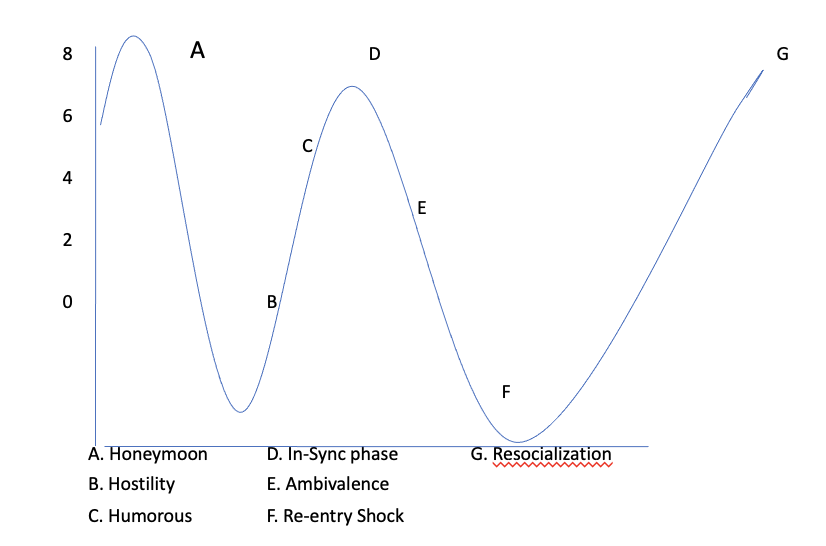
Re-entry Culture shock
Surprising elements for Sojourners’:
Identity change
Nostalgic and idealized images of home culture
Difficulty in reintegrating into old roles
Letdown due to unexpected distance with family and friends
Family and friends impatient with listening to sojourners’ stories
Home culture’s demand for role conformity
Absence of change in home culture, or too much change
Resocialization:
1. Re-socialized returnees do not recognize having learned new skills. They use “fit-back-in” strategy and re-socialize themselves quietly.
2. Alienated returnees are aware of their new skills, but have difficulty applying the new knowledge. They try to use the “distance-rejective” strategy and become onlookers in home culture.
3. Proactive returnees are highly aware of new values and skills. They try to integrate these into the home culture.